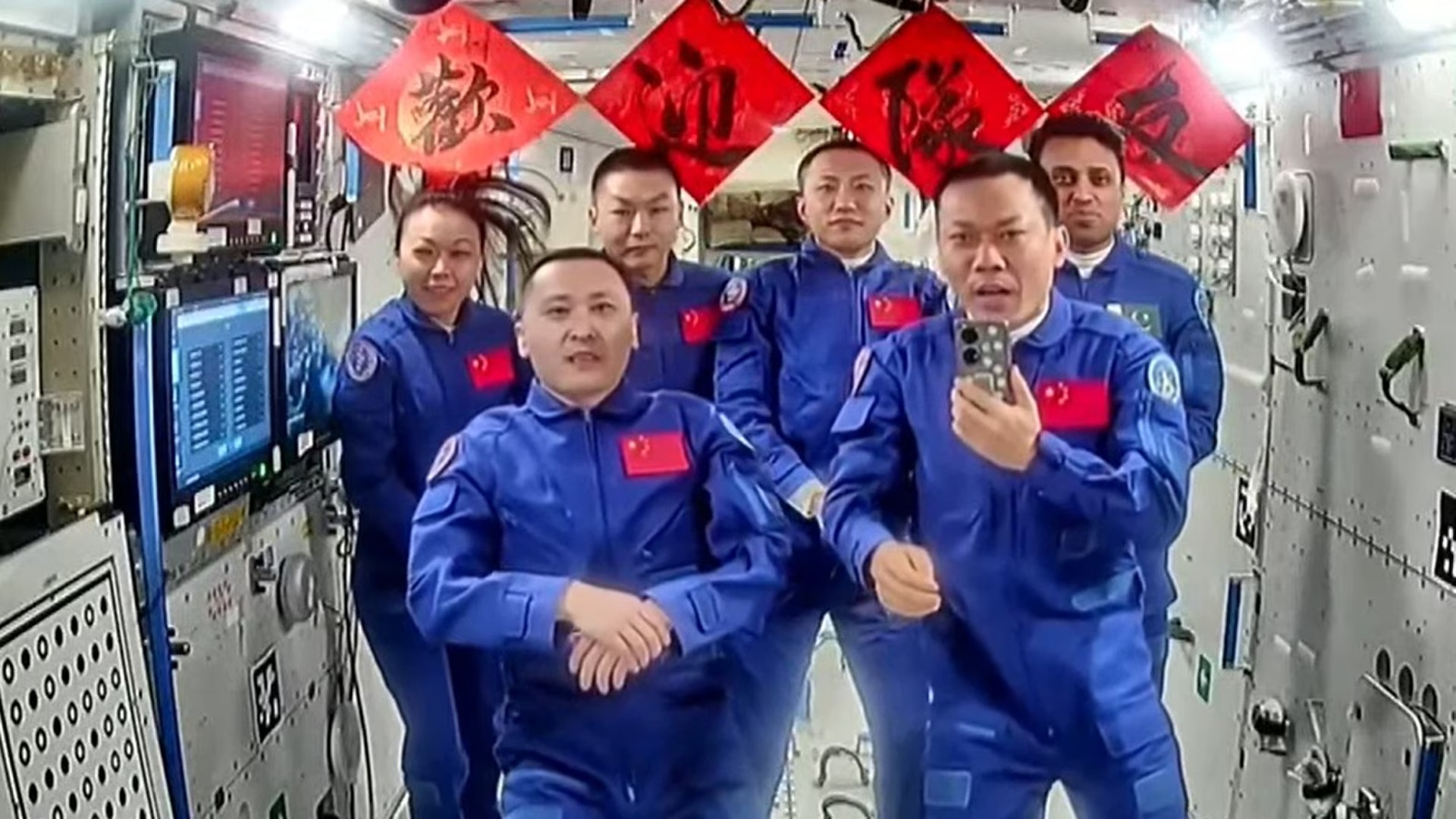
The Shenzhou-24 crew entered China's Tiangong space station at 2:35pm Beijing time on Wednesday. It had lifted off about six hours earlier from the Jiuquan Satellite Launch Center in north-west China. On board was Muhammad Zeeshan Ali, a 40-year-old Pakistani pilot. He is the first foreign astronaut to fly with China's crewed space programme.
Ali flew with commander Tang Hongbo, 51, and flight engineer Wu Yi, 39, on a Long March-2F rocket. Andy Wong and Kanis Leung reported the launch for the Associated Press, and Shi Bu and Alessandro Diviggiano for Reuters. The joint flight is part of an agreement China and Pakistan signed in February 2025.
Ali is the first Pakistani in orbit, according to Reuters. He is flying as a payload specialist and will stay at the station for five to 10 days. He will then return to Earth aboard the Shenzhou-23 spacecraft, China's official Xinhua news agency reported.
Seven months of training, much of it in Chinese
Ali trained for seven months in Beijing after he was chosen in April. The hardest part was the language, he said in an official Chinese video cited by the Financial Times.
“The real challenge, honestly speaking, was mastering the Chinese language for all the switches, all the software, all the programmes, all the voice announcements,” Ali said.
Tang told reporters on Tuesday that differences in language, culture and psychology had made working together harder. Both sides' efforts were paying off, he said, according to AP. It is Tang's third mission, and he is the first astronaut to board Tiangong three times, state broadcaster CCTV said.
The crew will run more than 90 experiments and technology tests, according to Xinhua. Ali's include a study of photosynthetic cyanobacteria, a type of bacteria that makes energy from light. He will also help test carbon fibre materials that repair small cracks in spacecraft on their own, Reuters reported.
“The journey of 240 million Pakistanis”
Pakistani Prime Minister Shehbaz Sharif marked the launch in a post on X.
“This is not just one astronaut's journey, but the journey of 240 million Pakistanis,” Sharif wrote.
China's President Xi Jinping and Pakistan's President Asif Ali Zardari exchanged letters of congratulation. CCTV reported that Xi called the station a “boat” for peace, friendship and cooperation.
Ahsan Iqbal, Pakistan's planning minister, said at the launch centre that he hoped for more cooperation, including a joint lunar mission. Asked whether Pakistan could one day send its own astronauts, he said: “Certainly that day will come.”
Space ties between the two countries go back to the early 1990s. China has launched Pakistani satellites, and a Pakistani-built rover is due to fly on a Chinese lunar mission around 2028, Reuters reported. In September, Greece also picked its first astronaut, for a flight in 2027.
A station China wants others to use
Tiangong has been fully operational since late 2022. China is promoting it as a base for international cooperation, while the NASA-led International Space Station faces possible retirement by 2030, Reuters reported.
The handover is also unusual. Shenzhou-23 commander Zhu Yangzhu will stay on board for a full year to study how the body copes with long missions. That will be the longest single stay in orbit by a Chinese astronaut.
China plans to land its first crew on the Moon by 2030, despite this year's delay to its Chang'e-7 lunar mission. NASA is aiming to land astronauts again in 2028.