SE3, the Munich startup building spatial intelligence software for autonomous systems, has raised a $30M Series A led by Accel, with Keen, Lakestar, and Seedcamp participating. The round comes just five months after the company emerged from stealth with a €5.5M seed.
SE3's pitch starts from a gap: AI can automate swathes of knowledge work, but it still struggles to understand three dimensions. The company's platform-agnostic software sits between raw sensor data and action, connecting drones and ground vehicles from different manufacturers and fusing what they see into a shared 3D picture of the environment.
From that picture, the software runs the swarm, optimising each system's behaviour, routes, and positions based on the terrain, with operators commanding everything by voice. It all runs on-edge, which matters in exactly the places SE3 is aimed at: contested environments where electronic warfare jams satellite navigation.
Those places are not hypothetical, as SE3 is already deployed in Ukraine, works on multiple contracts there and with Germany's Bundeswehr, and says it has shipped thousands of systems in the past two years. It counts defence prime HENSOLDT and scale-ups Auterion and ERC System among its partners; its software runs on Auterion's Skynode computers.
European procurement is shifting toward modularity and interoperability, through frameworks such as the Modular Open Systems Approach and Germany's MOSABw programme, favouring independent software that integrates across manufacturers without competing with them.
The Netherlands made a similar bet when it backed Intelic's single command system for mixed drone fleets.
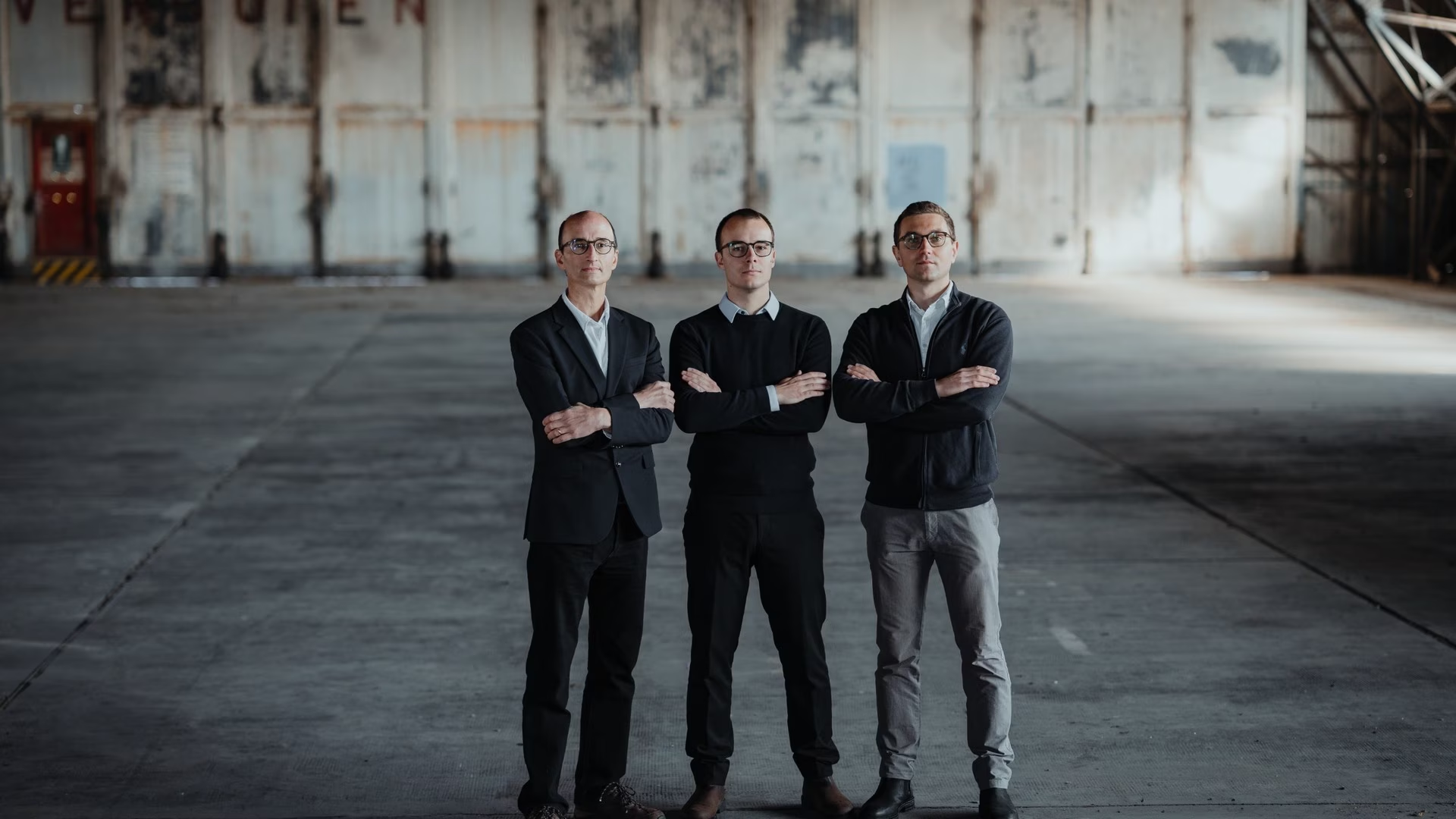
SE3 spun out of Professor Daniel Cremers' computer vision lab at the Technical University of Munich, where co-founders Lukas Köstler and Simon Klenk were doing PhDs. Cremers, the company's chief science officer, holds TUM's chair for computer vision and AI and won the Leibniz Prize, Germany's most prestigious research award.
“Working in defence means our technology has to deliver under pressure in the field,” said Köstler, SE3's CEO.
The EU aims to mobilise €800B in defence spending by 2030 and is planning a drone wall along its eastern flank, a wave of capital that has already produced Helsing's €12B valuation and Stark's rise from founding to €3.5B in two years. Accel's Matt Robinson argues SE3 is tackling the layer “defence primes have found so difficult to do”.
The new capital goes into engineering, commercial, and operations hires, a UK office, and a deeper presence in Germany and Ukraine.
Defence stays the focus for now; from 2027, SE3 plans to take the same spatial layer into robotics, emergency response, and other places where machines have to cope with the unpredictable.