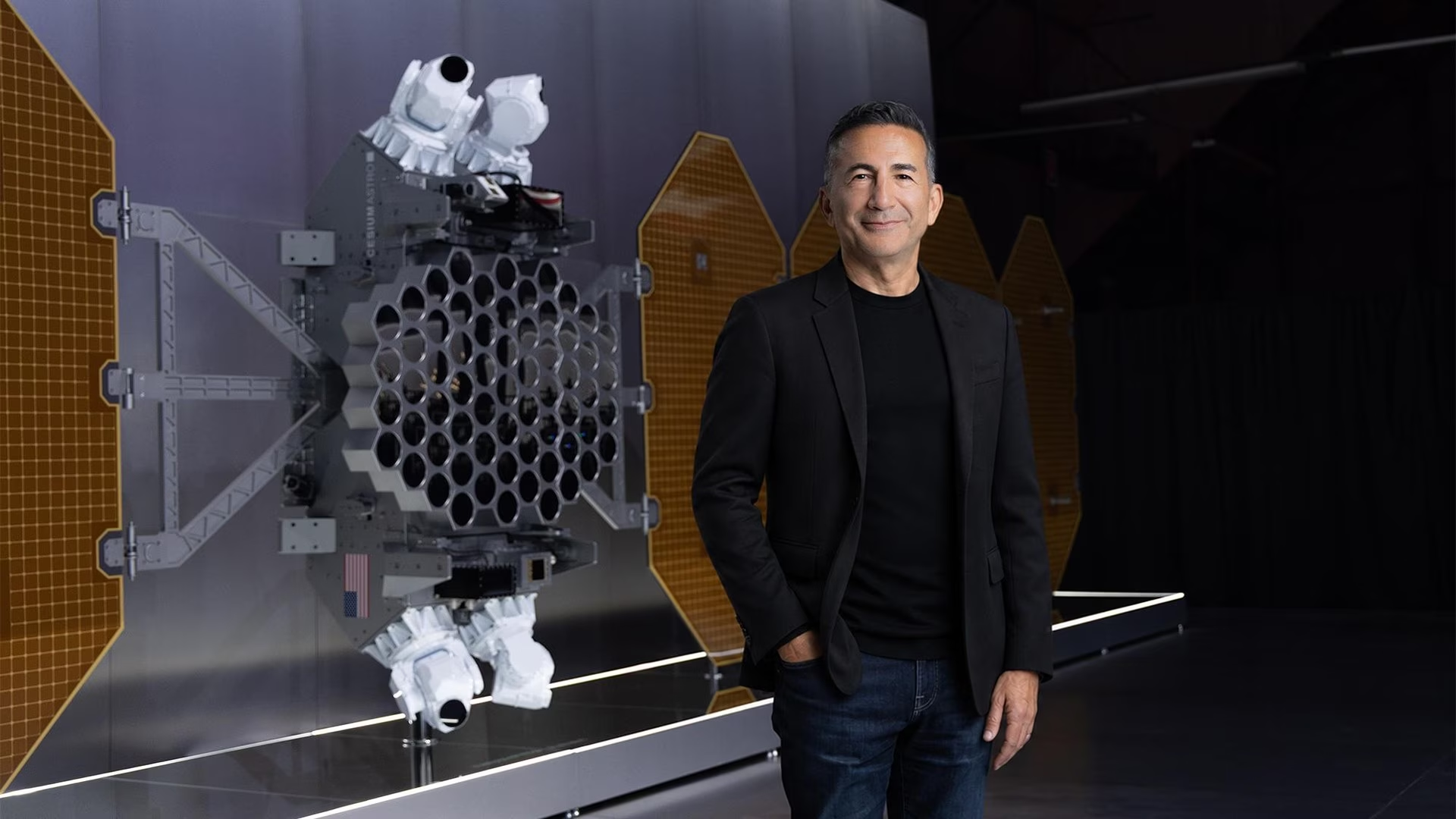
CesiumAstro has raised $730M in a Series D round that values it at more than $4.5bn. The Austin-based maker of satellites and space communications systems announced the round on Thursday. It also unveiled Synchronicity, a planned network of 737 satellites with AI built in, for commercial, sovereign and defence customers.
Asset manager Janus Henderson led the round. Insight Partners, Sands Capital, Sumitomo Corporation of Americas and Toyota's growth fund Woven Capital took part. So did Incharge Capital, Magnetar, AV and NewSpace Capital. The equity came with $100M of debt financing from the Export-Import Bank of the United States (EXIM) and JPMorgan.
CesiumAstro says it has announced more than $1.2bn of new capital this year. Bloomberg, which first reported the round, put its total raised to date at $1.4bn.
“With our technology proven on orbit, on the ground and in the air, a significantly expanded set of capabilities, and more than $1.2 billion in new capital raised this year, we are positioned to take the next major step in our growth,” said Shey Sabripour, CesiumAstro's founder and chief executive.
From antennas to its own network
Bloomberg's Loren Grush reported that the company's main product has been a phased-array antenna for satellites. These antennas send out beams of radio waves that operators can steer in different directions. That widens the area they cover on Earth.
In 2024 it added Element, a satellite it builds and operates for customers. Its first one, Element-1, went up in October on a SpaceX Falcon 9 rideshare mission and is now operating. It is the first of eight planned spacecraft, and CesiumAstro has booked launches for the other seven.
Synchronicity goes further: CesiumAstro will run the network itself. The constellation will use Ku-, Ka- and V-band frequencies and process data on board. AI will manage the network and allocate capacity. According to Bloomberg, it will operate at two different altitudes in low Earth orbit. The company gave no launch timeline.
Three deals in the past 12 months feed into it. Jariet Technologies makes millimetre-wave radio chips. 1Aardvark writes mission software for defence programmes, and Vidrovr builds AI for real-time signal analysis.
“We designed the silicon, the active phased array, the payload, processors, the spacecraft, ground terminals, and the network as one system,” Sabripour said.
Sovereignty, not Starlink
Sabripour told Bloomberg that the company's customers include businesses and governments that want “sovereignty over their own constellation”. Governments from Canada to Europe are backing their own networks amid concern over Elon Musk's power, Bloomberg noted. One example is Europe's IRIS² network. That concern grew after Starlink's role in Ukraine came under scrutiny.
“They're not necessarily competing with Starlink, but they don't want to be part of a proprietary system,” Sabripour told Bloomberg.
SpaceX already dominates the market with more than 11,000 Starlink satellites. Amazon's Leo network, which recently built its 1,000th satellite, will eventually span more than 3,000. Sabripour said CesiumAstro has access to radio frequencies beyond those regulators approved for SpaceX and Amazon.
The company will also spend $500M over five years on its Austin headquarters. That includes buying about 25,000 square metres of manufacturing space. It plans 550 new jobs, taking its Austin-area staff past 1,000 by 2030. It also has operations in the UK, Germany, Switzerland, Taiwan, Singapore and Japan. The round follows Xona's $250M round for a GPS rival in low Earth orbit last month.