ZuriQ, a Swiss quantum computing company spun out of ETH Zürich, has raised $25.5 million in a seed round to scale the trapped-ion processors it is building on a new two-dimensional architecture.
The money builds on the $4.2 million pre-seed round the company closed in 2025, and it arrives as ZuriQ pushes to increase the number of qubits its chips can hold.
The round was led by Quantonation, with participation from Forward.one, Extantia, Firgun Ventures, and all of ZuriQ's previous backers.
It lands in a year of buoyant European quantum investment, a stretch that has also produced the continent's first publicly listed quantum firm.
The capital will expand the company's team and its research and development, ZuriQ says, with the aim of significantly increasing the number of qubits the architecture can support.
Most trapped-ion quantum computers, the company notes, still rest on an architecture proposed more than 20 years ago, one that holds ions in roughly one-dimensional chains stitched into grids through complex junctions.
ZuriQ's processors are natively two-dimensional. They rely on Penning micro-traps and a static magnetic field rather than the rapidly oscillating fields legacy designs depend on, an approach the company says lets ions move freely in any direction without junctions constraining how the chip is reconfigured.
Professor Jonathan Home of ETH Zürich, a scientific adviser to ZuriQ, puts the advantage down to geometry.
“Hold ions in a line and the count grows one at a time; hold them in two dimensions, and it grows with the area of the chip; on a standard chip, that is the difference between tens of ions and many thousands,” he said.
“Just as important, the ions can be moved freely in three dimensions, so they can be connected together far more flexibly, and that connectivity is what ultimately makes a quantum computer more capable.”
The company has already built a working demonstrator in around 18 months: a 3×3 array of nine individually controlled ions, which it describes as the largest two-dimensional array of its kind demonstrated to date.
It was developed with researchers at ETH Zürich, and the chips were fabricated with ZuriQ's manufacturing partner, Infineon, which the company says shows the design can be made using established industry processes.
“The trapped-ion companies that started the race began with one-dimensional designs that were useful stepping-stones, but the real challenge is whether they can successfully pivot to two dimensions as they attempt to scale,” said Dr Pavel Hrmo, ZuriQ's co-founder and chief executive.
“We spent longer in the lab, and that time allowed us to identify an alternative route that is inherently easier to scale.
Our architecture is two-dimensional from the ground up, so the number of qubits we can place on a chip will grow far more readily than in systems built on a legacy blueprint.
This funding lets us turn our technical momentum into commercial scale with more people, more research, and an accelerated path to industrial applications.”
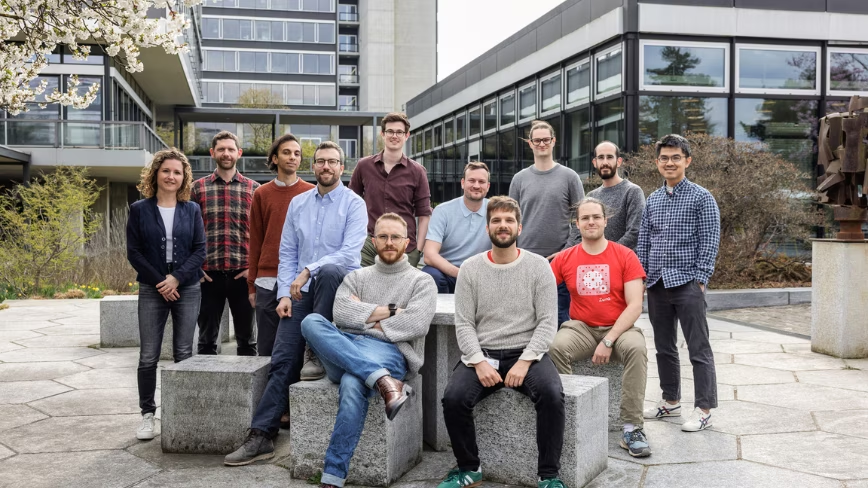
ZuriQ has grown from four people to 18 since its last round, adding hires with backgrounds at IonQ, Xanadu, and Hamamatsu.
The new money will go towards hiring, expanding research, and scaling chip fabrication, which the company frames as the groundwork for putting hundreds of qubits on a single chip.
For Christophe Jurczak, founding partner at Quantonation, whose latest €220 million fund backs physics-grounded startups, the wager is that the field remains wide open.
“A common misconception is that the quantum race is already decided, but that is far from reality,” he said.
“ZuriQ is demonstrating that there remain significant and transformational physics breakthroughs still to be made in Quantum architectures.
The scientific caliber of the team is world-class, which is why ZuriQ has been phenomenally successful in attracting global talent to join them and build 2D-native quantum computers where trapped-ion qubits finally have the freedom to move and connect.”