xLight, a US-backed startup chaired by former Intel chief Pat Gelsinger, is raising $350m to build an xLight EUV light source that could loosen ASML's grip on chipmaking. Days earlier, a Dutch rival took aim at Nvidia. Deep-tech chips are hot again.
The hardware behind AI is pulling in venture money again. xLight, a Californian startup building a new kind of light source for chip factories, is in talks to raise $350m, The Information reported. Boardman Bay Capital Management and Bain Capital are lining up to lead the round. xLight has stayed quiet through years of lab work, so the size of the raise signals how far the ambition now reaches.
The pitch is bold. xLight wants to cut the cost and time of making the most advanced AI chips. It is betting on an alternative to extreme ultraviolet (EUV) lithography, the process that prints microscopic circuits onto silicon. If it works, xLight EUV hardware would slot into the machines that build Nvidia's chips.
What xLight is actually building
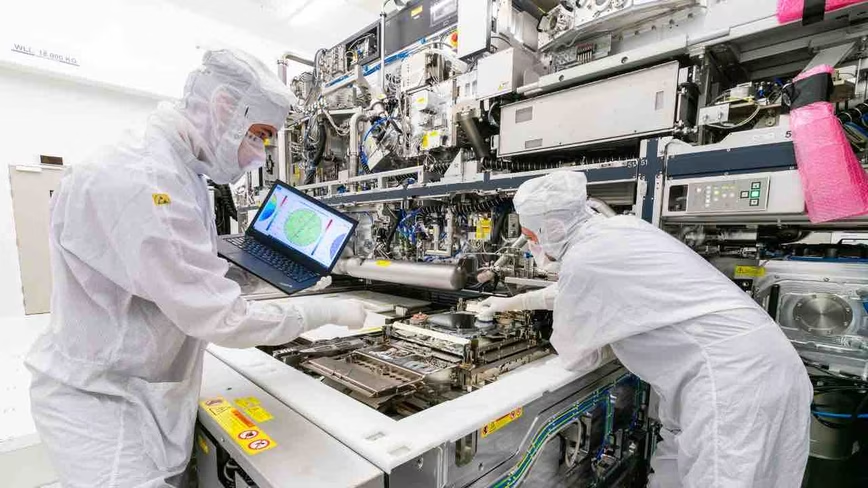
Today, only one company makes EUV machines: ASML. Its systems fire lasers at tin droplets to create light at a wavelength of 13.5 nanometres. That light prints the smallest features on a chip. The machines are vast, cost hundreds of millions of dollars each, and ship in pieces.
xLight wants to replace the light source itself. Instead of zapping tin, it is building a free-electron laser driven by a compact particle accelerator. The company says this can reach wavelengths as low as 2nm. Shorter light prints finer circuits, and that means more transistors on every chip.
The economics explain the interest. A single high-end EUV machine can cost more than $380m, and only a handful of factories on Earth can run one. Anything that prints finer circuits, or trims that cost, ripples through the whole industry.
The plan is not to fight ASML head-on. xLight wants to sell its light source to ASML. A first working prototype is due in 2028, at the Albany NanoTech complex in New York.
Washington is now a chip investor
The raise follows a big vote of confidence from the US government. This month, the Department of Commerce finalised a $150m award to xLight under the CHIPS and Science Act. The money backs construction of the free-electron laser prototype.
That makes Washington an early backer of a private chip venture, not just a customer. xLight has already raised about $200m in total, including the federal money and an earlier $40m round. The new $350m round would push it further, and the company has reportedly lined up billions in non-binding project financing for future plants.
The award flows through the CHIPS and Science Act, the law Washington passed to rebuild chip manufacturing at home. Most of that money has gone to factories. Backing a light-source startup is a rarer, riskier bet on a technology that does not yet exist.
The man fronting the effort knows the industry's pain. Pat Gelsinger ran Intel until the board pushed him out late in 2024. He now chairs xLight while working as a venture partner at Playground Global. His name gives the startup rare credibility with the chipmakers it hopes to supply.
A Dutch rival takes aim at Nvidia
xLight is not the only chip-hardware bet landing this week. In the Netherlands, Euclyd is seeking about €200m ($229m) in Series A funding, Bloomberg reported. Peter Wennink, the former ASML chief executive, backs the Eindhoven startup as an adviser and investor. Bernardo Kastrup, another ASML alumnus, founded the company in 2024.
Euclyd is chasing a different giant. It designs chips for AI inference, the job of running models after training. It claims its “Craftwerk” architecture runs that work up to 100 times more efficiently than Nvidia's newest Vera Rubin hardware. Where xLight wants to dethrone ASML, Euclyd wants to chip away at Nvidia.
The split is deliberate. Training built Nvidia's empire. Inference is the next prize, and it looks more open. Leaner, cheaper chips matter most once a model runs every day. That is the gap European challengers think they can fill. Euclyd is one of several chasing it.
The two raises rhyme. Washington backs one, Europe backs the other, and both attack a near-monopoly. They also arrive as investors pour money into the unglamorous machinery beneath the AI boom. Dutch firm Nearfield Instruments recently raised a record $380m for chip-inspection tools, and ASML spinout Invisix banked €20m for chip metrology.
Why the timing matters
Chip tooling used to be a quiet corner of hardware. Now it sits at the centre of a geopolitical fight. The US and the Netherlands have curbed exports of the most advanced lithography gear to China, and Beijing is betting on photonics to find another route. Whoever controls the light source controls the leading edge.
For Washington, funding xLight is a hedge. ASML is Dutch, and its EUV monopoly is a single point of failure in a supply chain the US wants to bring home. A homegrown light source, even years away, changes that calculus.
China faces the mirror image. It cannot buy the best machines, so it is funding its own. Light has become the bottleneck. Whoever bends it first sets the pace.
The case for caution
None of this is built yet. xLight's prototype is two years out, the $350m round is talks rather than signatures, and free-electron lasers have never run an EUV production line. Euclyd has not signed its funding either, and beating Nvidia on inference is a claim many startups have made and few have kept.
Government money carries its own risk. A federal stake invites political scrutiny, and a new administration can change priorities overnight. Building a chip-tool company takes a decade, not an election cycle.
Still, the direction is clear.
Money is flowing back into the hardest parts of hardware, the light sources and the silicon, not just the models stacked on top. The open question is whether either bet ships before the AI boom that justifies it cools. xLight has until 2028 to show its laser works. The market will not wait much longer than that.