TL;DR
Xiaomi's new $34,300 YU7 undercuts the Model Y by $4,350 with 50km more range. Sales had dropped below 10,000 units a month.
Xiaomis CEO admitted his SUV wasnt cheap enough to beat Tesla Then he launched one that is
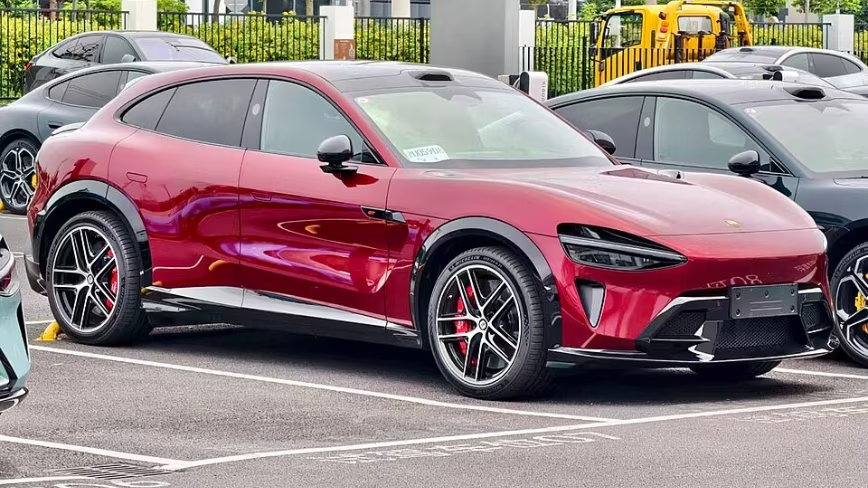
Xiaomi's new $34,300 YU7 undercuts the Model Y by $4,350 with 50km more range. Sales had dropped below 10,000 units a month.
Most CEOs would not go on stage and admit their product was not competitively priced against a rival. Lei Jun did exactly that on Wednesday evening, and then launched a model that fixes it.
At Xiaomi's “Human x Car x Home” launch event on 21 May, the founder and CEO unveiled the YU7 True Standard Edition, a new entry-level variant of the company's electric SUV priced at 233,500 yuan (approximately $34,300). That is 30,000 yuan ($4,350) cheaper than the cheapest Tesla Model Y in China, which starts at 263,500 yuan. The previous base YU7, now renamed the Long Range edition, started at 253,500 yuan, only 10,000 yuan ($1,450) below Tesla. Lei said the gap was simply not compelling enough.
The more interesting number is range. The new YU7 Standard Edition delivers 643 kilometres on the CLTC cycle (approximately 399 miles), compared to 593 kilometres (368 miles) for the equivalent rear-wheel-drive Model Y. Xiaomi is offering more range for substantially less money, and doing so with a vehicle that still includes air suspension and LiDAR as standard, features Tesla does not offer at any price point on the Model Y.
The technical changes are focused on cost reduction without visible compromise. The new variant uses a smaller 73 kWh lithium iron phosphate battery from CATL, down from the 96.3 kWh pack in the Long Range edition. A single rear motor produces 235 kW. The kerb weight drops by 115 kilograms to 2,200 kg, which partly explains how a smaller battery delivers competitive range. The SUV's five-metre exterior dimensions are unchanged.
The pricing move is a response to a sales trajectory that peaked and then dropped sharply. The YU7 launched on 18 June 2025 and secured more than 200,000 firm orders within three minutes, creating a waitlist that stretched nearly a year. By 30 April 2026, Xiaomi had delivered 232,000 YU7 units in ten months. But the initial backlog has cleared. In April, the YU7 contributed just 9,876 of Xiaomi's 36,702 total vehicle deliveries, a significant drop from January, when the YU7 alone sold 37,869 units and briefly became the monthly sales champion in the Chinese market. Lei needed a new price point to reignite demand.
Xiaomi has shipped more than 600,000 EVs in less than two years of automotive operations, a pace that no new entrant has matched. The company delivered 410,000 vehicles in 2025 and is targeting 550,000 in 2026. Its EV unit turned profitable in November 2025, roughly 18 months after the first SU7 sedan shipped, a faster path to profitability than Tesla achieved. The second-generation SU7, launched in April, received 40,000 firm orders immediately. The automotive business is no longer a side bet for a smartphone company. It is a structural growth engine.
Alongside the Standard Edition, Xiaomi also unveiled the YU7 GT, a performance variant starting at 389,900 yuan ($57,300) with a 990-horsepower dual-motor powertrain. The GT set a Nürburgring Nordschleife lap time of 7:22.755 on 2 April 2026, beating the previous SUV record by 14 seconds. The GT serves a different market, premium buyers who want a Chinese performance SUV that can compete with European rivals on the most famous circuit in motorsport, but it also gives the YU7 lineup a halo product that elevates the perception of the $34,300 Standard Edition below it.
Tesla's competitive position in China is under sustained pressure from multiple directions. BYD overtook Tesla as the world's largest EV seller in 2025 with 2.26 million battery electric vehicles. The Model Y remains the single best-selling EV in China, but its pricing power is eroding as competitors match or exceed its specifications at lower price points. Tesla's Q1 2026 deliveries missed Wall Street estimates, and the company produced 50,000 more vehicles than it could sell, suggesting a demand ceiling in its core markets.
Chinese EVs are already arriving in Canada under a new trade deal that cut tariffs to 6.1% for 49,000 vehicles annually. The US has moved in the opposite direction, with bipartisan legislation introduced on 12 May to ban Chinese connected vehicles entirely. Xiaomi's CEO has said the company has no plans to enter the US market, but the YU7's value proposition, more range, more features, and a $4,350 price advantage over the world's best-selling electric SUV, illustrates the competitive reality that American lawmakers are trying to keep out.
The Chinese EV market now has more than 200 battery-powered models priced below the equivalent of $25,000. The YU7 Standard Edition sits above that threshold but below the price point where most Western consumers can buy any new EV at all. For Tesla, the challenge is not a single competitor but a market in which the floor keeps dropping while the specification ceiling keeps rising. Lei Jun's admission that his previous price was not competitive enough is as much a statement about where the Chinese market is heading as it is about one product. When a $34,300 SUV with 643 kilometres of range, air suspension, and LiDAR is considered the entry-level option, the competitive benchmark has shifted in a way that no tariff wall can fully reverse.