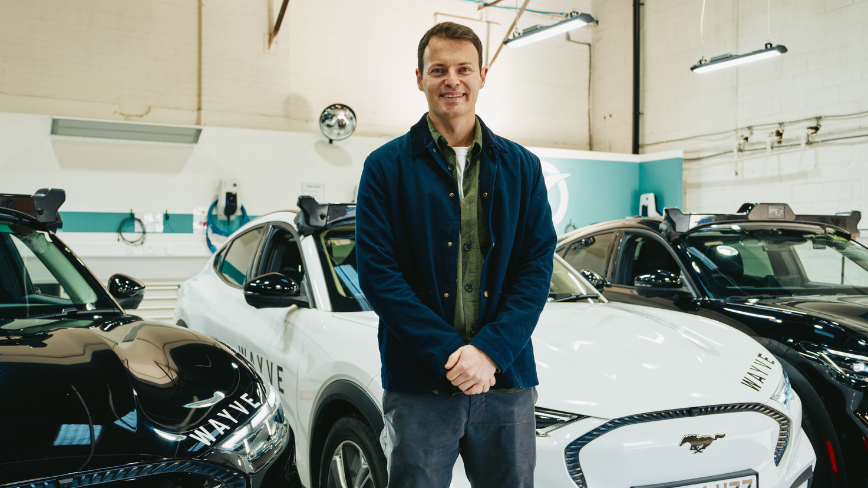
Wayve, the London-based autonomous driving software company, has raised a further $60 million from AMD, Arm, and Qualcomm Ventures, extending its Series D round.
The investment brings Wayve's total Series D to $1.2 billion and, combined with previous rounds, its total funding to approximately $1.5 billion at an $8.6 billion post-money valuation.
The three chip companies join a Series D investor base that already includes SoftBank Vision Fund 2, Eclipse, Balderton, Microsoft, NVIDIA, Uber, and automakers Mercedes-Benz, Nissan, and Stellantis.
The strategic significance of the new investors lies in coverage. AMD, Arm, and Qualcomm collectively span the automotive compute stack, from architectures already embedded in millions of production vehicles to those powering the next generation of autonomous systems.

The 💜 of EU tech
The latest rumblings from the EU tech scene, a story from our wise ol' founder Boris, and some questionable AI art. It's free, every week, in your inbox. Sign up now!
Together with NVIDIA, which joined the Series D in February, Wayve now has investment relationships with the four companies whose silicon underlies essentially every compute platform an automaker might deploy.
For Wayve, whose core proposition is that its AI Driver runs across any vehicle and any hardware configuration without location-specific engineering, this hardware-agnostic investor base is a commercial signal as much as a financial one: it makes it easier for automakers to deploy Wayve without being tied to a specific compute vendor.
Wayve was founded in 2017 by Alex Kendall, who remains co-founder and CEO, and takes an end-to-end AI approach to autonomous driving, training a single foundation model on large-scale, globally diverse driving data rather than relying on hand-coded rules or high-definition maps.
The same model powers capabilities from L2+ “hands-off” ADAS through L3 “eyes-off” and L4 driverless applications, and the AI Driver runs entirely on onboard vehicle compute using native sensors.
In 2025, Wayve conducted its AI-500 Roadshow, testing the AI Driver zero-shot, meaning without city-specific fine-tuning, across more than 500 cities in Europe, North America, and Japan.
The new capital will support integration across automotive compute platforms and continued deployment in production ADAS and automated driving systems. It builds on two specific partnerships already in place.
Wayve and Qualcomm Technologies announced a collaboration in March 2026 to deliver a pre-integrated AI Driver solution on the Snapdragon Ride Platform with Active Safety software, giving automakers a streamlined path to deploy Wayve's AI across Qualcomm's widely-used automotive SoCs.
Wayve also has a longstanding relationship with NVIDIA: the Nissan robotaxi prototype shown at NVIDIA GTC in March 2026 was built on NVIDIA DRIVE Hyperion, running the Wayve AI Driver on dual DRIVE AGX Thor processors.
On the commercial side, Wayve signed a definitive production partnership with Nissan in 2025 to integrate the AI Driver into its next-generation ProPILOT driver-assistance systems, with the first mass-produced vehicles expected to launch in Japan and other markets from fiscal year 2027.
In March 2026, Wayve, Uber, and Nissan signed a memorandum of understanding to run a robotaxi pilot in Tokyo starting in late 2026, subject to regulatory discussions, Uber's first autonomous vehicle partnership in Japan.
Wayve and Uber also have plans for a London robotaxi trial, as part of a planned rollout spanning more than ten cities globally.
Kendall said the goal is an AI Driver that works across “the full automotive compute ecosystem, from architectures already used in millions of vehicles today to the platforms powering the next generation of automated vehicles.”