TL;DR
Waymo paused service in five US cities after a software recall failed to stop robotaxis driving into floods. Freeway rides are also suspended.
Waymos robotaxis keep driving into floods The software patch didnt work Five cities are now shut down
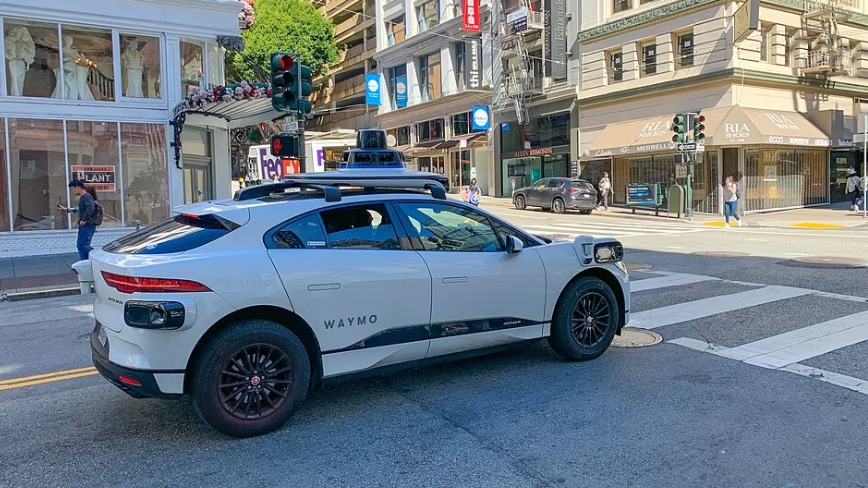
Waymo paused service in five US cities after a software recall failed to stop robotaxis driving into floods. Freeway rides are also suspended.
Waymo suspended robotaxi service across five US cities on 21 May after a software patch it pushed to its entire 3,791-vehicle fleet less than two weeks earlier failed to prevent another autonomous vehicle from driving into standing water. An unoccupied Waymo robotaxi got stuck on a flooded street in Midtown Atlanta on Wednesday evening during severe storms, roughly the same failure mode that triggered a recall on 8 May and a service shutdown in San Antonio a month before that.
The company has now paused operations in Atlanta, Austin, Dallas, Houston, and San Antonio, the last of which has been offline since late April. It has also suspended all freeway rides across San Francisco, Los Angeles, Phoenix, and Miami while it works to improve its vehicles' performance in construction zones. Waymo says it expects to resume those routes soon, but has not provided a timeline.
The underlying problem is architectural, not cosmetic. According to a letter posted on the National Highway Traffic Safety Administration's website, the software flaw could allow vehicles “to slow and then drive into standing water on higher speed roadways.” In the San Antonio incident on 20 April, an empty Waymo robotaxi encountered a flooded section of a road with a 40 mph speed limit, detected the water, reduced speed, and then drove into it anyway, because its decision system had no hard-stop condition for water in its path. The vehicle was swept into a creek. Waymo issued a voluntary recall of 3,791 robotaxis using its fifth and sixth-generation automated driving systems and shipped an interim software update that placed restrictions on operations during elevated flood risk. That update was not enough to prevent the Atlanta incident.

The 💜 of EU tech
The latest rumblings from the EU tech scene, a story from our wise ol' founder Boris, and some questionable AI art. It's free, every week, in your inbox. Sign up now!
Waymo has admitted it still has no permanent fix. When it filed the recall, the company acknowledged that the “final remedy” for avoiding flooded areas had not been developed. The Atlanta storm produced flooding before the National Weather Service had issued a flash flood warning, watch, or advisory, meaning Waymo's weather-monitoring system, which relies in part on official alerts, had no signal to act on. The company told the BBC that safety was its “highest priority” and that it was “closely monitoring forecasts, alerts, and live weather conditions.”
The flood problem is Waymo's third recall since February 2024. The first covered 444 vehicles after two robotaxis in Phoenix separately struck the same improperly towed vehicle. The second, filed in May 2025, covered 1,212 vehicles involved in low-speed collisions with stationary barriers including parking gates and telephone poles. Two active NHTSA investigations into separate failure modes are also ongoing, including one related to a January incident in which a Waymo robotaxi struck a child.
The freeway suspension was triggered by a separate but related concern. A Waymo rider posted on X on 19 May that a robotaxi “freaked out and sped up to highway speeds through construction trucks” on a closed freeway section, with police chasing the vehicle. The rider wrote: “Genuinely thought we were about to die.” Waymo has not commented on the specific incident but said it was evaluating its vehicles' freeway performance in construction zones.
The service disruptions arrive at a moment of rapid expansion for Waymo. Uber signed a deal worth up to $1.25 billion for up to 50,000 autonomous Rivian R2 robotaxis, and Waymo provides more than 500,000 paid trips per week across multiple US cities. The company plans to expand to San Diego, Las Vegas, and Detroit in 2026, with a goal of offering one million paid rides per week by the end of the year. It also hopes to launch a robotaxi service in London later this year.
Wayve, the London-based autonomous driving startup backed by Uber, raised $1.5 billion at an $8.6 billion valuation in February and is planning robotaxi pilots in London and Tokyo in 2026. Its AI-first approach, which learns from driving data rather than relying on detailed maps and hand-coded rules, represents a fundamentally different philosophy from Waymo's sensor-heavy, rules-based system. The flood incidents illustrate the limitations of Waymo's approach: a system that maps every road and codes rules for every scenario cannot code for every scenario, and water on a road in a city it has mapped for years exposed a gap that should have been closed long ago.
Over the past year, driverless car services have faced a pattern of failures that individually look minor but collectively undermine public confidence. In December 2025, a large power outage in San Francisco left Waymo vehicles stalled across the city, blocking intersections and causing significant disruption. In April, a mass Apollo Go robotaxi outage in the Chinese city of Wuhan caused more than a hundred self-driving cars to stop mid-traffic. Each incident reinforces the same lesson: autonomous vehicles work well within the conditions they were designed for and fail conspicuously when they encounter conditions they were not.
The autonomous vehicle industry is investing billions on the assumption that the technology will eventually handle every scenario a human driver can. Waymo is closer to that goal than any other commercial operator, and its safety record over hundreds of millions of miles is strong by statistical measures. But floods are not edge cases. They are weather. A robotaxi service that cannot operate when it rains heavily in Atlanta or San Antonio, cities where heavy rain is a routine occurrence, is a service that has not yet earned the trust its expansion plans require. The permanent fix, whenever it arrives, will need to solve not just the software problem but the credibility gap that three recalls and five city shutdowns have created.