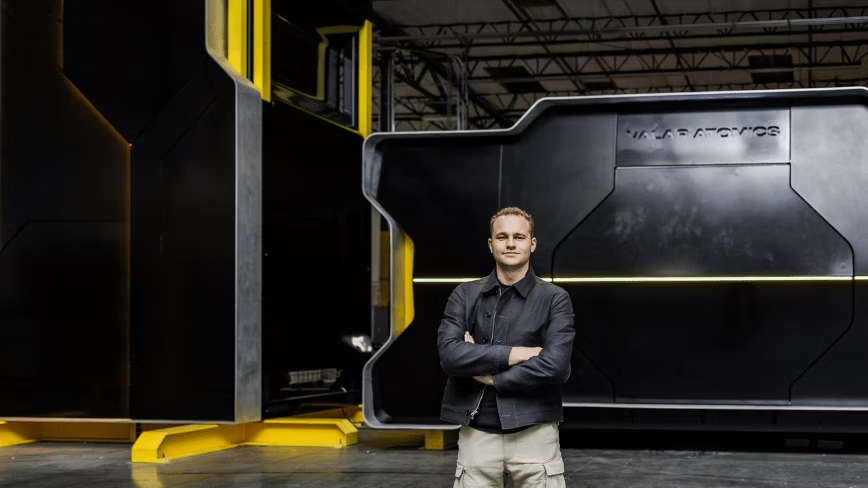
Isaiah Taylor was sixteen when he decided the nuclear industry had a size problem. Not that reactors were too dangerous or too expensive, though they are both, but that they were simply too big. The multi-gigawatt monuments to Cold War-era engineering that still dot the American landscape were designed for a grid that moved power in one direction: from a distant plant to a distant city. They were never meant to sit behind a hyperscaler's fence line, feeding a cluster of GPU racks whose appetite doubles every eighteen months.
Taylor, now 27, founded Valar Atomics in 2023 to build something different. On Tuesday, the El Segundo, California-based startup announced it has raised $450 million at a $2 billion valuation, according to Bloomberg. The round comprises $340 million in equity and $110 million in debt, and it lands barely five months after a $130 million Series A that valued the company at a fraction of its current price.
The backers read like a roster of the American defence-tech establishment that has lately been writing enormous cheques. Palmer Luckey, the Anduril Industries founder whose company was recently reported to be pursuing a $4 billion raise at a $60 billion valuation, is an investor. So is Shyam Sankar, the chief technology officer of Palantir Technologies. The earlier Series A was led by Snowpoint Ventures, the firm co-founded by Doug Philippone, Palantir's former head of global defence, alongside Day One Ventures and Dream Ventures. Lockheed Martin board member and former AT&T chief executive John Donovan also participated.
Valar's pitch is built around what it calls “gigasites”, sprawling industrial campuses that would host hundreds or even thousands of small, high-temperature gas-cooled reactors operating in concert. Each unit uses helium as a coolant and TRISO fuel encased in graphite, a combination that allows the reactors to run at significantly higher temperatures than conventional light-water designs. The company says these clusters can deliver dense, steady, carbon-free power tailored to the load profiles of AI data centres, industrial manufacturers, and grid-constrained regions.
It is an audacious answer to an increasingly urgent question: where will the electricity come from? The International Energy Agency projects that data-centre power consumption will double by 2026. Goldman Sachs estimates that 85 to 90 gigawatts of new nuclear capacity will eventually be needed to help fill the gap. Microsoft, Amazon, and Google have all signed nuclear power agreements in recent months, but the reactors those deals depend on do not yet exist at commercial scale.
Valar claims a meaningful head start. In November 2025, the company announced that its NOVA Core achieved zero-power criticality at Los Alamos National Laboratory's National Criticality Experiments Research Centre, making it what the Breakthrough Institute described as the first company to reach that milestone under the US Department of Energy's Nuclear Reactor Pilot Programme. Zero-power criticality — a self-sustaining chain reaction of uranium-235 without reaching full operating temperatures — is a necessary validation step, not a working power plant, but it is further than most of Valar's competitors have publicly demonstrated.
The company is now preparing its Ward250 reactor, a 100-kilowatt thermal high-temperature gas-cooled unit, for power operations at the Utah San Rafael Energy Research Centre. In February 2026, the reactor was airlifted from California to Utah aboard three C-17 Globemaster military cargo aircraft in a joint operation between the Departments of Defence and Energy — a logistical stunt that doubled as a proof of concept for rapid reactor deployment. Valar is targeting operational status before 4 July 2026, the deadline the DOE set for three reactors in its pilot programme to achieve criticality.
Taylor's trajectory has been unconventional even by deep-tech standards. A self-taught coder who launched his first venture as a teenager, he comes from a family with nuclear roots: his great-grandfather, Ward Schaap, was a physicist on the Manhattan Project. The Ward250 reactor carries Schaap's name. Taylor has assembled a leadership team that includes Mark Mitchell, the former president of Ultra Safe Nuclear Corporation, and Muhammad Shahzad, the former president and chief financial officer of Relativity Space.
The competitive field is crowded and well-funded. TerraPower, backed by Bill Gates, broke ground on a sodium-cooled reactor in Wyoming last year. Kairos Power is building a molten-salt demonstration plant in Tennessee. X-energy has a partnership with Dow Chemical for an industrial HTGR. Oklo, which went public via a SPAC in 2024, is developing a fast-neutron microreactor. None has yet delivered commercial power from an advanced design.
Valar has also taken a combative approach to regulation that few young companies would risk. In April 2025, the startup sued the Nuclear Regulatory Commission, arguing that the agency's licensing framework unlawfully restricts small-scale reactor innovation by requiring the same approval process for low-power test reactors as for full-scale commercial plants. The lawsuit, filed alongside the states of Texas, Utah, Louisiana, Florida, and Arizona, as well as fellow reactor startups Last Energy and Deep Fission, seeks to shift regulatory authority for small reactors to individual states. The case has since been paused amid the Trump administration's broader executive order to overhaul the NRC.
The $2 billion valuation places Valar among the most richly valued nuclear startups in the United States, a distinction that would have seemed absurd five years ago. Whether the premium reflects genuine confidence in the technology or the gravitational pull of AI-adjacent capital is a question the next eighteen months should begin to answer. If the Ward250 reaches power operations in Utah this summer, Valar will have done something no advanced-reactor startup has managed: moved from incorporation to criticality to grid-connected electricity in roughly three years. If it does not, $2 billion will buy a very expensive physics experiment in the desert.