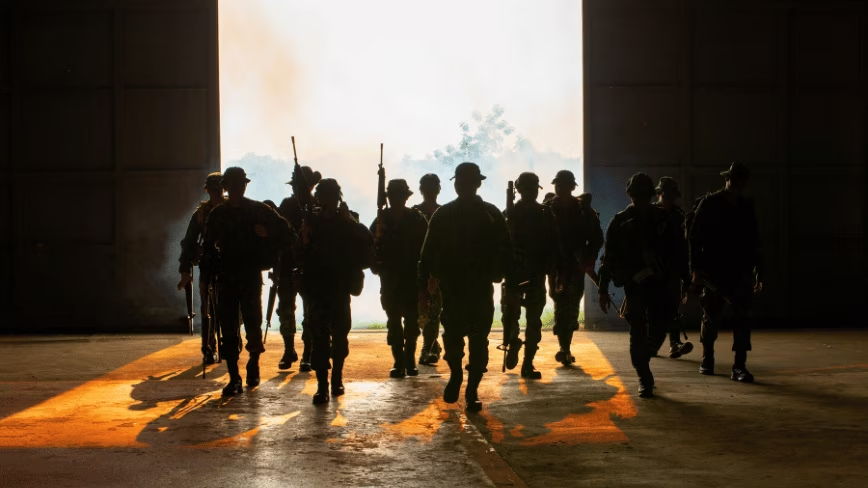
Britain is spending £2bn to train its army inside a simulation. It has handed the job to an American defence giant, with a German one taking a slice.
The UK has signed a £2bn ($2.7bn) contract to train its soldiers with artificial intelligence. The deal, announced by the Ministry of Defence on Friday, runs for 15 years and goes to a consortium led by the US contractor Raytheon UK.
At the centre of it is what the ministry calls a Combat Laboratory. It is a digital platform that uses AI, analytics and virtual environments to recreate the chaos of modern warfare. The point is to let commanders and troops rehearse anywhere, at any time.
Up to 60,000 soldiers a year will train on it, in exercises that scale from teams of 100 to formations of 50,000. The system blends simulation, live drills and data so the army can spot patterns, judge performance and decide faster. Officials say it draws directly on lessons from Ukraine.
Who is actually building it
The contract went to Omnia Training, a group of five UK-based firms: Raytheon UK, Capita, Cervus, Rheinmetall UK and Skyral. Raytheon set the consortium up more than three years ago. Behind it sits a supply chain of 44 British businesses.
One name stands out. Rheinmetall, the German company that has become Europe's busiest arms maker, sits inside a contract the government keeps calling sovereign. Its UK arm supplies physical training infrastructure, system setup and logistics, and will grow its footprint on the Isle of Wight and in Southampton.
Rheinmetall said its share is worth just under €1bn ($1.14bn), close to half the total, Bloomberg reported.
The pitch, and the politics
The framing is all about jobs and readiness. The contract will support around 400 roles across the UK, including 270 skilled jobs and 100 apprenticeships developed with Wiltshire College and the University of Staffordshire. Much of the work lands in Wiltshire, with veteran roles based in Warminster, a garrison town.
The government wants the British Army to be ten times more lethal by 2035, a goal it repeats often, backed by a £298bn investment plan over four years. Defence Secretary Dan Jarvis said the new system would give soldiers “the quality training they need to keep us safe.”
A sovereign capability, mostly
Two consortium members, Skyral and Cervus, built their software in Britain, backed by more than £2m in government innovation funding. The ministry stresses that the intellectual property stays under UK control. That matters when European governments are nervous about depending on foreign technology they cannot switch off.
Britain has been trying to build its own sovereign AI capability for that reason. Yet the largest single slice of this “sovereign” training contract goes to a German prime, under an American lead. It is a tidy illustration of how tangled European defence has become, even as the continent rearms.
Where it fits
The deal arrives in a busy season for AI on the battlefield. NATO is building an AI “kill web” on its eastern flank, Germany has turned to Helsing for combat software, and Europe just minted a new defence unicorn in Kraken. American autonomous vehicles have already spent months fighting in Ukraine.
Training is the quieter end of that shift, and arguably the more consequential one. Before a single new weapon fires, this is where an army decides how it will think. Implementation begins this summer.