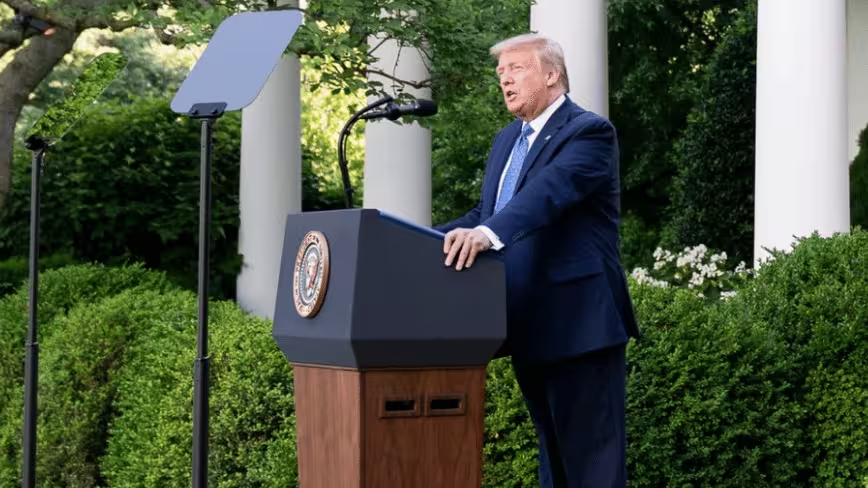
Donald Trump told reporters on Air Force One on Friday that he and Xi Jinping discussed AI guardrails and Nvidia's H200 chips during the two-day Beijing summit, Bloomberg reported.
Asked what kind of guardrails, the US president said: ‘standard guardrails that we talk about all the time'. He added that the two leaders had ‘talked about possibly working together' on them.
The summit closed without a signed AI governance framework, and without the most-watched piece of the deal moving. Shortly before the meeting on Thursday, Washington had cleared roughly ten Chinese technology firms, including Alibaba, Tencent, ByteDance, JD.com and Lenovo, to buy up to 75,000 H200 chips each under a new export-licensing regime, as CNBC reported.

The 💜 of EU tech
The latest rumblings from the EU tech scene, a story from our wise ol' founder Boris, and some questionable AI art. It's free, every week, in your inbox. Sign up now!
Not a single H200 has yet shipped to the cleared buyers, and Chinese rare-earth exports remain about 50% below pre-restriction levels.
The phrase ‘standard guardrails' is doing a lot of work in the read-out, because the US and Chinese governments have not, on the record, agreed on what those guardrails would cover.
Time's account of the meeting described AI as ‘the elephant in the room' rather than the centrepiece, with the public-facing conversation focused on trade and the H200 question while a deeper bilateral framework on autonomous weapons, model misuse, and dual-use AI was discussed only in outline.
Senior officials briefing on background suggested the two governments are considering a recurring dialogue track on AI risk, but no schedule, working group or signed text has emerged from this round.
The export-licensing regime that cleared the ten Chinese buyers is unusually elaborate. China-bound H200 volumes are capped at no more than 50% of Nvidia's US domestic sales, each shipment must be verified by a US-headquartered third-party laboratory, Chinese buyers must certify against military use, and the deal includes a 25% revenue share routing through US territory.
The practical effect so far has been a paper clearance rather than a physical delivery.
Senate Democratic leader Chuck Schumer posted that ‘giving China access to this premier US technology is dangerous and threatens our lead in the AI race'.
The administration's argument, framed publicly by Nvidia's Jensen Huang last week, is that the H200 sits one generation behind the Blackwell line still inside export controls, and that selling regulated Chinese demand to Nvidia keeps the revenue, and US jobs, in-country.
China's rare-earth controls, imposed last year to retaliate against earlier US tariffs, are still constraining Western magnet and motor supply chains and were not lifted as part of the AI conversation. Rare earths and chips sit in the same negotiating folder on both governments' read-outs. They did not move together in Beijing.
The corporate stakes are visible in the broader AI capex cycle. Hyperscalers have committed more than $650bn to AI infrastructure across 2026 on the combined Q1 numbers from Microsoft, Alphabet, Amazon, Meta and Apple, and Nvidia sits at the centre of the supply side of that spend.
A China revenue line, even at controlled volumes and with a 25% pass-through, materially changes its medium-term forecast. Microsoft and OpenAI's joint trajectory is the visible US half of that picture; Huawei's Ascend chips are the half the export regime is implicitly trying to slow down.
Trump's read-out from Air Force One is, in that frame, less a substantive AI-policy announcement than a procedural signal.
The president confirmed that AI guardrails and H200s were on the agenda and that the licensing regime cleared earlier in the week remains operative on the chip side. The signed text everyone was watching for did not arrive.