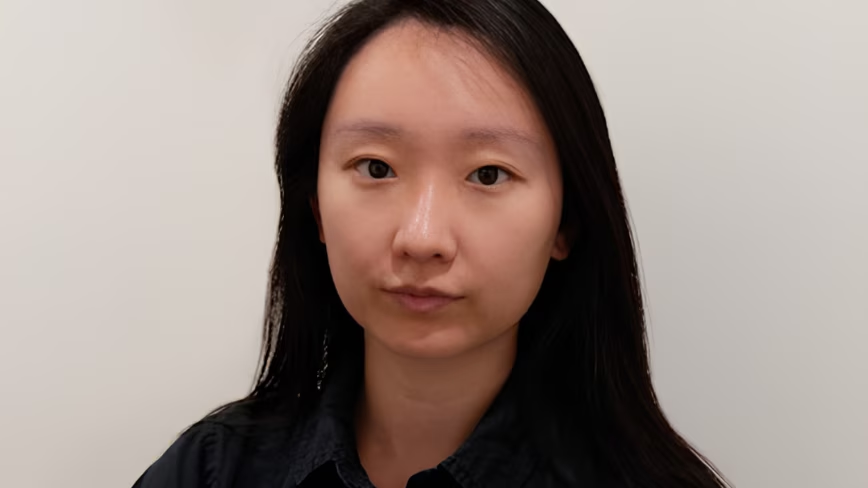
Artificial intelligence has dramatically accelerated software development, making it easier than ever to transform ideas into working products. According to Stanford's recent report, AI performance on a key coding benchmark jumped from 60% to nearly 100% in a single year, while organizational AI adoption reached 88%. As AI capabilities continue to expand, Tingyu Su believes the challenge is no longer simply building software. It is creating products that people immediately understand, trust, and choose to adopt.
According to Su, a startup Founding Designer with experience spanning creative technology, product innovation, and multidisciplinary design, that shift has made the founding designer an increasingly important early hire. She explains that while startups often prioritize engineering talent, they also need someone who can connect product development, branding, and customer experience into a cohesive whole from the very beginning.
“The speed of AI development has changed what companies compete on,” Su says. “Building an early product is becoming more accessible. Creating a brand and experience that people immediately understand, trust, and remember is where lasting differentiation begins.”
Customers often form opinions about a company well before they ever use its technology, Su notes. “A website, conference booth, presentation deck, or marketing material may become the first interaction someone has with an organization,” she says. She recalls a recent industry conference where a prospective customer stopped by the company's booth and remarked that the materials felt clean and immediately understandable, and looked noticeably more refined than those of the surrounding exhibitors. For Su, moments like that confirm why every touchpoint should reinforce the same identity customers eventually experience inside the product itself. A startup's product will change many times, she says, but a thoughtfully built brand is the one thing that shouldn't. For AI startups, that consistency is what earns customers' trust before the technology proves itself.
Su's multidisciplinary career has influenced how she approaches design. Her experience spans art institutions, creative agencies, consumer brands, and technology companies, backed by formal training in communication design and product innovation. Her work has also been recognized with an iF Design Award, and she contributed published research presented at the CHI 2025. Today, she applies that broad perspective as the founding designer at Youlify, a Silicon Valley healthcare AI startup developing revenue cycle management technology for healthcare organizations and providers.

The 💜 of EU tech
The latest rumblings from the EU tech scene, a story from our wise ol' founder Boris, and some questionable AI art. It's free, every week, in your inbox. Sign up now!
Su also believes expectations for early-stage products have evolved alongside AI. While the minimum viable product remains a valuable way to validate ideas, she says functional software alone is rarely enough to earn customer confidence. Instead, she encourages founders to think about creating a Minimum Lovable Product, an experience that is clear, intuitive, and trustworthy from the very first interaction. According to Su, thoughtful design helps turn an early prototype into a product that people are willing to adopt and recommend.
“A product does not need dozens of features to make an impression,” Su says. “Sometimes one carefully designed experience that clearly solves a real problem creates far more confidence than a long list of capabilities people never fully understand.”
According to Su, AI is reshaping the role of designers as much as it is reshaping technology. She believes the next generation will contribute across branding, product strategy, customer research, and engineering instead of remaining confined to traditional design responsibilities. She says AI tools and a growing technical understanding are enabling designers to collaborate more closely with engineering teams throughout product development.
Su encourages founders making their first design hire to prioritize curiosity, initiative, and systems thinking alongside technical ability. She explains that early-stage startups rarely have the structure for highly specialized roles, making adaptability an important characteristic for anyone joining the founding team. Designers who proactively explore customer problems, collaborate across departments, and confidently recommend practical solutions often contribute well beyond traditional design responsibilities.
“The most valuable founding designers are constantly learning alongside the company,” Su says. “They are willing to understand the customer, work closely with engineers, contribute to business conversations, and refine every experience as the company evolves.”
Su's own multidisciplinary career reflects that philosophy. Before entering the startup ecosystem, she worked across prominent cultural institutions, including the Museum of Modern Art, Solomon R. Guggenheim Museum, and Rubin Museum of Himalayan Art, experiences that strengthened her understanding of storytelling, accessibility, and large-scale design systems. She later expanded that perspective through creative agencies, consumer brands, and product innovation before moving into AI startup leadership, where she now combines design, technology, and business strategy to help shape emerging products.
As artificial intelligence continues to reshape how software companies are created, Su believes the role of the founding designer will continue expanding alongside technological progress. While engineering excellence remains fundamental to successful startups, she suggests that long-term differentiation increasingly depends on how clearly companies communicate value, earn customer confidence, and deliver cohesive experiences across every interaction.
“The companies people remember are the ones that make every interaction feel intentional,” Su says. “Technology will continue to evolve, but trust is built through experiences that feel consistent from the first impression to the product itself. That is where I believe the founding designer creates lasting value.”