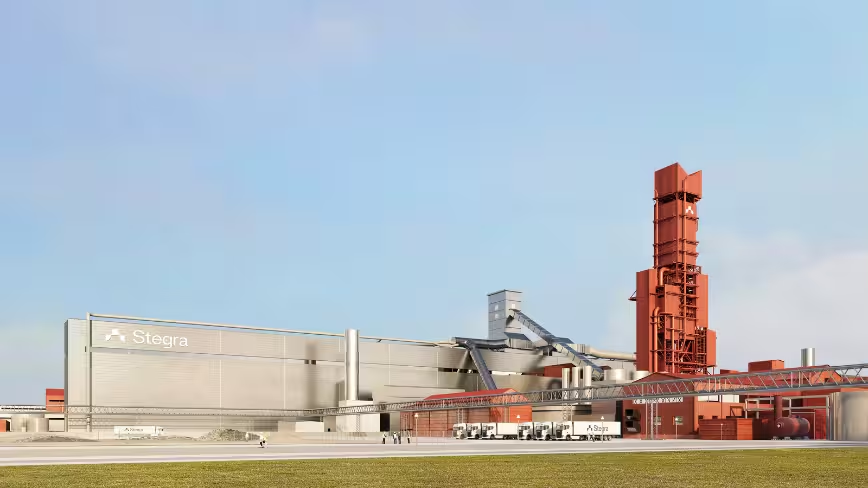
Stegra, the Swedish green steel company formerly known as H2 Green Steel, has agreed in principle on €1.4 billion ($1.65 billion) in new financing to complete the construction of what would be the world's first large-scale green steel plant, located in Boden in northern Sweden.
The round is led by a consortium assembled by Wallenberg Investments, which also includes Singapore's Temasek and the IMAS Foundation.
The Wallenberg family will contribute €250 million and, upon closing, will become Stegra's largest shareholder. Existing investor Altor will be the second largest owner.
Hy24 and Just Climate, both existing shareholders, are also supporting the round. Senior and junior lenders have indicated support subject to credit approvals.
The announcement ends months of acute financial uncertainty for one of Europe's most consequential industrial decarbonisation projects. Construction at the Boden plant had slowed significantly during the fundraising process.
Stegra said it will now ramp activities back up, though the project timeline is under review. The plant originally targeted operations by the end of 2025; that deadline has long since passed. Signing of principal agreements is expected by the end of April, with closing of the financing round targeted for June 2026.
Leif Johansson, an adviser to the Wallenberg-led consortium and Sweden's most prominent industrial statesman, former CEO of Ericsson and Volvo, and former chair of AstraZeneca, was direct about both the conviction and the caution the investment reflects.
“We are convinced of the competitiveness of Stegra and the commercial attractiveness of green steel in addition to the climate benefits, while remaining clear-eyed about the challenges that lie ahead,” he said.
“We also consider the project to be of great importance to Sweden's position as an industrial nation.”
Upon completion of the round, Johansson is expected to become Chair of the Board, replacing Shaun Kingsbury. Wallenberg Investments' senior industrialist Håkan Buskhe and Altor's Managing Partner Paal Weberg are also expected to join the board. Johansson and Buskhe have joined as board observers with immediate effect.
The Wallenberg intervention matters beyond the capital it brings. One person familiar with the situation told Swedish business daily Dagens Industri:
“You have to see this as more than an investment. The Wallenbergs' coming in means that Stegra will become part of the elite of Swedish industry and will never be allowed to go bankrupt.”
The family's investment group has historically been one of the most patient and committed industrial investors in Scandinavia, with long-term positions in companies including Ericsson, Saab, SKF, and Electrolux.
Stegra has raised more than €2.1 billion in equity since its Series A of €86 million in 2021, a Series B1 of €260 million in 2022, a €1.5 billion round in 2023, then the largest private placement in Europe that year, and an additional €300 million alongside more than €4 billion in debt financing in 2024.
The plant has also benefited from a €250 million grant under the EU's Innovation Fund. Its process uses green hydrogen, produced by electrolysis powered by renewable electricity, to replace coking coal in the steelmaking process, producing iron and then steel with up to 95% fewer CO₂ emissions than conventional blast furnace production.
Steel accounts for roughly 7–8% of global CO₂ emissions and has long been one of the hardest industrial sectors to decarbonise.
The project has operated under the long shadow of Northvolt, the Swedish battery manufacturer that shared early investors through Vargas Holding and declared bankruptcy in late 2025. The comparison has dogged Stegra's fundraising.
Its lenders, according to prior Financial Times reporting, included Citigroup, which indicated it wanted to stop lending due to concerns about the company's future.
The Wallenberg rescue package appears to have resolved the immediate crisis, CEO Henrik Henriksson described achieving the round as having required “significant efforts by everyone involved” in what he acknowledged was a “very challenging macro-environment.”