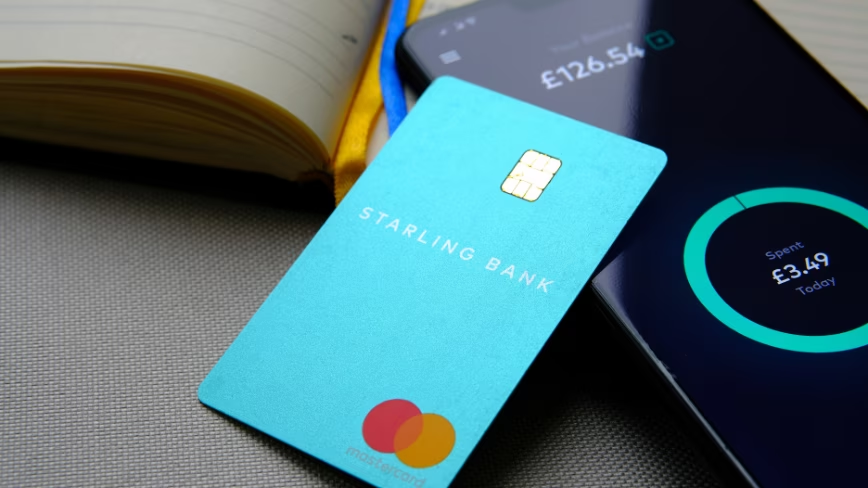
The Goldman-backed UK challenger has booked a second consecutive annual decline as it takes additional expected-credit-loss provisions, on top of the FY25 fallout from the BBLS Covid-loan compliance issue and the FCA's £29m anti-money-laundering fine.
Starling Bank's annual profit fell again in the year to 31 March 2026, Bloomberg reported on Thursday, as the Goldman-backed UK neobank took additional expected-credit-loss provisions on its retail-lending book.
The report describes the result as the second consecutive annual decline for the company, following the 26% pre-tax-profit drop reported in May 2025.
The FY25 baseline against which the new numbers should be read was a £223.4m pre-tax profit on £714m of revenue.
That figure was itself down from £301m in the prior year, principally because of a £29m FCA anti-money-laundering fine and the first round of provisioning against the bank's BBLS (Bounce Back Loan Scheme) Covid-loan exposure.
Starling identified a tranche of BBLS loans that ‘potentially did not comply with a guarantee requirement' due to weaknesses in historic fraud checks, and voluntarily removed the government guarantee, leaving the bank itself on the hook for losses inside that tranche.
The new FY26 results carry that provisioning forward. The Bloomberg headline framing, ‘presumes more credit losses', signals that management has taken additional expected-credit-loss reserves rather than working through the existing provision.
The accounting treatment is the standard IFRS 9 forward-looking-loss approach, calibrated against management's view of how the affected BBLS tranche performs over the residual loan duration.
Starling's investor materials describe the bank's lending book as comprising retail mortgages, BBLS legacy positions, and a growing commercial-SME book; the BBLS line is the principal source of the provisioning movement.
Customer-and-deposit metrics, on the FY25 baseline, were the brighter half of last year's story: 4.6m customer accounts (+10% YoY), £12.1bn in deposits, revenue growth from £682m to £714m.
The Bloomberg report on FY26 carries forward the underlying customer growth as ongoing, but it is the credit-loss line that has dominated the headline number.
Raman Bhatia, who joined as group CEO in March 2024 from OVO and before that the head of HSBC's UK and European digital-retail bank, has been running the company through the BBLS clean-up and the FCA-fine fallout for two consecutive reporting cycles.
The FY26 results are the first to fully reflect operational decisions made entirely under his tenure, with founder Anne Boden having resigned from the board in 2024.
Bhatia's prepared commentary, on the Bloomberg account, frames the additional provisioning as a one-off legacy adjustment rather than a structural deterioration of the underlying lending book.
The wider UK-banking context is the part the FY26 release sits inside. HSBC's recent £4bn China clean-tech lending facility and Standard Chartered's 7,000-job AI-driven cut announcement have both, in different ways, signalled how the established UK-headquartered banks are positioning around the next cycle.
Starling, as the most successful UK neobank to have made the transition from challenger to profitable scale, is operating in the same regulatory-and-customer environment but with a materially smaller balance sheet and a legacy-loan-book problem the larger banks worked through earlier in the post-Covid cycle.
Starling did not disclose, on the Bloomberg report available at publication, the headline FY26 pre-tax profit figure, the size of the additional credit-loss provision relative to last year's £800k disclosed BBLS reserve, the customer-and-deposit growth print for the year, or specific guidance on whether the BBLS-related provisioning is expected to continue into FY27.
The bank's full FY26 annual report, expected to be published shortly on the Starling investor page, will carry the segment-level breakdown. Sacra's running database has historically captured the headline metrics within hours of release.
The next visible proof point will be how the FY26 report breaks down the credit-loss provisioning between BBLS legacy and any new flow from the current retail-mortgage book, where rate-and-affordability pressure has been the wider UK-bank concern through the past year.