TL;DR
SpaceX's $75 billion IPO made Elon Musk the world's first trillionaire, with a net worth above $1.1 trillion. But Nasdaq's fast-tracked index inclusion means retirement savers in passive funds are forced to buy shares in a company that lost $4.94 billion last year, drawing a failed SEC intervention from Senator Elizabeth Warren.
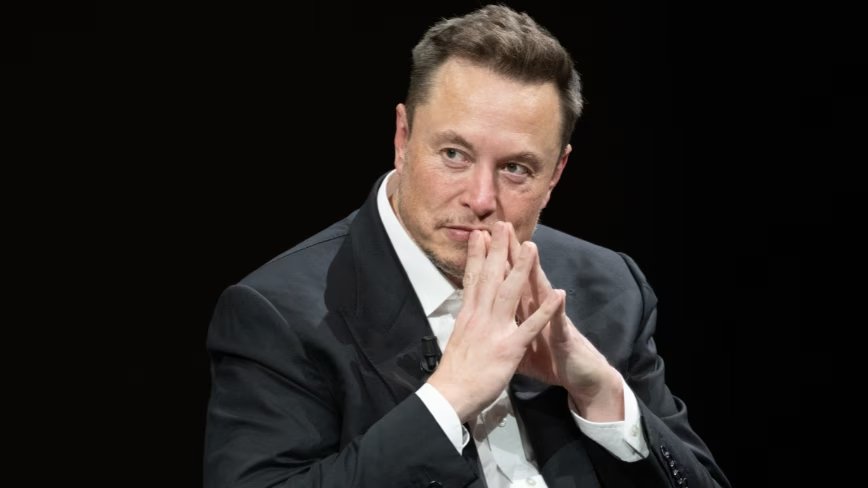
Elon Musk is now worth more than $1 trillion. The SpaceX IPO, which priced 555.6 million shares at $135 each on 12 June, valued the company at roughly $1.77 trillion and pushed Musk past a threshold no individual has ever crossed.
His SpaceX stake alone is worth an estimated $866.5 billion, according to the updated IPO prospectus. Combined with his Tesla holdings and other assets, Forbes and Reuters put his total fortune above $1.1 trillion.
A trillionaire on paper
The milestone comes with a large asterisk. Musk's wealth is almost entirely tied to his equity positions in SpaceX and Tesla, not liquid cash.
Selling a meaningful portion of that stake would flood the market and depress the share price, a constraint that makes the “trillionaire” label more symbolic than spendable. The Washington Post headlined its report with the qualifier “on paper,” and for good reason.
Nasdaq changed the rules
What makes this IPO different from previous mega-listings is the speed at which it will enter index funds. Effective 1 May 2026, Nasdaq revised its methodology so that any newly listed company ranked in the top 40 by market capitalisation can join the Nasdaq-100 after just 15 trading days.
The previous seasoning period was far longer, and the minimum float requirement has been eliminated outright. SpaceX, listing under the ticker SPCX, will almost certainly qualify within weeks of its debut.
The S&P 500, by contrast, rejected a similar proposal on 4 June. SpaceX cannot enter that index until at least mid-2027, and only if it posts four consecutive quarters of positive GAAP earnings.
Given the company's current financials, that timeline is generous.
The retirement-fund problem
Index inclusion sounds like a technicality, but it is not. When SpaceX enters the Nasdaq-100, every fund that tracks the index, including the widely held QQQ ETF, must buy shares regardless of whether fund managers believe the company is a sound investment.
Analysts estimate that $22 billion to $27 billion in automatic buying will flow into SpaceX from funds tracking the Nasdaq-100 and Russell indices combined. Nearly half of all index fund assets come from retirement plans: 401(k)s, IRAs, and pension accounts.
Fortune reported that the arrangement effectively forces millions of passive investors to take on exposure to a company that has never posted a full-year profit. Critics describe it as a “massive wealth transfer” from retirement savers to existing SpaceX shareholders, including Musk himself.
Warren tried to stop it
Senator Elizabeth Warren wrote to SEC Chairman Paul Atkins on 10 June, urging the agency to delay the listing. Her letter flagged three concerns: the company's valuation, its governance structure, and the risk that index rules were being “rigged” to funnel passive capital into an unprofitable company.
Musk holds roughly 42% of SpaceX's equity but controls 82.4% of all voting power through a dual-class share structure in which Class B shares carry ten votes each. A Danish pension fund blacklisted SpaceX entirely, calling the governance “catastrophic.”
Warren's letter described Musk as “virtually unimpeachable.”
The SEC did not act on the request. The IPO proceeded on schedule.
A company built on one profitable business
SpaceX reported a $4.94 billion net loss for 2025 on $18.67 billion in revenue. In the first quarter of 2026, the company lost another $4.28 billion.
The only consistently profitable segment is Starlink, the satellite broadband division, which generated $11.4 billion in revenue and $4.42 billion in operating profit last year. That 39% operating margin looks more like a software business than a hardware one, and subscriber growth remains strong, from 2.3 million users in 2023 to 10.3 million in Q1 2026.
The drag comes from xAI, the artificial intelligence unit Musk merged into SpaceX in February 2026. That segment posted a $6.36 billion operating loss in 2025, more than wiping out Starlink's gains.
As TNW has previously reported, the AI operations have also seen a talent exodus, with geopolitical complications compounding operational risks.
What a trillion dollars looks like
Musk's fortune now rivals the combined wealth of Larry Page, Jeff Bezos, Sergey Brin, and Larry Ellison, the four men who previously jostled for the top spot on the Bloomberg Billionaires Index. Forbes lists him at $826 billion before the IPO, with the SpaceX listing adding roughly $275 billion to that figure.
The gap between Musk and everyone else is no longer a lead. It is a chasm.
The Elon premium
Market observers have dubbed the network of businesses around Musk the “Muskonomy,” and some investors describe a persistent “Elon premium” in which valuations reflect faith in Musk's vision rather than traditional financial metrics. “Much like Tesla, SpaceX is a bet on Elon Musk,” said Matt Kennedy, senior strategist at Renaissance Capital.
JPMorgan Chase CEO Jamie Dimon, once a legal adversary, has become an admirer. He recently called Musk “our Einstein,” a striking shift from the pair's prolonged courtroom disputes.
The premium carries political baggage. Musk's role in President Donald Trump's Department of Government Efficiency last year coincided with weakening Tesla sales in several international markets as consumer boycotts targeted the carmaker.
The political fallout highlighted the increasingly blurred lines between Musk's business empire and his partisan interventions. Whether that baggage follows him into SpaceX's public market debut remains to be seen.
The flags
The original Reuters report states SpaceX lost “almost $4.9 billion” in Q1 2026. Multiple independent sources, including the company's own S-1 filing, put the Q1 2026 net loss at $4.28 billion, not $4.9 billion.
The discrepancy may stem from confusion with the full-year 2025 loss figure of $4.94 billion. We have used the S-1 figure.
Musk's exact net worth varies by source. Forbes, Bloomberg, and Reuters each use different methodologies and arrive at different totals.
The “$1 trillion” figure is an estimate, not an audited sum.
The “trillionaire” status is entirely contingent on SpaceX's share price holding at or above $135. A sustained decline would erase the milestone.
Nasdaq's rule change was a general policy update effective 1 May 2026, not a bespoke accommodation for SpaceX. However, the timing has drawn scrutiny, and critics have described the practical effect as tailored to the company's listing.