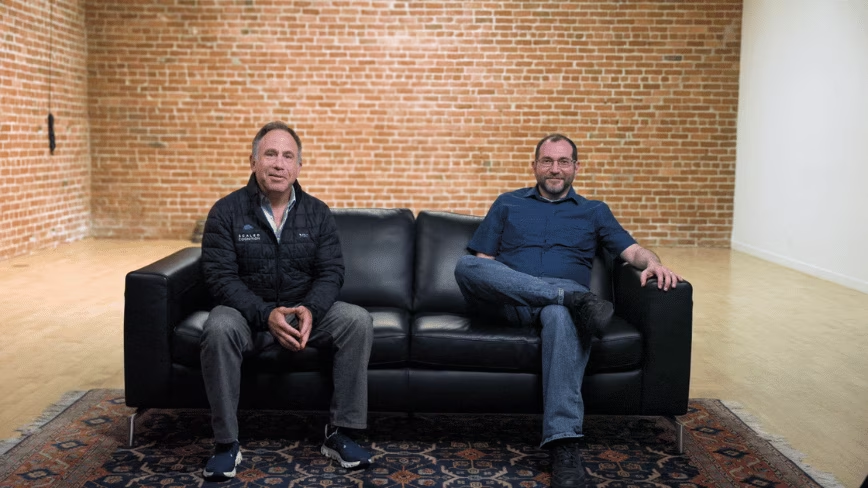
Scaled Cognition has raised $100M led by Khosla Ventures to build AI that does not hallucinate. The startup says its model will not give a wrong answer, a bold claim in a field built on probability.
Scaled Cognition, a Mountain View AI lab, has raised $100m in a Series A round led by Khosla Ventures. The company chases one prize: reliability. The Wall Street Journal reported the round values the startup at about $750m.
The pitch is simple to state and hard to deliver. Today's AI is capable but unreliable. It hallucinates, and those mistakes block its use in workflows where a wrong answer costs real money. Scaled Cognition wants to fix that at the root.
The startup is already in production with Fortune 500 firms across financial services, healthcare, telecom and insurance. These are industries where errors carry consequences, from a wrong bank balance to a botched insurance claim.
An architecture problem, not an effort problem
The company's core claim cuts against the grain. You cannot bolt reliability on, it argues. You have to design it in. That sets it apart from rivals who wrap a safety layer around an existing frontier model.
“We spent years trying to apply AI to business applications and found it was essentially impossible to make these systems reliable,” said Dan Roth, the chief executive and co-founder. “You could have an interaction that was spectacular, think the singularity is here, and then look at the data and discover the system was making grievous errors.”
For Roth, the fix was not more compute or more effort. “The problem isn't resources or effort, it's architecture,” he said. The company spent years on the rebuild.
That framing echoes a wider debate. The hardest failures are not the obvious ones. They are the answers that look completely correct and are quietly wrong, the kind a human reviewer waves through.
The model: APT
Scaled Cognition calls its flagship model APT, short for Agentic Pretrained Transformer. The company brands its output “Super-Reliable Intelligence.”
The promises are large. APT is meant to match the conversational quality of leading models while eliminating hallucinations and sticking to policy. It is also smaller, faster, cheaper and, the company says, more accurate than frontier models.
The deployment angle matters too. APT runs in a private cloud or fully self-hosted, so enterprises own their AI rather than renting it from a third party. For regulated industries wary of sending data to outside model providers, that control is a selling point.
“Reliability is engineered into the architecture of our models, not bolted on after the fact,” said Dan Klein, the chief technology officer and co-founder. “If you want AI to take real actions on behalf of customers, that's the problem you have to solve.”
The founders and the backer
The team has form. Klein is a UC Berkeley professor of AI and a veteran natural-language researcher. Roth and Klein previously built and sold one of the first agentic AI companies to Microsoft.
The lead investor reinforces the point. Vinod Khosla, founding partner of Khosla Ventures, framed the bet as a hard road most avoid. He has made similar wagers before, backing startups like Pramaana Labs that try to make AI verifiable.
“The way to quickly get into the market is to take a frontier model and put a layer on top,” Khosla said. “Most people are too lazy to do that. The result is Super-Reliable Intelligence: a model that will not give you a wrong answer. In any industry where an agent takes a real action, nothing else counts.”
Customers and scale
The early customers give the claim weight. Genesys, a cloud contact-centre giant serving more than 8,000 organisations in over 100 countries, uses APT for agentic virtual agents inside its platform. Genesys has also invested in the startup.
The numbers are ambitious. Over the next twelve months, companies using Scaled Cognition's models are on track to automate more than one billion customer support interactions.
Roth ties reliability to the bottom line. “When a system makes mistakes 30% of the time, complex issues go unresolved and customers don't come back,” he said. He claims its models resolve most issues, saving “hundreds of millions” in operational costs.
Beyond the model, the company sells a full platform. It includes agentic tooling, simulation and evaluation frameworks, and live monitoring of agents in production.
The bigger prize
Customer experience is only the first step. The real target is the $600bn business process outsourcing market, the sprawling world of outsourced customer service, IT support, HR and finance.
The thesis is a reversal. For years, enterprises shipped these jobs to third-party providers. Now some want to insource them again, swapping managed services for AI workforces they own and control. Scaled Cognition wants to supply the engine.
Timing helps the pitch. Enterprises have run AI pilots for two years but stalled on wider rollout, often because a single bad answer can trigger a complaint, a fine or a lawsuit. Scaled Cognition aims its entire message at that hesitation.
It is a vast market, and a crowded one. Every contact-centre platform is bolting AI onto its tools, and frontier labs are pushing into agents that act, not just chat. To win, Scaled Cognition must prove its reliability claim survives contact with messy, real customers.
The bold claim
The risk lies in the promise itself. “A model that will not give you a wrong answer” is a striking line in a field where models work, by design, on probability. Few in AI would make it so flatly.
Scaled Cognition is betting the architecture backs the boast. If APT really does cut the quiet, confident errors that block enterprise use, the reward is enormous. If it merely lowers them, it joins a long line of tools that promised reliability and delivered improvement.
Either way, the pitch is sharp. The company is selling trust, not raw capability, and trust is the thing enterprises keep saying they lack. Whether one model can guarantee it, at the scale of a billion interactions, is the question this round leaves open.