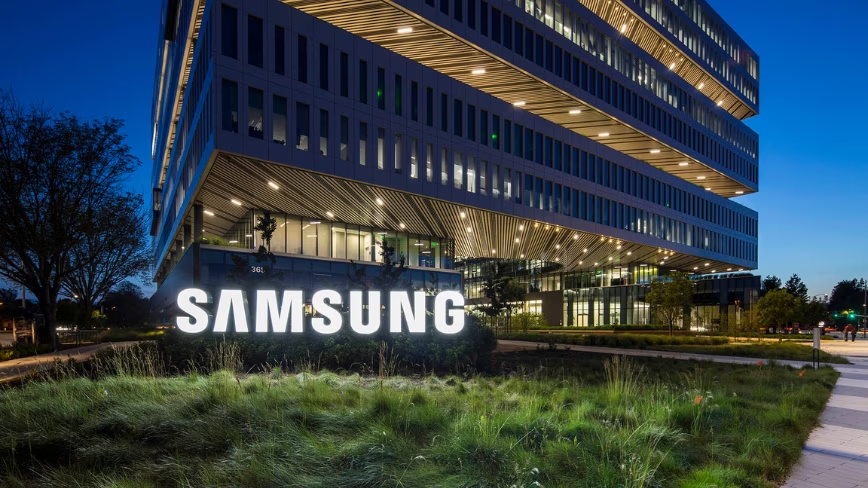
Samsung Electronics sent a letter to its two largest unions on Thursday morning asking them to come back to the negotiating table. Two days of government-mediated talks had collapsed the night before.
The strike, called by the National Samsung Electronics Union, is still scheduled for 21 May and is still planned to last 18 days.
The union's response, given through representative Choi Seung-ho, was four words long in spirit and one sentence long in practice: there is no reason to continue the dialogue without institutionalisation and transparency.
Choi was using a phrase rather than a position. The phrase means: put the bonus formula in the employment contract, in numbers, and stop offering one-time payments.
What is being fought over is not whether Samsung pays more. Management has already offered a one-time bonus for 2026 and proposed a profit share equal to about 13% of the chip division's operating profit.
The union is holding out for 15%, a 7% base wage increase, and removal of the existing cap that keeps performance bonuses at 50% of base salary. The gap is small. The principle is not.
The reference point sits one company over. SK Hynix agreed last September to remove its bonus cap and allocate 10% of annual operating profit directly to staff, locked in for ten years.
With $169bn of projected 2026 operating profit, that arithmetic produces an average bonus of about $477,000 per worker this year and close to $900,000 next year, across roughly 35,000 staff.
Samsung workers, watching their counterparts at the smaller HBM rival receive a structural share of the same AI windfall, are asking for the equivalent in their own contracts.
Samsung's bargaining position is bound by something the company would rather not say out loud, which is that the $1tn valuation it crossed on 6 May was driven almost entirely by the chip division. Semiconductor operating profit accounted for roughly 94% of the company's Q1 2026 figure, and the bulk of that came from the HBM and server DRAM lines the union is threatening to take offline.
A strike at the Pyeongtaek and Hwaseong sites where those chips are produced would land squarely inside Nvidia's H2 supply window.
The Korean prime minister has called an emergency meeting on the dispute. Yonhap, the South Korean news agency, has reported the central labour relations commission is asking both sides back into mediated talks on Saturday.
Samsung said in its letter that it remains open. The union said the letter changed nothing because the letter did not contain the formula.
Some of the proportions are worth holding in mind. The NSEU has roughly 36,000 members and represents about 30% of Samsung Electronics' workforce. More than 50,000 staff are expected to walk if the strike proceeds, drawn from the NSEU and the four smaller unions.
The 2024 strike, the first in Samsung's 55-year history, lasted around 25 days and included a one-day token action followed by an indefinite extension. The 2026 plan is shorter, more organised, and arrives at a moment when the company is more exposed to short-term production losses than at any point in its history.
The fight is no longer whether Samsung workers get more money. It is whether the bonus is written into the contract or left in the chairman's discretion. That is the difference, in the union's view, between a one-off and a structural share. It is the same difference SK Hynix already conceded.