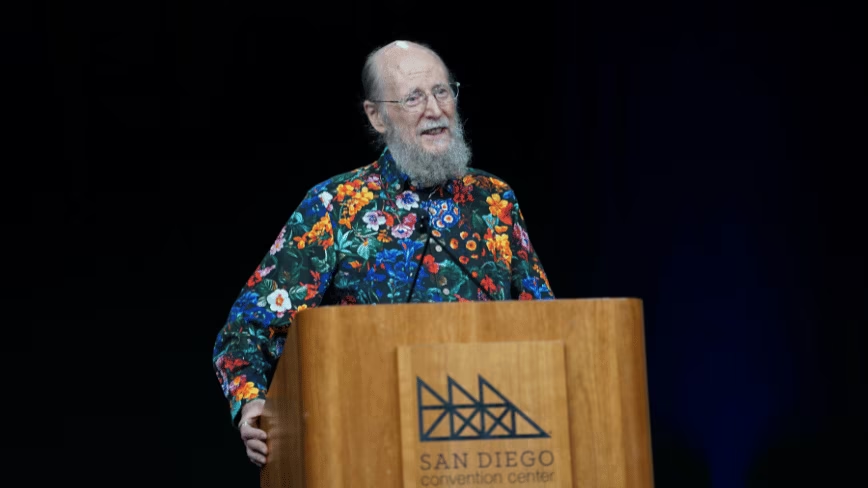
One of the most decorated minds in AI is striking out alone. Richard Sutton shared the 2024 Turing Award for founding modern reinforcement learning. On Monday he said he is leaving John Carmack's startup Keen Technologies to start a new one, Oak Lab.
He announced it plainly on X. He praised Carmack and Keen, then said he and his collaborator Khurram Javed had “broken away to start our own startup” to chase “a slightly different path toward understanding intelligence.”
His diagnosis of the field is blunt. Current deep-learning methods, he wrote, are “weak and inefficient, and need not more tweaks, but fundamentally new ideas and a thorough reworking.”
Learning from experience, not datasets
Oak Lab's core argument is about where intelligence comes from. Sutton has long held that it is created and maintained from run-time experience, not distilled from a clean, human-curated dataset.
That distinction matters more than it sounds. Today's models learn from data that people have collected, cleaned and filtered. Real experience is messier. Some of it is predictable, and a lot of it is just noise.
In the lab's first research post, Sutton and Javed put numbers to the problem. The standard optimiser, SGD, cannot tell the two apart. Nor can cousins like Adam. It spreads the blame for every error across all its parameters, so it quietly absorbs the noise.
Their fix updates an old idea of Sutton's. An algorithm called IDBD, and a new neural version they call NetworkIDBD, learns to assign credit selectively. It rewards only the signals that actually predict something. In their tests it learns the real pattern where SGD drowns in the junk.
An agent that runs on 20 watts
The point of all this is efficiency. Their methods learn from a stream of experience, one step at a time, without storing or replaying data. Oak Lab says that needs orders of magnitude less compute and energy than today's approach.
That leads to the lab's stated holy grail: a trillion-parameter agent that learns and plans in real time on 20 watts. Twenty watts is roughly what the human brain runs on. Today's frontier models train once, in data centres that draw megawatts, then sit frozen. Sutton wants a system that never stops learning, on a sliver of the power.
The contrarian bet
Sutton has spent his career arguing against the grain. His 2019 essay “The Bitter Lesson” is quoted constantly in AI. His textbook with Andrew Barto trained a generation of researchers. But he doubts that scaling up pretrained language models is the road to real intelligence.
That puts him in interesting company. Yann LeCun has made a similar case, leaving Meta's orbit to bet $1bn on world models rather than bigger chatbots. AlphaGo's David Silver has placed his own bet on a different route. All of them think a machine should learn like a child does, from experience, not from a frozen snapshot of the internet.
The timing fits the mood. The AI race has quietly stopped being only about the biggest model. Cost and efficiency now matter as much as scale, and researchers are digging into how models actually reason rather than just making them larger.
Whether Oak Lab delivers is another question. It is chasing a goal the whole field would love and nobody has reached. But Sutton is betting a storied career on it. The future of AI, he thinks, looks less like a bigger brain in a bigger building, and more like a small one that never stops learning.