What is it worth to increase your chance of success? Or to reduce the chance of a costly failure? For most of modern history, we have not been able to answer those questions clearly. We have relied on averages: simple, clean, and often misleading.
That is starting to change. A new class of tools, which we call ChanceOmeters, can now measure uncertainty directly. Like a speedometer measures speed, these tools quantify the likelihood of outcomes. Powered by AI and a new form of data that preserves uncertainty, they run thousands of calculations instantly and return something far more useful than a single number: the odds.
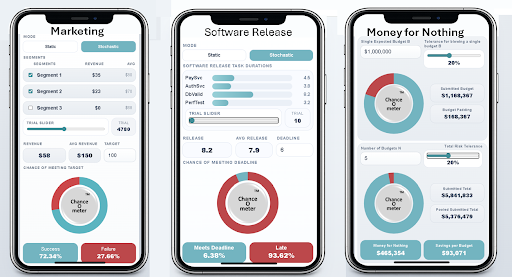
This shift changes how decisions feel. When you can see the chances move in real time, you engage both instinct and analysis. We have long described this as connecting the seat of the intellect to the seat of the pants, which we call Limbic Analytics.
Consider a simple marketing decision. You are choosing two of three customer segments to target. If you rely on averages, the answer is obvious: pick the two segments with the highest expected revenue. But suppose your goal is to exceed $100,000 in sales. Once you account for uncertainty, the picture changes. Two of the segments may rise and fall together, while a third behaves independently. By diversifying across uncertainty, not just maximizing averages, you can improve the chance of hitting your goal. The “best” choice depends on probabilities, not just expectations.
The same principle appears in software development. Imagine launching a product that depends on four approval processes that can take place in parallel, each expected to take six weeks. The average suggests a six-week timeline. In practice, delays compound. When uncertainty is accounted for, the chance of finishing in six weeks is only around 6%. A ChanceOmeter lets you test different deadlines and see the probability of success. Suddenly, the decision is no longer about optimism or pessimism. It is about choosing a level of risk you are willing to accept.
Uncertainty is typically something thought to be avoided. However, uncertainty can be harnessed to create money from nothing. Consider the budgeting process that every company and government agency engages in. To avoid running short, each department builds in a buffer. This is sensible behavior in isolation. Across an entire organization, it creates a vast accumulation of unused contingency funds. Techniques that harness uncertainty, such as pooling contingencies, enable us to recoup this accumulation, in effect creating “money for nothing.”
The challenge has always been practical. You cannot simply add uncertainties together like dollars. You need a way to represent and combine them coherently. That capability emerged on Wall Street in the 1980s, where financial engineers developed methods to model thousands of possible futures simultaneously.
In 2013, we co-founded a nonprofit with the late Nobel laureate Harry Markowitz to bring those capabilities beyond financial engineering. The goal was to create open data standards so uncertainty could be stored, shared, and calculated as easily as numbers in a spreadsheet. That work has made it possible for non-specialists to work with uncertainty directly, using familiar tools.
The result is what we are now seeing in these interactive apps. They are data systems that carry uncertainty with them, allowing calculations to reflect how risks interact. When combined with AI, which is naturally fluent in probabilities, they create a powerful new way to reason about the future.
We are only beginning to see the implications. From marketing campaigns to software launches to budgets, the same pattern repeats. Averages conceal risk and opportunity. Probabilities reveal them. Once you can measure your chances, you can manage them and improve them.