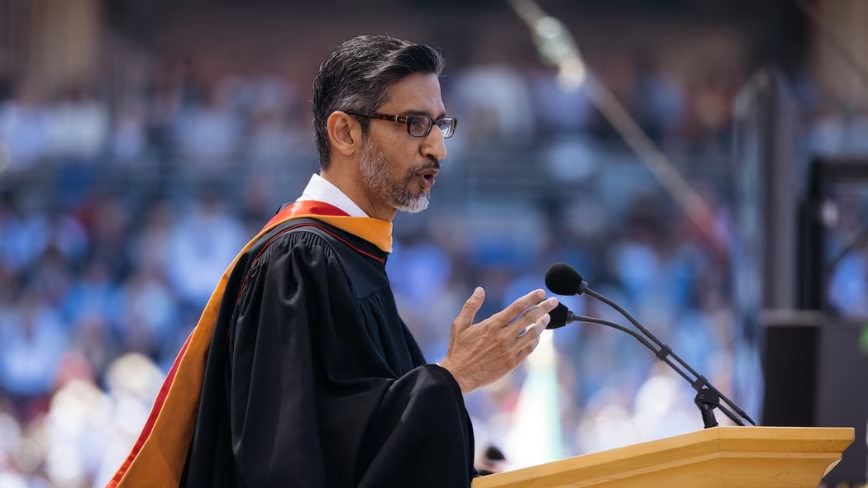
The man who runs one of the world's largest artificial-intelligence companies stood up to address Stanford's graduating class and, for the most part, declined to talk about artificial intelligence. Sundar Pichai, the chief executive of Google and Alphabet, gave the address at the university's 135th commencement on Sunday 14 June, in Stanford Stadium, and chose almost everything except the subject he is best known for.
He acknowledged the omission with a joke. The pressure to discuss AI, he said, was hard to escape given the last two letters of his surname, before pivoting to advice he described as “technology agnostic.”
It was a calculated swerve. Technology executives have had a rough graduation season: Eric Schmidt, Pichai's predecessor at Google, was booed at the University of Arizona this year for praising AI's promise, and Pichai appeared determined not to repeat the experience.
What he offered instead was autobiography organised around three filters: choose optimism, work on hard things, and do what genuinely excites you. The optimism came with an origin story.

The 💜 of EU tech
The latest rumblings from the EU tech scene, a story from our wise ol' founder Boris, and some questionable AI art. It's free, every week, in your inbox. Sign up now!
Arriving from Chennai for his first winter quarter, Pichai looked out at hills he saw as brown and was corrected by his host, Jane Earl, who told him, “We prefer to call it golden.”
The reframing, brown to golden, became the speech's controlling image. He drew on his own path through Google, including the building of Chrome, as evidence for the other two filters, and closed by telling the class to “set your heart ablaze.”
It was, by his own account, only his second commencement address and his first before a live audience. The other was filmed in his backyard in 2020, a YouTube ceremony for a graduating class that could not gather. Pichai holds a Stanford master's in materials science and engineering, which gave the return a certain symmetry.
The part that travelled furthest, though, was not in the speech. As Pichai took the stage, a group of graduates rose and walked out of the stadium. The protest had been pledged weeks in advance by Stanford Students for Justice in Palestine, and it was aimed not at AI or job displacement but at Google's involvement in Project Nimbus, the roughly $1.2bn contract under which Google and Amazon supply cloud and AI services to the Israeli government.
That distinction matters, because the temptation to read the walkout as a verdict on AI is strong and, in this case, wrong. The students were protesting a specific commercial relationship, not the technology in the abstract, and conflating the two flattens a deliberate political act into a more convenient narrative about graduates fearing the machines. The two stories happened to share a stage; they were not the same story.
Project Nimbus has been a flashpoint inside Google for years. Signed in 2021, the contract has drawn sustained internal protest, including a wave of employee firings in 2024 after sit-ins at company offices, and it has become a recurring target for campus activists who see university ties to the tech industry as fair game.
The Stanford walkout was the latest expression of a campaign that long predates this commencement, which is part of why its organisers were able to plan it so far ahead.
Taken together, the optics were their own kind of message. A chief executive whose company is racing to put AI into every product spent his moment at the lectern talking about golden hills and hard work, while the controversy that actually disrupted the ceremony concerned a defence-adjacent cloud deal rather than anything he said. For a leader practised at staying on message, the safest message this year was apparently the one with the least technology in it.
Sundar Pichai's remarks have since been published in full on Google's blog. The walkout, for its organisers, was the point, and it landed before he had finished his opening lines.