The London-and-San-Francisco startup, formerly Orbital Materials, has closed $50M led by Plural for PFAS-free cooling fluid and modular high-density compute infrastructure.
Orbital Industries, the London-and-San-Francisco AI-materials startup formerly known as Orbital Materials, has raised $50m in a Series B led by Plural with participation from Nvidia's NVentures, Radical Ventures, Compound and Fly Ventures.
The funding will scale commercial deployment of the company's data-centre cooling fluid and modular compute-infrastructure products, and expand its team across London and San Francisco.
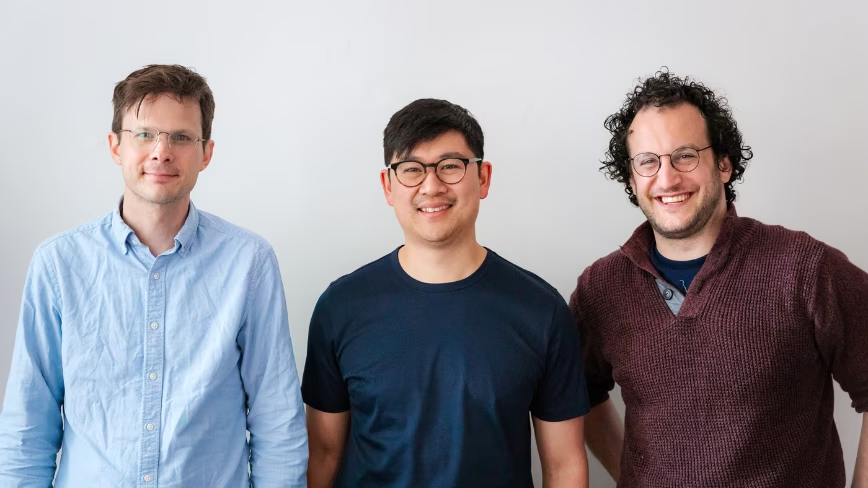
The company has rebranded along with the round. Orbital Materials, founded in 2022 by chief executive Jonathan Godwin (formerly of DeepMind), chief technology officer James Gin-Pollock and chief operating officer Daniel Miodovnik, originally positioned itself around AI-discovered carbon-capture and sustainable-aviation-fuel chemistry.
The company has since pivoted, or rather expanded, toward data-centre infrastructure where the immediate commercial pull has been strongest.
The new Orbital Industries name captures that broader scope; the long-term ambition is to apply the same model to semiconductors, critical minerals, aerospace and energy.
The two near-term products are worth describing concretely. The first is a PFAS-free dielectric cooling fluid designed for next-generation high-density GPUs.
PFAS, the so-called “forever chemicals” that have anchored two-phase immersion-cooling systems in data centres for years, are facing tightening EPA and EU regulatory bans.
3M exited the production of its Novec PFAS-based coolants entirely in 2024, leaving data-centre operators scrambling for alternatives just as Nvidia's Blackwell and Rubin generations push power densities into ranges that water-cooling alone cannot handle. Orbital's fluid, developed with its AI materials platform, sits in that gap.
The second product is a modular, off-site-manufactured data-centre system delivered as ready-to-deploy units. Orbital claims the approach cuts deployment timelines to as little as six months versus the traditional three years for purpose-built high-density facilities.
The capacity bottleneck is real: Anthropic, OpenAI and Meta have all visibly struggled to secure enough power-and-cooling capacity to absorb their planned compute scaling, and modular pre-fabrication has emerged as the standard industry response.
Orbital's differentiator, on its framing, is the AI-led engineering loop that designs the modules rather than just assembling them off-site.
The underlying technical asset is Orb, the company's open-source AI model for simulating the quantum-mechanical behaviour of atoms.
Published on GitHub under Apache 2.0, Orb's most recent v3 release handles fully solvated 20,000-atom enzyme simulations at scale, with the company claiming stable simulations of up to 100,000 atoms on a single GPU.
Published benchmarks show Orb running three-to-six times faster than existing universal interatomic potentials and producing a 31% reduction in error against the Matbench Discovery benchmark.
The AWS partnership the company has been promoting since December 2024 was struck under the old Orbital Materials name.
The strategic agreement covers data-centre decarbonisation, cooling and water-utilisation technologies, with Orb itself available to AWS customers via SageMaker JumpStart and the AWS Marketplace.
That commercial relationship is the primary near-term revenue anchor for the cooling-fluid product line.
The Plural-led round is a meaningful endorsement on the European deeptech side. Plural partner Ian Hogarth, who led the investment, is one of the more visible UK AI-policy figures and chaired the UK AI Safety Institute's predecessor body.
The Nvidia NVentures participation is the other one worth flagging: the chip giant's strategic-investment arm rarely backs hardware-infrastructure startups directly, and its involvement here signals that Orbital's cooling fluid is plausibly relevant to Blackwell-and-beyond GPU deployment.
Godwin, on the company's framing, joined DeepMind around the time of AlphaFold and worked on AI-for-science and materials before leaving to found Orbital.
The company has not disclosed revenue figures, customer-count specifics, or the post-money valuation implied by the Series B.