The AI industry just picked a side, in public. On Friday, 25 companies and groups published an open letter, “Open Weights and American AI Leadership”, urging Washington not to crack down on open-weight AI, Business Insider reported.
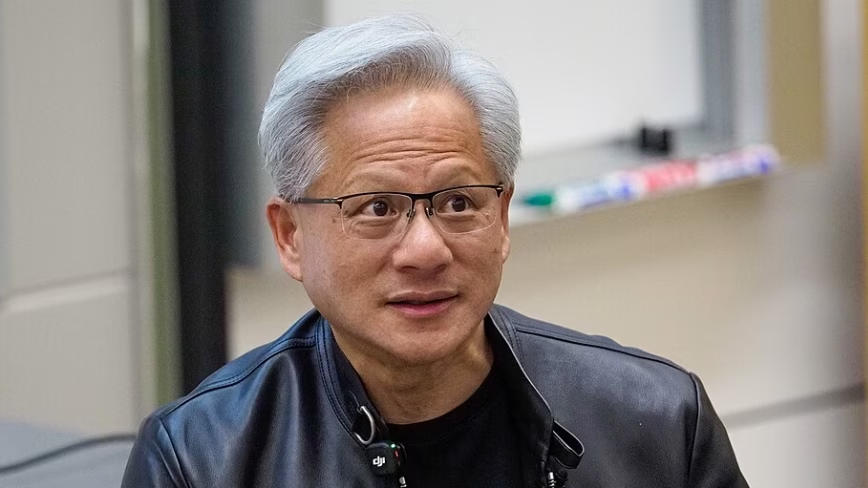
The names are heavy: Nvidia, Microsoft, Meta, Mistral, Palantir, IBM, Andreessen Horowitz, Hugging Face, Mozilla and the Linux Foundation. Jensen Huang fronted it with his first-ever post on X, which drew more than 11 million views.
“For my first post, I'm sharing a letter Nvidia signed on why open models matter,” the Nvidia chief wrote. “The world needs both frontier closed models and frontier open models.”
The letter reaches back to the 1980s, casting open weights as the heir to the open-source software that now “supports most of the internet”. America's AI lead, it argues, “will be judged not by one frontier AI model, but by whether the United States builds a strong, open ecosystem”.
Who didn't sign
The absences say as much as the signatures. OpenAI, Anthropic and Google did not sign. They are the closed-model leaders.
Each would gain if Washington blocked Chinese open-model makers like Moonshot. Its Kimi K3 is the world's most powerful open-weight model. The letter is, in effect, the rest of the industry lining up against them. It landed a day after nearly 200 startups made the same plea to the White House.
The closed camp did not fight it. Altman said he was “glad to see” the support. Microsoft's Satya Nadella backed the message the same day, CNBC reported.
Even Musk, whose SpaceX did not sign, quote-tweeted Huang: “This has my full support. Jensen is right.”
Turning the safety argument around
The letter's boldest move is to aim the safety case at the closed labs. Relying only on closed models “is not inherently safe”, it says, because they “can be breached, misused, or fail in ways that outsiders cannot detect”. Concentrating AI behind a few closed models creates “single points of failure”.
Openness, by contrast, “may be one of the most important paths to AI safety”. That is a direct answer to OpenAI and Anthropic, who have made security the heart of their case for restricting Chinese open models.
The China problem
The timing is not subtle.
This week the White House's Michael Kratsios accused Moonshot of building Kimi K3 by distilling Anthropic's Fable 5. Treasury Secretary Scott Bessent floated sanctions for distillation he likened to theft.
The letter calls distillation “a widely used technique”, but does not wave off every abuse. Policymakers should not “conflate legitimate model-development techniques with misappropriation”, it says, and unlawful extraction deserves “targeted” rules “rather than sweeping restrictions”.
There is self-interest here, and an awkward truth. Nvidia sells chips to everyone. Meta, Mistral and Hugging Face build open models. All of them gain if open AI spreads. And the US has fallen behind on the very thing the letter champions, as China now leads a field America once defined.
The signatories want Washington to keep “the frontier plural” and avoid “premature restrictions” that “stifle competition or drive innovation overseas”. Whether America can still win a race it is currently losing is the question the letter cannot answer.