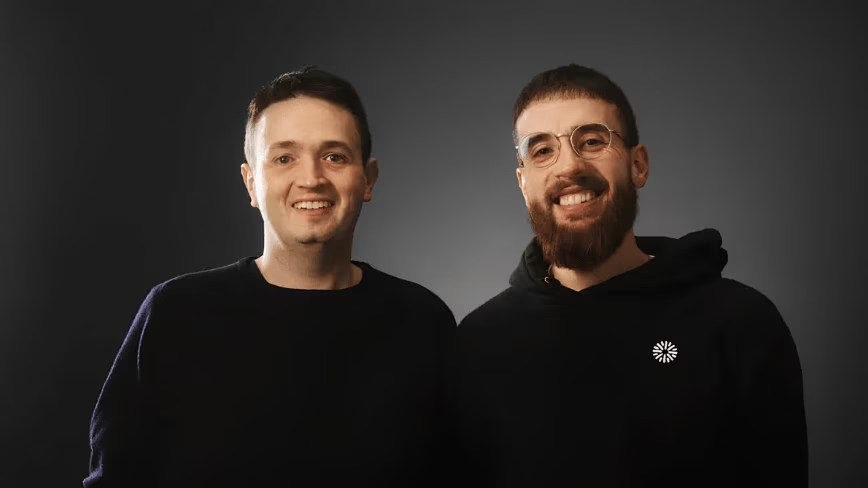
Odyssey, an AI lab building real-time ‘world models', has raised $310mn at a $1.45bn valuation. The more telling number is whose names are on the round.
The Series B was led by Natural Capital, with Amazon, AMD Ventures, Google's GV, EQT and the CIA-linked fund In-Q-Tel taking part. As part of the deal, AWS becomes Odyssey's preferred cloud provider and supplies its Trainium chips.
That matters because of who is missing. Just four months ago, Nvidia's venture arm, NVentures, backed Odyssey's Series A. Nvidia is nowhere in the Series B.
A defection, or just a better deal
Trainium is Amazon's in-house answer to Nvidia's grip on AI computing, built for the fast, high-volume workloads that real-time world simulation demands. Pairing it with money from AMD Ventures, Nvidia's main chip rival, makes the round read like a vote against the market leader.
“This round provides the compute, infrastructure, and partners to push the frontier of general world models, and to achieve a GPT-3 moment for the field,” said co-founder and chief executive Oliver Cameron.
The honest caveat is that this is diversification, not a divorce. As Tech Funding News put it, it is unclear whether the switch reflects real conviction in Amazon's chips or simply better terms in a fierce market, and ‘preferred cloud' is not ‘exclusive'.
Either way, it lands as buyers everywhere hunt for Nvidia alternatives, from China's carmakers designing their own chips to startups turning Nvidia GPUs into a commodity.
From self-driving to simulating everything
Odyssey was started in late 2023 by Cameron, a former Cruise and Voyage executive, and Jeff Hawke, a founding engineer at self-driving firm Wayve. Their pitch grew out of the core driverless-car problem: predicting what happens next so a machine can act on it.
A world model tries to do that for everything, simulating persistent 3D environments trained on physics and cause-and-effect rather than text. A robotics company could run thousands of training scenarios inside Odyssey's simulation instead of on a real factory floor.
Its roughly 55 staff, spread across Palo Alto, London and Zurich, include alumni of DeepMind, Tesla, Waymo and Apple. Recent projects include Odyssey-2 Max for physics simulation and Agora-1, which lets multiple agents act in one shared world.
A crowded, deep-pocketed race
The money reflects how hot the field has become. Runway reached a $5.3bn valuation after a $315mn round in February, Fei-Fei Li's World Labs raised $230mn, Google DeepMind's Genie model is already used at Waymo, and Yann LeCun's new lab is reportedly raising at a €3bn valuation before shipping a product.
Odyssey's wager is steeper than most: about 55 people and roughly $27mn raised before this, betting on a technology that has yet to prove it pays. The presence of In-Q-Tel, and Odyssey's own mention of defence as a target use, is a reminder that whoever can convincingly simulate the world will have customers well beyond gaming.