The US has cleared roughly 10 Chinese companies to buy Nvidia's H200, the company's second-most powerful AI accelerator, but not a single chip has been delivered, according to three people briefed on the licences and first reported by Reuters on 14 May.
The approvals from the US Commerce Department cover Alibaba, Tencent, ByteDance, and JD.com, alongside a handful of distributors, including Lenovo and Foxconn.
Each cleared customer is permitted to buy up to 75,000 H200s under the licence terms. On paper, that is one of the largest single-tranche openings to China since the Biden administration first tightened controls on high-end AI silicon in late 2023.
In practice, nothing has moved. Chinese buyers have held back after Beijing told domestic technology firms to pause H200 orders earlier this year, with the State Council pushing a parallel supply-chain security review aimed at reducing dependence on US chips. Order books exist, but the deliveries do not.
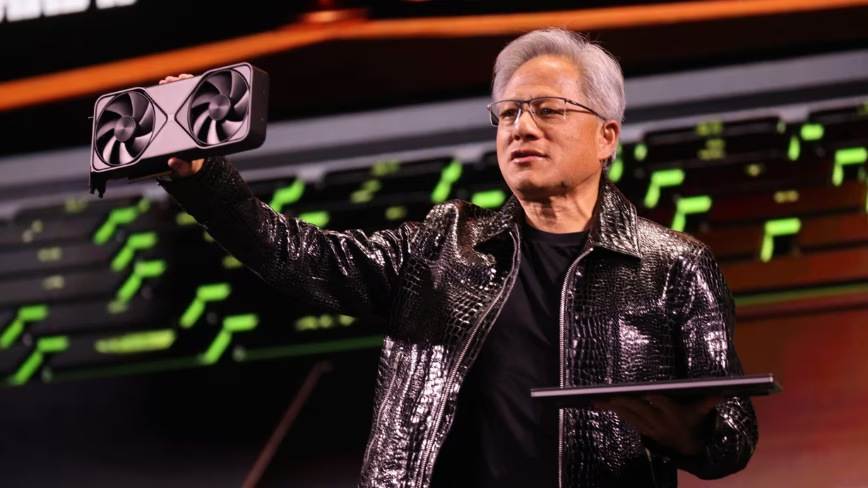
That is the context for the trip Jensen Huang did not originally expect to be on. NVIDIA's chief executive was left off the White House delegation to Beijing earlier this week, a decision read inside Washington as an effort to keep China hawks in the Republican caucus from picking a fight over NVIDIA's market access.
President Donald Trump reversed course on Tuesday, called Huang directly, and picked him up in Alaska as Air Force One refuelled en route to the Xi Jinping summit, according to Bloomberg.
Huang now lands in Beijing alongside Trump, Tim Cook, and Elon Musk, with two specific things to ask for: a green light from Beijing for the H200 deliveries already cleared in Washington, and a reciprocal easing on Chinese export curbs aimed at rare-earth magnets and chip-grade gallium.
The Chinese side is expected to push for reduced US restrictions on chipmaking equipment and EUV-adjacent tooling.
The H200 is the variant Nvidia has been allowed to sell into China under the Trump administration's case-by-case review framework, introduced last December to replace the previous presumption of denial.
The H200 is a step below the H100 and well below the Blackwell-generation B200, which remains entirely off the table for Chinese customers. Each approved buyer's 75,000-unit ceiling implies a maximum theoretical order book of about 750,000 chips if every licence is fully drawn.
NVIDIA has confirmed orders exist. Huang told investors in March that the company had received purchase orders from Chinese customers and that H200 production had been restarted to fill them. What he has not said publicly is when, or whether, those orders convert into actual shipments.
Tom's Hardware reported in January that Nvidia was demanding full upfront payment from China-based buyers, a structural hedge against precisely the kind of Beijing-driven cancellation now in play.
The financial stakes for Nvidia are smaller than the policy theatre suggests. China has shrunk to roughly 5% of Nvidia's revenue from a pre-controls high above 20%, after the company's Q1 FY2026 disclosure that an additional $2.5bn of H20 inventory could not be shipped and that an $8bn Q2 hit from H20 curbs was likely. The H200 clearance is meaningful, but it is a recovery of part of a market, not a return to the old one.
What happens next depends almost entirely on whether the Xi-Trump meeting produces something concrete on Beijing's side. Until it does, the cleanest read on Nvidia's China position is the one the licences themselves provide: paperwork issued, orders booked, chips not moving.