Nuclear power usually arrives with a very large price tag and a very long wait. Nuclear Turbines, a Manchester startup spun out of BAE Systems, has raised £15M to argue that it need not be either, at a moment when nuclear power startups across Europe are pulling in record amounts of private capital.
The foundational round was led by IQ Capital, joined by Rhapsody Venture Partners, Zero Carbon Capital and Empirical Ventures.
The money will go towards validating the company's reactor design, building large-scale test rigs, and expanding the team as it prepares to manufacture its first fuel elements. The company positions the technology as a step beyond the conventional small modular reactors now competing for UK contracts.
The technical idea is a substitution. Nuclear Turbines replaces the steam turbine systems at the heart of a conventional plant with high-temperature turbine technology borrowed from jet engines and gas-fired power stations.

The 💜 of EU tech
The latest rumblings from the EU tech scene, a story from our wise ol' founder Boris, and some questionable AI art. It's free, every week, in your inbox. Sign up now!
Take out the steam infrastructure, the company says, and the reactor becomes compact enough to sit ‘behind the meter' on an industrial site, powering data centres, factories and manufacturing plants directly rather than feeding the grid.
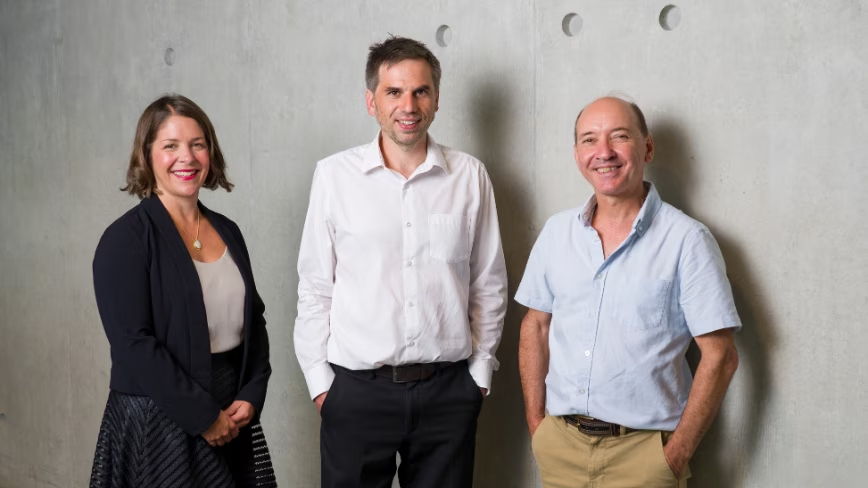
The startup was founded by Jeremy Owston, a former BAE Systems Principal Engineer, and Tim Abram, a nuclear engineer and professor at the University of Manchester, in partnership with Empirical Ventures' venture studio.
It emerged through BAE's in-house “Launchpad” programme, an unusual pedigree that underlines how much reactor engineering overlaps with defence.
Then there are the numbers the round is really being sold on. Nuclear Turbines says its approach could generate electricity at one-fifth the cost of today's nuclear plants, and, more strikingly, bring nuclear prices below those of fossil fuels. Both are company projections rather than demonstrated results.
“The nuclear industry has always designed reactors first, then figured out what to do with the heat. We flipped this script: we started with the cheapest way to generate power and designed a reactor to fit,” said Owston, the co-founder.
“If we're serious about reindustrialising while meeting climate goals, we need energy that's clean and cheap. We've created the only tech that solves both, from the UK.”
The commercial case leans on a genuine British pain point. UK businesses pay some of the highest electricity prices in Europe, roughly 50% more than their French and German counterparts and around four times what firms pay in the US, according to Deloitte.
Conventional nuclear, meanwhile, tends to cost tens of billions of pounds and take decades to build, which is part of why reactor developers courting data centres have found such a receptive audience.
“This is the first time I've seen an SMR design that genuinely solves the economic and sustainability equation, and it's at a time when market dynamics, government ambition and regulatory reform are creating unprecedented opportunity,” said Jordan Billiald, a principal at IQ Capital, which led the round.
Empirical Ventures, Rhapsody Venture Partners, Zero Carbon Capital and BAE Systems all supplied backers who spoke in support of the raise.
The company has also brought in Lauren Dickerson as Chief Commercial and Strategy Officer. She joins from Centrica, where she spent more than four years, latterly as Strategy Director, an appointment that signals a company thinking about customers well before it has a working commercial reactor.
The timing is not accidental. Nuclear Turbines is positioning itself alongside a wave of UK policy, including the 2025 Nuclear Regulatory Review billed as a “radical reset”, the Clean Energy Industries Sector Plan, and the government's Advanced Nuclear Framework.
Britain is also building a new uranium enrichment facility for the high-assay fuel that advanced reactors need, the kind of supply-chain gap that pushed another UK nuclear startup to build abroad.
For now, the claims sit ahead of the hardware. Nuclear Turbines has a design, a funded plan to test it, and a bold number attached. Whether the turbine from a jet engine can do to nuclear what the release promises is the thing the next few years, and the test rigs, are meant to find out.