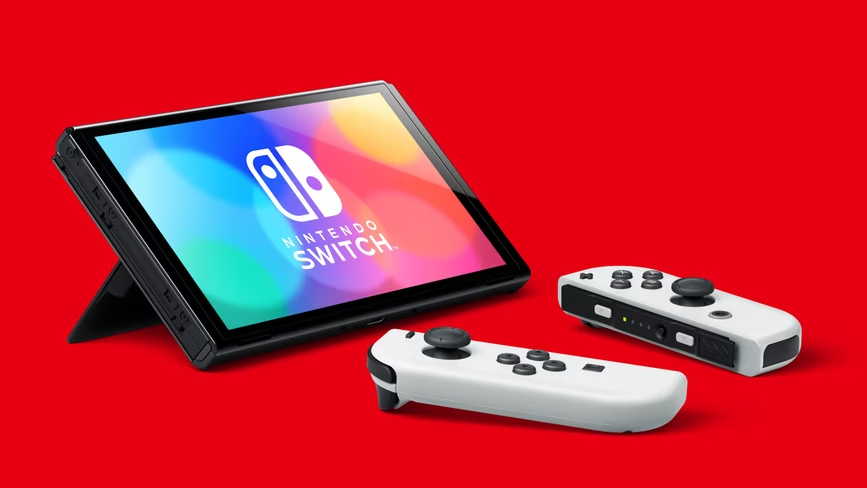
Nintendo shares dropped roughly 7% in Tokyo trading on Monday after Friday's full-year results paired a record fiscal year with a notably cautious outlook for the year ahead. The stock has shed close to 30% since the start of 2026.
FY26, which closed in March, was the strongest in Nintendo's history. Revenue almost doubled to ¥2.31 trillion. Net profit rose 52.1% to ¥424bn.
The Switch 2 launched in early June 2025 and has been the largest console launch by units in the company's history. The numbers that came in alongside that, however, are what unsettled the market.
For FY27, Nintendo is guiding to ¥2.05 trillion of revenue, an 11.4% decline, with net profit down 26.9% to ¥310bn. Switch 2 hardware unit sales are projected at 16.5 million units, 16.9% below FY26.

The 💜 of EU tech
The latest rumblings from the EU tech scene, a story from our wise ol' founder Boris, and some questionable AI art. It's free, every week, in your inbox. Sign up now!
The company attributed the softer view to a ¥100bn combined hit from higher memory and material costs, US tariffs on Asian-manufactured electronics, and elevated shipping expenses linked to the Iran conflict.
The Switch 2 price will rise to $499.99 in the United States from 1 September, up from $449.99 at launch, and to ¥59,980 in Japan from 25 May, up from ¥49,980. Other regions are following on different schedules.
The cost trigger is familiar. The Switch 2 uses 12GB of LPDDR5X RAM from Micron, and Nintendo is now paying roughly 41% more per chip than at launch. NAND flash is up about 8%. Both increases are driven by the AI-led DRAM squeeze lifting SK Hynix to record margins, as AI data-centre buyers absorb capacity faster than the foundries can ship it.
Console makers, smartphone vendors and PC OEMs are all caught downstream of the same allocation problem. Sony lifted PS5 prices in March; Nintendo is now repeating the same playbook for Switch 2.
What turned a routine memory-cost story into a more painful market reaction is the game pipeline behind the hardware.
The Switch 2's first six months delivered launch titles and Nintendo's own evergreen franchises, but the next twelve months show fewer first-party tentpoles than analysts had expected.
There is no confirmed Zelda or 3D Mario in the window, and the third-party slate, while broader than the original Switch enjoyed, has not yet delivered an exclusive that pulls hardware.
The bear case is that Switch 2 will follow the standard console curve in which hardware demand collapses early without a steady drumbeat of high-profile games; the bull case is that the slower release calendar reflects deliberate spacing, and that the back half of FY27 will include the kind of titles that drive both hardware refreshes and software attach rates.
President Shuntaro Furukawa has held to the latter view in public communications, framing the FY27 guidance as conservative and the price increase as a margin-recovery measure rather than a demand-suppression one. Investors are reading the gap between FY26 and FY27 differently.
The stock decline since the start of the year suggests the market is treating the guidance as a leading indicator rather than a one-off adjustment.
The competitive picture also matters. Microsoft's next-generation Xbox is reportedly slipping; Sony has signalled that PS6 development may not produce hardware until 2028 or 2029, citing the same memory-cost problem.
That gives the Switch 2 a longer effective generation than would normally be the case and, in theory, more room to grow the install base before a competing platform launches.
The thirteen-month window between the Switch 2 launch and a hypothetical PS6 has always been Nintendo's strategic advantage; if it widens further, that advantage compounds.
Against that, Nintendo's traditional software pipeline cycle relies on a steady cadence of first-party hits. The company has historically managed that cadence well, but the FY27 guidance reads as an admission that the next twelve months will be lighter than usual.
Whether that is the Switch 2 hitting an early lull or a structural change in Nintendo's first-party development cycle is the question the next two quarters will answer.
Currency adds another layer. The yen has appreciated modestly through 2026, removing some of the FX boost that has flattered Nintendo's earnings for several years.
The FY27 guidance assumes a more conservative exchange-rate path; if the yen weakens again, reported revenue and operating profit improve without anything underlying changing. The opposite is equally true.
For now, the immediate cost-of-ownership story is the more concrete one. The Switch 2 in Japan moves from ¥49,980 to ¥59,980 in two weeks, a 20% jump. In the US, the increase is from $449.99 to $499.99, an 11% jump.
Both make the console significantly more expensive than the original Switch ever was at launch.
Whether Nintendo's brand and software pipeline carry that price through the consumer-confidence picture of the next twelve months is what FY27 will test.