Luxembourg, with a population smaller than Manchester's and an outsized role in European finance, has spent the past few years quietly trying to make itself a credible address for technology as well. The country's national digital sovereignty strategy aims to build out data, AI, and quantum capabilities by 2030. It now hosts more than 810 active startups, of which over 240 use AI as a core component.
Its MeluXina supercomputer and Tier IV data centres are part of the substrate. The flagship public moment in this story arrives, for the third year running, in June.
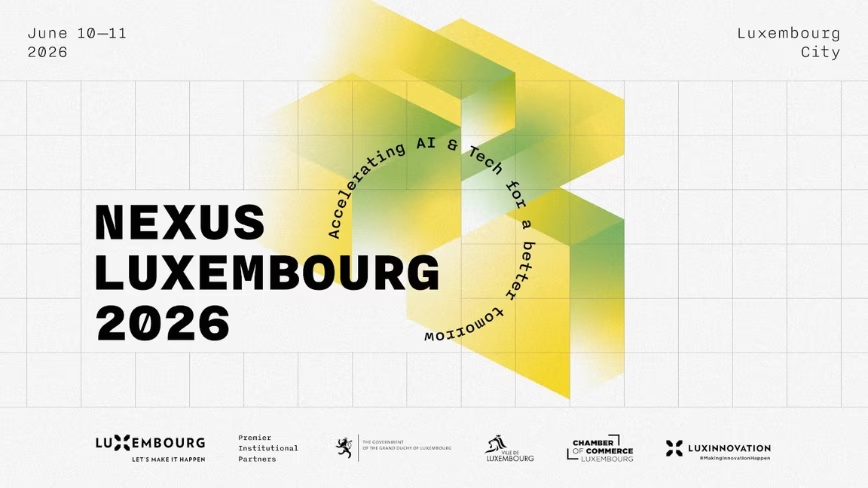
On 10 and 11 June 2026, Nexus Luxembourg returns to Luxexpo The Box for its third edition, a two-day summit that has, in a relatively short period, become one of the more closely watched AI and tech events on the European calendar. Organised by The Dots and Paperjam, this year's edition unfolds across 13,500 square metres, five conference stages, and a roster of more than 150 speakers, with over 10,000 attendees expected from more than 50 countries.

The 💜 of EU tech
The latest rumblings from the EU tech scene, a story from our wise ol' founder Boris, and some questionable AI art. It's free, every week, in your inbox. Sign up now!
The 2026 edition is structured as what Nexus Luxembourg calls a “4-in-1” experience, four curated tracks running in parallel rather than a single, sprawling agenda.
The Intelligence Forum is the conference's centre of gravity, focused on applied AI, autonomous systems, cybersecurity, sovereignty, and productivity tools across industries. The Fintech Sphere convenes financial-services players, founders, and regulators around the future of European finance, a natural fit for Luxembourg, where fintech remains a structural pillar of the economy.
The Launchpad Arena hosts the startup competition. The fourth track, Luxembourg Makes It Happen, runs at the centre of the venue and is where institutions, EU policymakers, national champions, and keynote speakers congregate.
That structure is not accidental. It reflects a calculation that has become familiar at the better European tech events: a sprawling unconference no longer earns the attention of senior decision-makers, who prefer a defined room with the right people in it. Nexus Luxembourg is positioning itself in that register.
The €100,000 prize, in detail
The Launchpad Arena's centrepiece is the Nexus Luxembourg Awards. This year, 250 startups and scaleups have been selected across 10 categories to compete live on stage for a €100,000 grand prize. The composition of the prize, €25,000 in cash plus €75,000 in premium business services, including workspace, consultancy, and media exposure, is a deliberate signal from Luxembourg's startup ecosystem: it wants to embed winners locally rather than write a one-off cheque.
The 10 categories give a useful map of where European tech investment is currently concentrated: cybersecurity, fintech and digital finance, govtech and digital society, green and climate tech, healthtech and biotech, Industry 4.0, smart mobility and autonomous driving, space tech, web3 and digital assets, and data & AI. Space, in particular, reflects Luxembourg's longstanding national positioning as one of Europe's serious space-economy hubs.
Luxembourg is small but substantial
We have written before about how Luxembourg punches above its weight in tech. The country's R&D grants, which can cover up to 80% of qualifying costs, its English-speaking workforce, and its proximity to Brussels are all part of the proposition.
Talkwalker, OCSiAI, and JobToday, three earlier-generation Luxembourg success stories, established that the ecosystem could produce internationally relevant companies. The harder challenge has been doing it at scale and with consistency.
Nexus Luxembourg is one of the lever-points in that effort. It is also a deliberate counterpart to the broader European push for technological self-determination, the wider movement as Europe's bid for digital sovereignty. Luxembourg's national strategy aligns directly with that movement: data, AI, and quantum infrastructure as a public-investment priority.
The summit's track is, in effect, a curated showcase of that strategy.
What attendees can expect
The thematic spread of the 150-plus speaker programme is broad: cybersecurity, data sovereignty, fintech and digital finance, govtech and digital society, green and climate tech, space tech, Industry 4.0, smart mobility, and healthtech all feature.
Final speaker names continue to be added in the run-up to the event, but the pattern is consistent with previous editions: a mix of European policymakers, founders running serious operating businesses, and a smaller number of international voices brought in to broaden the panel.
Logistically, Luxexpo The Box is well-suited to the format. Five stages, 13,500 square metres of exhibition space, and the city of Luxembourg's compact geography make it easier than at most large European events to get from session to session, and to meet the people the sessions are about.
Why this matters this year
Tech conferences are, in any normal year, a soft category to assess on their merits. Most do not move markets, do not set policy, and serve mainly as networking infrastructure. Nexus Luxembourg is not exempt from those caveats.
What distinguishes the 2026 edition is timing. The summit closes weeks before the EU AI Act's most consequential implementation deadline. Luxembourg's own startup ecosystem has crossed 800 active companies, with the AI-using subset doubling since 2020.
The MeluXina supercomputer is in its second generation. The Grand Duchy's national strategy explicitly positions the country as a sovereignty-credible alternative to dependency on US hyperscalers. All of this is happening in the months either side of June.
Whether Nexus Luxembourg succeeds in capturing that moment, in producing the kind of concrete connections, regulatory clarity, and capital introductions that justify the airfare, will be visible in the deal flow that follows it.
For now, the third edition reads as a more confident outing than the first, and a more substantial one than the European tech-event circuit has historically associated with a country its size. The Grand Duchy is, on this evidence, no longer asking to be considered. It is making the case in person.
The event runs from 10 to 11 June at Luxexpo The Box. Registration and the full speaker programme here.