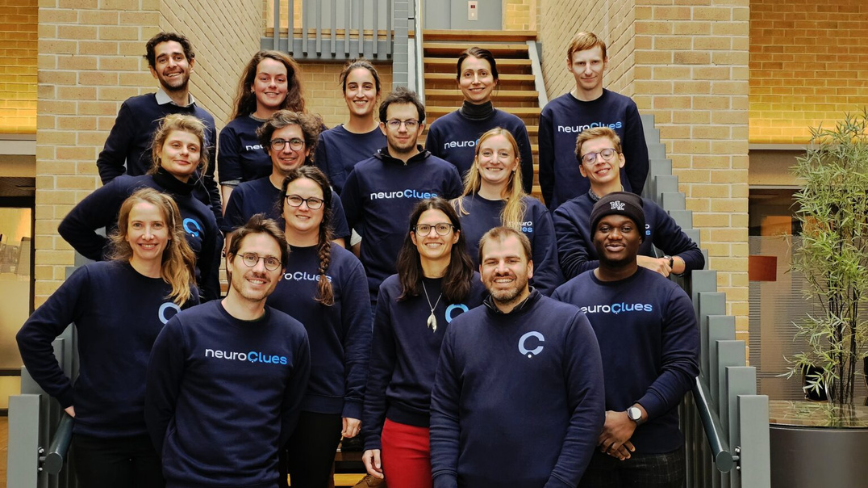
neuroClues, a French-Belgian medtech company developing an AI-powered eye-tracking device for the early diagnosis of neurological disorders, has closed a €10 million Series A.
The round follows the company's receipt of CE certification for its Class IIa medical device in January 2025, which cleared it for use in the European market, and brings its total funding raised since founding in 2020 to more than €22 million including grants.

The 💜 of EU tech
The latest rumblings from the EU tech scene, a story from our wise ol' founder Boris, and some questionable AI art. It's free, every week, in your inbox. Sign up now!
The neuroClues device is a portable, connected headset that captures up to 800 infrared images per eye per second as a patient visually tracks a moving target on screen.
Its AI models then extract oculomotor biomarkers within minutes, providing neurologists with objective, quantifiable measurements that can indicate the presence of neurological disorders including Parkinson's disease, Alzheimer's disease, and multiple sclerosis, in some cases years before clinical symptoms such as memory loss or tremors become apparent.
The device requires no calibration and is designed to fit into a standard clinical consultation.
The company was founded in 2020 as P3Lab by Antoine Pouppez, Pierre Daye, and Pierre Pouget, the latter two being neuroscience researchers with more than 35 combined years studying oculomotor function.
The research basis for using eye movements to detect neurological conditions has a long history: Pouppez has noted that the first scientific paper linking eye tracking to neurological diagnosis dates to 1905.
Despite decades of research demonstrating clinical relevance across thousands of patients, the technique has not entered widespread clinical practice, largely because the hardware was either too expensive or insufficiently precise.
neuroClues is building on that evidence base with a device designed for the 2.3 million physicians worldwide who currently assess brain health through the conventional ‘follow my finger' test.
The diagnostic gap the company is targeting is acute for Parkinson's. One in four Parkinson's patients is misdiagnosed, and patients wait an average of 13 months for a confirmed diagnosis. By that point, research indicates they have typically lost 50 to 70 per cent of their dopamine-producing neurons.
The number of people with Parkinson's is expected to double to 13 million by 2040. The neuroClues device has been integrated into the Iceberg cohort study at the Paris Brain Institute within La Salpêtrière Hospital, led by Professors Marie Vidailhet and Stéphane Lehéricy, which is investigating biomarkers for early Parkinson's detection.
Earlier presentations at the Society for Neuroscience conference described preliminary evidence of a test capable of identifying a preclinical Parkinson's marker five years before imaging-confirmed diagnosis.
Prior to the Series A, neuroClues had raised €4.7 million in a 2021 seed round, €2.5 million in grants from the European Commission's EIC Accelerator programme with up to €9 million in subsequent EIC equity committed, and €5 million in a pre-Series A round in April 2024 led by White Fund and the EIC Accelerator, with participation from Invest.BW and business angels including Fiona du Monceau and Olivier Legrain, CEO of IBA.
The new capital will be used to build out the commercial team, pursue FDA clearance in the United States in 2026, and expand into European markets. The company's headquarters and manufacturing facility are in Louvain-la-Neuve, Belgium, with an office at the iPEPS incubator within La Salpêtrière Hospital in Paris.