TL;DR
Drone strikes hit AWS data centres in the UAE. Oil surged 55%. Gulf AI investment decisions are pausing as the region's risk profile changes.
Two Amazon data centres in the UAE were hit by drones The Gulfs AI ambitions are being tested
Drone strikes hit AWS data centres in the UAE. Oil surged 55%. Gulf AI investment decisions are pausing as the region's risk profile changes.
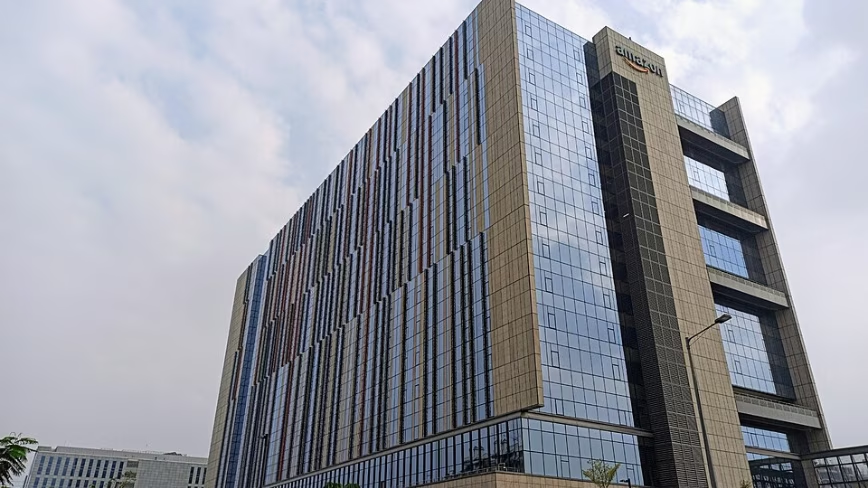
Two Amazon Web Services data centres in the UAE were targeted early in the Middle East war. Nearly three months later, oil prices remain around $100 a barrel and the Strait of Hormuz remains closed. The Gulf's ambition to become a global AI hub is facing its first real stress test.
Before the conflict began in February, the UAE, Saudi Arabia, and Qatar were racing to position themselves at the centre of the AI boom. Abundant, low-cost energy, strategic geography, and sovereign wealth backing made the region an attractive destination for hyperscalers building data centre networks. That proposition has changed.
Investment decisions into some data centre projects have been paused or are taking longer. Pure Data Center Group CEO Gary Wojtaszek told CNBC the company had temporarily paused investment decisions in the Middle East. Mark Richards, partner at law firm BCLP, said decisions “are taking longer because of the nature of the risks associated with effectively being in a region that has some serious threats.”
Risks that were not part of the original investment thesis are now being priced into the process. The Atlantic Council's Trisha Ray put it bluntly: “The ongoing conflict in the Middle East is putting AI infrastructure on the literal front lines in ways that even a year ago would have seemed out of the realm of possibility.”
The energy economics have shifted. Gulf markets previously offered industrial power at around $0.11 per kWh versus $0.25 to $0.40 in parts of Europe. The war destabilised global energy markets. The IEA has called the effective closure of the Strait of Hormuz the largest oil supply disruption in history.
Brent crude surged more than 55% from around $72 to nearly $120 at its peak over three months. UAE gas prices jumped 30% for consumers in April. Even in energy-rich states, cheap power is no longer guaranteed for large industrial users like data centres.
The drone strikes on AWS facilities marked an unprecedented escalation. Data centres are becoming as strategically important as oil pipelines. Ray said future facilities would need to be physically hardened, potentially built underground, or diversified by building outside the country entirely.
The threat is not theoretical. Iran's Islamic Revolutionary Guard Corps released satellite footage of OpenAI's Stargate campus in Abu Dhabi and designated it a potential military target. The Gulf's AI infrastructure is now part of the region's strategic calculus in ways it was never designed to be.
The major Gulf AI players say the war will not dent their ambitions. G42, the UAE AI champion backed by Mubadala, said its “conviction has only deepened.” Saudi Arabia's HUMAIN CEO Tareq Amin said the company is “building the full AI stack” and that the Kingdom's “scale is a strategic advantage.” KKR's Tara Davies said “this is a game that lasts decades.”
But the CSIS think tank's Aalok Mehta said the conflict has “shattered the illusion of long-term stability in the Gulf.” Future data centres will likely be more expensive and slower to build. Facility hardening, anti-drone technology, higher insurance rates, and supply chain disruptions will all add cost.
The energy problem for AI infrastructure is global, not just regional. OpenAI paused its Stargate UK project over industrial electricity costs that run at more than four times US rates. xAI is spending $2.8 billion on gas turbines because it cannot secure clean energy fast enough. The Gulf was supposed to be the answer to these problems: cheap power, sovereign backing, and fast permitting. The war has reintroduced a variable the investment models did not include.
Amazon pointed CNBC to CEO Matt Garman's comments about the company's “excitement about investing long term in that region.” Google and Microsoft declined to comment. Cisco and Oracle did not respond. The silence from hyperscalers contrasts with the public confidence of Gulf sovereign investors.
The global chip and memory shortage is already constraining AI infrastructure buildout. Adding geopolitical risk to an already supply-constrained market means the Gulf's data centre pipeline faces pressure from both sides: hardware that is hard to get and locations that are harder to insure. The region's AI ambitions are not dead. But they are more expensive, slower, and riskier than they were four months ago.