TL;DR
Nadella retired Microsoft's senior leadership team and replaced it with startup-style engineering groups. He reviews AI metrics weekly.
Nadella quietly dismantled Microsofts leadership structure The SLT that ran the company for decades is gone
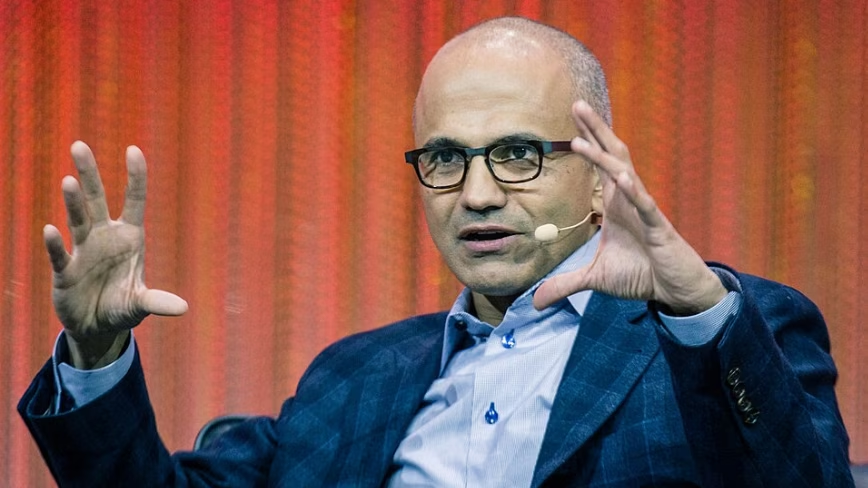
Nadella retired Microsoft's senior leadership team and replaced it with startup-style engineering groups. He reviews AI metrics weekly.
Satya Nadella has dismantled the senior leadership structure that ran Microsoft for decades. The company “quietly retired what's known as the SLT,” a person close to the CEO told Business Insider. The senior leadership team, the powerful executives who ran sprawling businesses and reported directly to Nadella, no longer exists.
In its place, Nadella has created three new structures. A corporate leadership group of five, Nadella, Brad Smith, Amy Hood, Amy Coleman, and Judson Althoff, meets weekly for governance. An engineering leadership group of roughly 35 product and engineering leaders works in close coordination rather than through large managerial chains. A Copilot leadership team of three, Charles Lamanna, Jacob Andreou, and Ryan Roslansky, meets with Nadella in a separate weekly standup.
Nadella also personally reviews AI metrics every week. He meets with the Azure cloud infrastructure team every two weeks. The structure resembles the startup-style operating model he has publicly praised. Engineers, researchers, and product builders work together directly. The managerial chains that characterised Microsoft's cloud era have been compressed.
“The pace of this platform shift is happening faster than anything we've seen,” one person close to the CEO said. “Microsoft can't afford to be slow.” The company's stock had its worst quarter since the 2008 financial crisis as investors pressure Nadella to demonstrate returns on hundreds of billions of dollars invested in AI.
Nadella has been studying startups because, as he recently put it, Microsoft's vast size has become “a massive disadvantage” in the AI era. The restructuring follows a year-long campaign in which Nadella asked leaders to commit to a more demanding culture or leave. Several high-profile departures followed.
The executive shifts are extensive. Rajesh Jha, one of Microsoft's most influential product leaders for years, retires on 1 July. Yusuf Mehdi, a 35-year veteran and consumer CMO, is leaving. Charlie Bell, widely considered an architect of AWS who joined Microsoft in 2021 to lead 10,000 security staff, is now listed as “engineer” with zero reports on an internal org chart.
Mustafa Suleyman, the DeepMind co-founder whom Nadella hired in 2024 to lead a new AI division, now has a narrower role overseeing roughly 650 employees. He remains close to Nadella and is focused on superintelligence. The AI division he was hired to build has been absorbed into the broader engineering structure.
Perhaps the most surprising move was in gaming. Asha Sharma replaced longtime Xbox leader Phil Spencer as CEO of Microsoft Gaming in February. Sharma joined Microsoft's Core AI group in 2024 from Instacart and Meta. She had limited gaming experience. Nadella had been mentoring her privately and viewed her as capable of modernising the business.
Rising stars include Arun Ulag, a Microsoft veteran promoted to EVP in April. Ulag reports to cloud boss Scott Guthrie but Nadella treats him as a direct report. Pavan Davuluri, a 25-year veteran who worked on the original Surface team, now leads Windows and devices. Hayete Gallot, who briefly left Microsoft for Google Cloud, returned to replace Bell as EVP of security.
Microsoft's Trusted Technology Group, which we reported on earlier this month, sits within this restructured landscape. Jenny Lay-Flurrie's responsible AI work reports into a flatter organisation where engineering leads rather than follows.
The restructuring mirrors a pattern across enterprise software. Salesforce lost 51% of its value as investors questioned whether legacy SaaS companies can compete in the AI era. Microsoft's answer is to tear out the management layers that made it slow and rebuild around small teams, weekly AI reviews, and engineers who report closer to the CEO.
Georgetown professor Jason Schloetzer said the velocity of change in technology requires “senior-level executives to get their finger on the pulse of what's going on at the very local levels.” Asked if any large company has figured out how to do this well, he said: “I cannot think of a company in the four dozen I talk to on a routine basis.”
Nadella is trying to turn a 220,000-person company into something that operates like a 35-person engineering team that happens to have 220,000 employees behind it. Whether that is possible is the question Microsoft's stock price will answer. The SLT is gone. The AI metrics are weekly. The old guard is retiring. The reboot is underway.