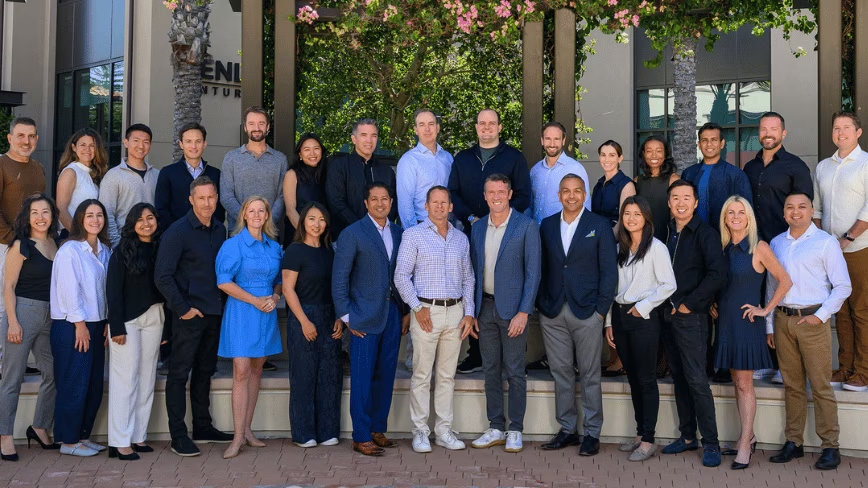
Menlo Ventures has raised $3bn, the biggest haul in its 50-year history. It is funded, in effect, by a single bet on Anthropic that is now worth about $14bn.
Most venture funds are sold on a promise. Menlo Ventures' new $3bn is sold on a receipt. The firm announced the raise on Tuesday, its largest in 50 years, and the case for it sits in one line item. Menlo's stake in Anthropic is now worth about $14bn, people familiar with the matter told Bloomberg.
Menlo first backed Anthropic in 2023, when the company had no product and no revenue. It has put roughly $1bn into the model maker since. Anthropic is now valued at more than $900bn. That is the kind of return that lets a firm raise whatever it wants.
The obvious story is the number. The more interesting one is what the raise says about venture capital itself. The AI boom is rewiring how these firms work, and Menlo is a clean example of the change.
Two funds, one strategy
The $3bn is split in two. Menlo Ventures XVII writes the early cheques, from seed to Series A. Menlo Inflection IV is a growth fund for Series B and beyond. Together, the firm says, they let it back a founder at the start and keep writing cheques as the company scales.
That second fund is the tell. Menlo has spent three years selling itself as an early-stage contrarian, the firm that backs companies before the market agrees. A growth vehicle drops it into the same rooms as the largest funds in the world, chasing the same late-stage deals.
The pitch is to be a “Goldilocks” firm, present at every round. The risk is that it becomes the very thing it used to undercut.
Menlo is not alone in stretching. AI startups now stay private far longer, with Anthropic and Databricks raising Series H and Series L rounds rather than going public. That locks the biggest gains into late-stage rounds, so early backers bolt on growth funds to keep capturing them. Even Benchmark, a famously early-stage firm, recently raised its first growth fund after three decades.
Menlo's move is part of a pattern, not a one-off.
The bet that paid for everything
The Anthropic position did not come cheap, or calmly. In 2024, Menlo led Anthropic's $750m Series D, the largest cheque it had ever written. The round quadrupled the startup's valuation to $18.4bn at the time.
The structure was unusual. Menlo put about $500m through a special-purpose vehicle, a one-off entity built to pool money for a single deal. It added $250m from its own fund and from firm insiders. Managing partner Shawn Carolan has called it a “bet-the-firm moment”. It worked, and it has since become a template.
AI special-purpose vehicles are now everywhere, so common that Anthropic recently warned that many unauthorised ones are simply scams.
Menlo did not stop at the cap table. In July 2024, it launched the $100m Anthology Fund with Anthropic to back startups building on the company's technology. That fund has since deployed about $250m across more than 60 companies.
Some have already exited, including Graphite, bought by Cursor, and Astrix Security, bought by Cisco. In practice, Anthology works as an early-warning system, showing Menlo where AI applications gain traction before the rest of the market notices.
The firm now writes its cheques with conviction.
Over the past year, Menlo has put $100m each into Lovable, the Swedish coding startup valued at $6.6bn, the music generator Suno, and the voice-dictation company Wispr. It has also set aside $50m for bets on brand-new research labs, including Flapping Airplanes, valued at $1.5bn at inception.
Matt Murphy, the managing partner who led the Anthropic deal, summed up the shift bluntly. “Now we're just fierce,” he said. “Let's get after it.”
Raising into a crowded room
The market Menlo is raising into looks nothing like 2023. Kleiner Perkins closed $3.5bn across two AI funds in March. Andreessen Horowitz raised more than $15bn in early 2026, a sum equal to over 18% of all US venture capital raised the year before. Sequoia gathered roughly $7bn for its expansion fund. At $3bn, Menlo is not trying to win on size.
It is trying to win on position. “Strong portfolios attract strong founders,” partner Venky Ganesan said. The argument is that proximity to category-defining companies is an edge that capital alone cannot buy. Every founder Menlo backs, the firm claims, makes the network a little smarter.
The team is the other half of the pitch. Menlo has hired engineers and operators with real technical depth, among them an early Glean engineer, Atlassian's former product chief, and the co-founder of a security firm Palo Alto Networks bought. Founders, the firm argues, want partners who can read the architecture, not just sign the cheque.
The history helps the story. Menlo cut a $20m cheque for Uber in 2011, when the company was valued at $322m. It backed Siri, Roku and Hotmail before each became obvious. The firm now manages more than $8.5bn, with over 170 exits behind it.
The question under the headline
Menlo is raising at a moment of open nerves about an AI bubble. Ganesan did not dodge it. “That's a natural part of any technology cycle,” he said. The firm's defence, he added, is discipline on fund size and concentration in the best companies it can find.
That is the real test buried under the $3bn headline. Menlo's last cycle was defined by one outlier that returned many times the firm. The next one asks a harder question.
Does Menlo need to find another Anthropic, or can it compound the stake it already owns? The answer will decide whether this raise looks visionary or like the top of the market, and nobody, including Menlo, knows which yet.