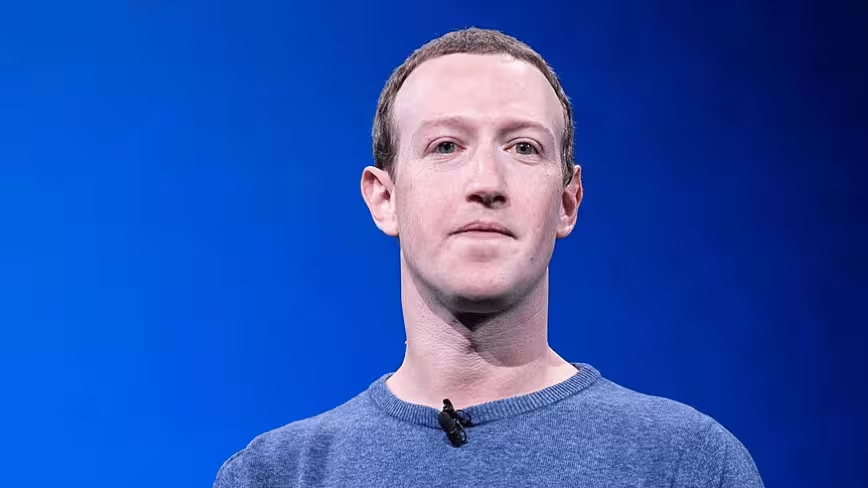
Mark Zuckerberg thinks almost everyone will soon have an AI that works for them. On Meta's second-quarter earnings call on 29 July, he predicted that within five years “billions of people” will each have “a personal agent that understands your goals,” handling their finances, health, relationships, and homes.
It was the boldest version yet of a pitch he has been sharpening for months. Mark Zuckerberg has cast personal AI agents as the next mass-market computing platform, and Meta's own apps, WhatsApp and Messenger, as the place most people will meet them.
The prediction is also a business plan. Meta already runs AI agents for companies on its messaging apps, reaching more than a million business users this quarter, and the consumer version is meant to become a revenue stream large enough to justify the money going in.
That money is the uncomfortable backdrop. Meta's free cash flow fell 91% in the quarter, to $784 million, and its Reality Labs division lost another $4.6 billion, bringing its cumulative losses since 2021 to roughly $88 billion.
The infrastructure bill keeps climbing on top of that. Meta and BlackRock announced a $14 billion data-centre partnership in El Paso this quarter, one more sign that the company is building for the agent future long before the revenue exists to pay for it.
Investors were not soothed by the vision. Meta's stock fell nearly 10% after the results, a sign that Wall Street is, for now, more moved by the collapsing cash flow than by the promise of an agent in every pocket.
He has a history of declaring the next platform early, from the metaverse to AI, and of spending vast sums to be first, with results that have ranged from dominant to disappointing.
His own agents have not all arrived on schedule. Zuckerberg conceded earlier this year that Meta's AI-agent progress was slower than he had hoped, which makes the confidence of a five-year, billions-of-users forecast a notable bet on a sharp acceleration.
He is, at least, using the products himself. Zuckerberg has talked about building a personal assistant to handle his own executive load, a hint of the everyday, do-things-for-you agent he expects the rest of the world to adopt.
The vision is coherent, whatever its odds. If agents become the way people manage money, health, and household admin, whoever owns the agent owns an extraordinary position, which is why Meta, OpenAI, and Google are all racing for the same ground.
He is not the only one. OpenAI, Google, and a wave of startups are making near-identical promises, which lends the idea momentum but also means that being right about agents is not the same as winning them.
The catch is the same for all of them. Building agents that reliably act on someone's behalf, with their money and their data, is far harder than building a chatbot that answers questions, and trust is not something a demo can manufacture.
For Meta specifically, there is a credibility gap to close. This is a company fighting lawsuits over how its existing products affect users, now asking those same users to hand an AI agent the keys to their finances and health.
Regulators may have views on that too. Giving an agent access to someone's bank account and medical history raises exactly the privacy questions Meta is already fighting, which could slow the very future Zuckerberg is describing.
Mark Zuckerberg's answer is to spend his way through the doubt. Meta's capital budget is heading toward $145 billion, a bet that if it builds the infrastructure and the models, the agents, and the billions of users, will follow.
The five-year clock is now running, at least rhetorically. Zuckerberg has named a number and a date; the market's tepid response suggests it would rather see the agents than hear about them, and the gap between the two is where the next few years will be decided.