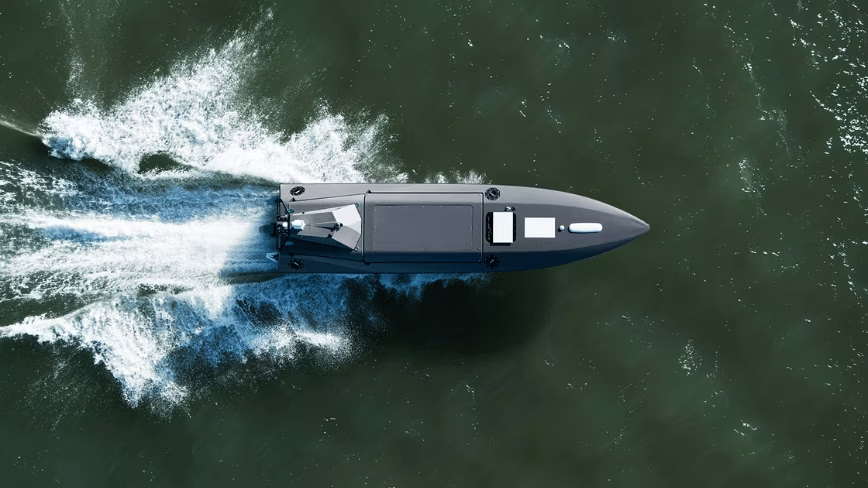
First the Royal Navy shoved a robot boat out of a transport plane at 1,300 feet. Then its maker became Europe's newest defence unicorn.
Kraken Technology Group, a British maker of uncrewed surface vessels, has raised $175m (€152.9m) in a Series B round. It values the company at more than $1bn. Kraken announced the raise this week, crossing into unicorn territory.
Digital Transformation Capital Partners (DTCP) led the round. The backers read like a map of Europe's rearmament. The British Business Bank, the NATO Innovation Fund and Germany's Rheinmetall all took part. So did Inocea Group and a clutch of European VCs. Earlier backers, among them the UK's National Security Strategic Investment Fund and Speedinvest, converted their stakes to equity.
Cheap, fast, and already at war
Kraken builds dual-use composite boats that run with no crew aboard. The line-up runs from the low-signature K3 SCOUT to the high-endurance K5 KRAKEN. A third boat, the K4 MANTA, skims the surface before submerging for covert work. The pitch is speed and modularity over size. Small hulls get re-rolled for surveillance, logistics, anti-submarine work or precision strike.
These are not prototypes. Over the past year Kraken won contracts from the UK Ministry of Defence, NATO's European partners and USSOCOM. It says its platforms are now deployed across several ongoing conflicts. Days before the raise, the Royal Navy airdropped a K3 SCOUT from an A400M at 1,300 feet. It was a world first, letting a sea drone deploy with no port or mothership nearby.
Built with partners, not shipyards
Kraken's model sets it apart from its biggest rival. Rather than run its own yards, it builds through established manufacturers. Those include Rheinmetall in Germany, Anduril in the United States and Inocea's Davie Shipbuilding in Canada. More partnerships in the Middle East and the Indo-Pacific are coming.
The contrast is with Saronic. The Austin startup raised $1.75bn in April at a $9.25bn valuation and runs its own shipyards. Kraken is betting that a lighter, partner-led approach can scale faster, and reach NATO buyers sooner, than pouring steel itself.
Europe's defence-money moment
The round lands in a gold rush. Venture funding for defence tech hit a record $49.1bn in 2025. Europe is scrambling to build sovereign capability as it rearms. Kraken joins a run of big European raises, from Stark Defence's €500M to BAE-backed funds built for the sector. Its boats sit alongside the autonomous systems already fighting in Ukraine.
“The maritime domain is profoundly under-invested,” said DTCP partner Ole Aguirre, arguing that Kraken had “swiftly responded to NATO requirements” with affordable, high-speed boats.
Why it matters
Kraken's founder, Mal Crease, spent 20 years chasing offshore powerboat records before turning to defence in 2020. His bet: the next edge at sea is not a bigger warship but a swarm of cheap, fast, uncrewed ones. Ukraine proved the point when its sea drones crippled Russia's Black Sea Fleet. With NATO wiring autonomy into its defences and $1bn behind him, Crease now has the money to build that swarm.