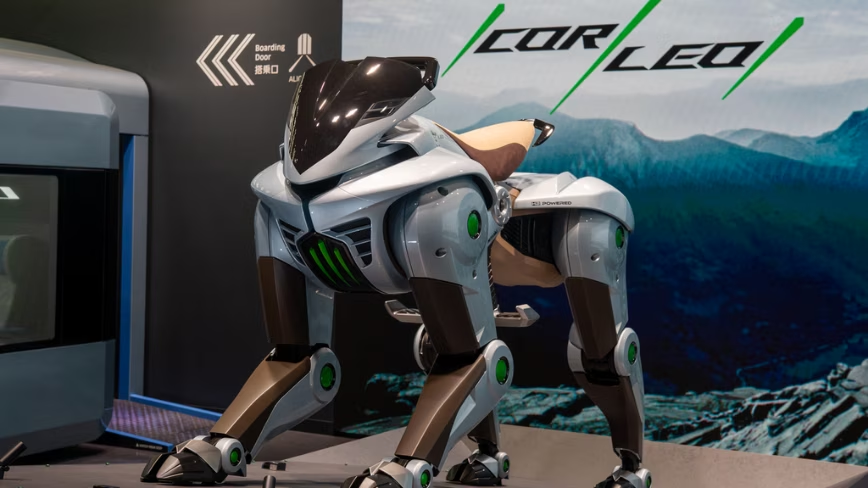
Shares jumped 12% as the Japanese industrial group opened a San Jose development base with Nvidia, Analog Devices, Microsoft, and Fujitsu, with its four-legged CORLEO mobility concept as the first showcase.
Kawasaki Heavy Industries said on Friday it will partner with Nvidia and a handful of other US and Japanese firms on physical AI for robots, opening a joint development base in San Jose, California.
Shares of the 130-year-old Japanese industrial group rose as much as 12 per cent on the news, their biggest move since 9 February. Other physical-AI exposed Japanese names followed, with Fanuc up 8 per cent and Yaskawa Electric gaining 5.9 per cent.
The San Jose base will bring together Kawasaki, Nvidia, Analog Devices, Microsoft, and Fujitsu, initially focused on healthcare, nursing-care, and mobility applications.
The first product to be put through the new pipeline is CORLEO, a four-legged personal-mobility robot Kawasaki has been developing for off-road use. It is roughly the size of a large motorcycle, runs on a 150cc hydrogen engine that powers leg-mounted drive units, and is meant to be straddled and ridden, with the rider steering through weight shifts.
Kawasaki has previously said it is aiming to use the vehicle at Expo 2030 in Riyadh and to bring it to market by 2035.
The partnership applies Nvidia's simulation tools to CORLEO's development, alongside medical robotics work meant to produce assistants for doctors and nurses. Nikkei reported the plan before the official confirmation, and Kawasaki confirmed the outline of it on Friday morning Tokyo time.
Morgan Stanley MUFG analysts including Takeshi Kitaura wrote in a pre-confirmation note that the collaboration “could lead to an acceleration in its AI robot development efforts” if the report turned out to be accurate.
The same note flagged that Kawasaki's investment plan for the fiscal year ending March 2027 will include a year-on-year increase of around ¥10 billion ($63 million), including robot-related spending, which “indicates a proactive stance on AI adoption.”
The wider context is that Japanese industrial robotics is being reorganised, in real time, around partnerships with the foundation-model layer.
Earlier this month Fanuc tied up with Google to integrate Gemini Enterprise and the Intrinsic robotics platform into its 1.1 million installed industrial robots, sending Fanuc shares to a record. Kawasaki's deal sits at the same intersection from the Nvidia side.
The two largest hyperscaler-adjacent AI stacks now both have anchor partners among Japan's industrial robot incumbents.
The CORLEO showcase suggests Kawasaki's tie-up is, at least at the start, oriented toward consumer-adjacent and care-economy form factors rather than the welding-cells-and-pick-and-place axis where Fanuc dominates.
Japan has the demographic problem the rest of the OECD is two decades behind on, and physical AI in elder care is a politically funded priority at home.
The investor read is straightforward enough. Robotics is the Asian stock theme of the year, and any credible tie-up with Nvidia, Google, or one of the other foundation-model providers is treated as an option on the next leg of the cycle.
Nvidia's humanoid stack is already being trialled in live logistics operations through Siemens in Germany, and Nvidia's own conversations with LG Electronics on robotics and AI data centres are public. The Kawasaki deal adds a heavy-industry Japanese partner to the same list.
Whether CORLEO ends up as a real product or a very expensive demonstration is the longer question. The robot exists today as a hydrogen-powered concept that drew about 1.2 billion social-media impressions when Kawasaki unveiled it at Expo 2025 in Osaka.
The Nvidia partnership gives it a route to a simulation-trained control stack that could plausibly get it closer to working hardware. The share move on Friday says investors are willing, for now, to price that route in.