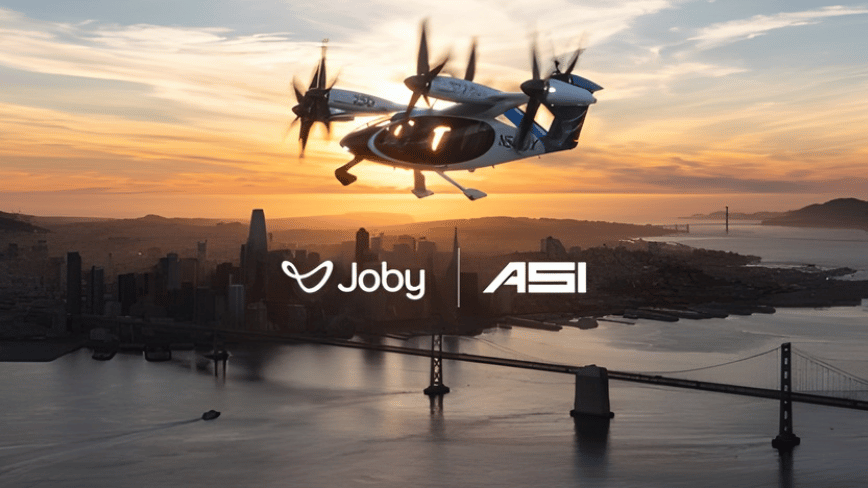
In short: Joby Aviation and Air Space Intelligence have announced a partnership to integrate AI-driven airspace management into U.S. electric air taxi operations, using ASI's Flyways AI platform to model high-density eVTOL traffic before commercial flights begin later this year.
The electric air taxi race has long centred on the aircraft itself: wing count, battery range, noise footprint. Now, with Joby Aviation weeks away from completing FAA type certification and the White House's eVTOL Integration Pilot Programme clearing the way for early commercial operations across 10 U.S. states, the harder question is finally being asked out loud. The skies may be ready for one or two electric air taxis. They are almost certainly not ready for hundreds of them, all manoeuvring simultaneously through the same congested corridors above Manhattan, Miami, and Dallas. Joby and Air Space Intelligence (ASI) announced on 7 April 2026 that they intend to fix that, before it becomes a problem.
The partnership tasks the two companies with accelerating the integration of advanced air mobility into the U.S. National Airspace System (NAS), using ASI's AI-powered Flyways platform as the core coordination layer. Joint demonstrations, including live operational exercises, are expected before the end of 2026, a timeline that aligns directly with Joby's own commercial launch ambitions.
A new operating system for the sky
ASI, founded in Boston in 2018 and backed by a $34 million Series B led by Andreessen Horowitz in December 2023, has spent years solving a version of this problem for conventional aviation. Its flagship PRESCIENCE platform provides a four-dimensional digital twin of the operating environment, ingesting live traffic data, weather feeds, and demand forecasts to simulate airspace conditions hours in advance. Flyways AI, ASI's commercial product layer built on PRESCIENCE, translates those simulations into decision-ready recommendations for air traffic controllers, allowing them to proactively reroute flows before congestion sets in rather than reacting after the fact.
Alaska Airlines and the U.S. Department of Defense are among ASI's confirmed customers. The company's existing work with legacy aviation gives it a dataset and a regulatory credibility that most newer entrants in the advanced air mobility space cannot easily replicate. Applying that platform to eVTOL is, in ASI's framing, a natural extension. “Scaling advanced air mobility requires more than new aircraft,” said Bernard Asare, President of Civil Aviation at Air Space Intelligence. “It requires a new operating system for the airspace. Our Flyways AI platform gives operators and controllers the predictive awareness to coordinate high-density operations proactively, not reactively. This partnership brings that same capability to eVTOL operations from day one.”

The 💜 of EU tech
The latest rumblings from the EU tech scene, a story from our wise ol' founder Boris, and some questionable AI art. It's free, every week, in your inbox. Sign up now!
What Joby brings to the table
Joby's contribution is operational experience and institutional relationships that no software company can substitute. The Santa Cruz-based manufacturer has conducted more than 1,000 test flights of its S4 aircraft, completed Stage 4 of the FAA's five-stage type certification process, and, in March 2026, was selected to participate in five projects under the White House-backed eVTOL Integration Pilot Programme, giving it the legal pathway to begin passenger operations in states including New York, Florida, Texas, North Carolina, and Utah before full certification is granted.
Joby has also built a commercial ecosystem that few of its rivals can match: a partnership with Delta Air Lines that includes vertiport infrastructure at JFK and LAX, a $250 million strategic investment from Toyota, a 25-site vertiport deal with Metropolis, and an active Dubai operation that represents the company's first revenue-generating international market. Its SuperPilot autonomy stack, developed with Nvidia's IGX Thor platform, is designed to progressively reduce cockpit dependency as regulatory confidence grows, part of a broader AI infrastructure build-out that mirrors a year of rapid enterprise AI expansion across sectors.
“America has long set the global standard for aviation, and modernising our airspace is key to maintaining that leadership,” said Greg Bowles, Chief Policy Officer at Joby Aviation. “By combining Joby's operational capabilities with ASI's advanced AI-driven Flyways platform, we're helping build the intelligent infrastructure needed to integrate electric air taxis seamlessly into the NAS.”
The BNATCS window
The timing is not accidental. The FAA's Brand New Air Traffic Control System (BNATCS) is now under active development, a $32.5 billion overhaul of the U.S.'s ageing telecommunications, radar, and automation infrastructure. Congress has committed $12.5 billion, with a further $20 billion still required. Peraton has been named as system integrator. The programme will introduce 5,170 new high-speed network connections across fibre, satellite, and wireless, and is expected to include automated decision-support tools specifically designed for the influx of new traffic categories, including drones and eVTOLs, that current systems were never built to handle.
The Joby-ASI partnership positions both companies to influence how those tools are designed. By running live operational exercises with Flyways AI ahead of the BNATCS rollout, the two companies will be able to generate real-world data on how AI-mediated coordination performs alongside human controllers. That data is precisely what the FAA needs to define the standards that will govern every eVTOL operator in the country. Joby and ASI are, in other words, not merely preparing their own operations; they are helping to write the rulebook. This kind of infrastructure investment at scale echoes broader AI infrastructure deals reshaping technology's physical footprint, with companies moving quickly to own the foundational layers before standards harden.
The governance gap eVTOL must cross
The challenge ASI is addressing sits at the intersection of aviation safety and AI governance, an area that regulators globally are still working to define. Autonomous or AI-assisted systems operating in safety-critical environments require a level of explainability and auditability that most machine learning architectures were not originally designed to provide. PRESCIENCE's 4D simulation approach, which generates human-interpretable lookahead scenarios rather than black-box outputs, is partly a product of this regulatory reality. Making AI legible to air traffic controllers is not a nice-to-have; it is a certification prerequisite. The broader question of governed AI in high-stakes environments is one the entire industry is grappling with, and the Joby-ASI model may offer a template.
What sets this partnership apart from earlier eVTOL airspace initiatives, which tended to focus on unmanned traffic management (UTM) for drones rather than manned commercial aircraft, is the integration of existing air traffic control workflows. Flyways AI is not a parallel system that operates alongside the NAS; it is designed to slot into the controller's existing interface, augmenting rather than replacing human judgement. That design philosophy may prove decisive as the FAA works to define what AI assistance in the cockpit and in the tower is, and is not, permitted to do.
What comes next
Both companies have indicated that live operational exercises will begin in 2026, though neither has specified which markets or corridors will be used for the initial demonstrations. Given Joby's eIPP designations, New York and Florida are the likeliest candidates. The exercises are expected to produce data that can be submitted to the FAA as part of the ongoing NAS integration process, contributing to the regulatory record that will define how all future eVTOL operators handle airspace coordination at scale.
The partnership carries no disclosed financial terms. It is framed as a technical and operational collaboration, with both companies sharing data and co-developing protocols rather than exchanging capital. Whether that structure changes as the relationship matures will depend in part on how quickly Joby's commercial operations scale, and how central Flyways AI becomes to running them. The question that defined much of last year's AI conversation, whether AI tools can move from demonstration to durable operational infrastructure, is about to be tested in one of the most demanding environments imaginable: the U.S. National Airspace System, at altitude, with passengers on board.
The aircraft are almost ready. The question now is whether the sky itself can keep up.