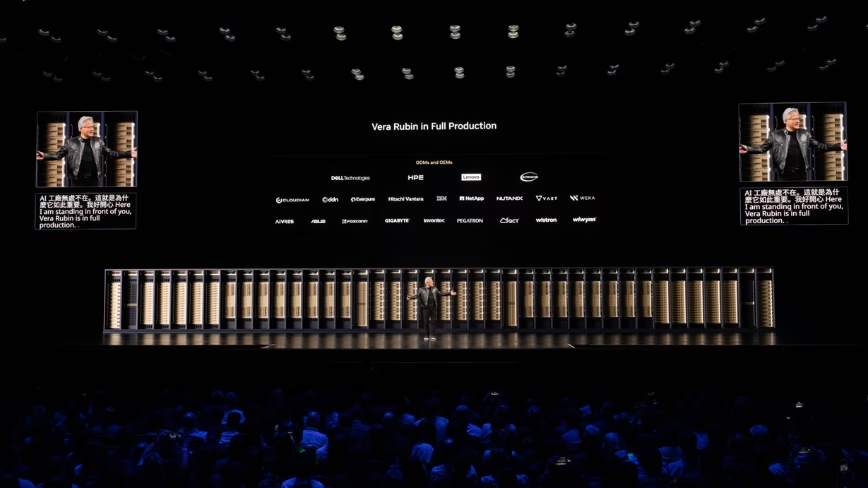
Nvidia's chief executive used the GTC Taipei keynote to declare its next platform shipping and to reveal RTX Spark, an Arm-based Windows machine.
Jensen Huang got the keynote slot, as he tends to. Nvidia's chief executive opened Computex 2026 in Taipei on Monday with the speech the rest of the week is built around, and he used it to make two claims: that the company's next-generation Vera Rubin platform is now in full production, and that Nvidia is moving into the one part of computing it has largely sat out, the Windows PC.The keynote, delivered at the Taipei Music Center at 11am local time, doubled as GTC Taipei, Nvidia's developer conference.
Huang said Vera Rubin, the pairing of the in-house Vera CPU with the Rubin GPU, has reached full production, and claimed Nvidia now has the lowest token cost in the world for AI inference, a function of designing the chips and the rack as one system.The newer move was RTX Spark, an all-in-one Arm-based Windows machine.
Nvidia said it combines a 20-core Grace CPU, developed with MediaTek, and a Blackwell GPU with 6,144 CUDA cores, up to 128GB of memory, and what the company puts at one petaflop of AI performance.Jensen Huang announced three Windows products built around it: RTX Spark laptops, RTX Spark desktops, and a DGX Station for Windows aimed at developers who work outside the Linux ecosystem.
That is the part that reaches past the data centre. Nvidia's business runs on the AI build-out, and almost everything it announces is aimed at the companies spending billions on it. An Arm-based Windows PC, by contrast, points at a market Intel, AMD, Apple and Qualcomm already fight over. Whether RTX Spark sells in any volume is a question the keynote could not answer, and the comparisons drawn on stage were Nvidia's own.
Huang returned to AI agents as the organising theme, describing them as workers in a workshop who can reason, plan, and execute. Today, he said, they are simple users of tools; the implication, as ever, was that they will need a great deal more Nvidia silicon to become anything more.
It is the same argument that underpins Vera, the CPU the company says it built specifically for those workloads, and which Huang separately named Anthropic, OpenAI, SpaceX and Oracle as among the first to receive.
The Vera Rubin claim is the one with the most riding on it. Huang has called the platform the largest product launch in Taiwan's history, with each system running to nearly two million parts and built through some 150 ecosystem partners on the island.
Full production is the milestone Nvidia needed to clear before the next wave of data-centre orders, and saying so from the Computex stage is as much a signal to suppliers and investors as to customers.
Computex runs through the week, and the rest of the announcements, from partners and rivals alike, will land against the frame Huang set on Monday. He has spent the year calling Taiwan the centre of the AI economy and Nvidia the company supplying it. Nothing in the keynote suggested he plans to stop.