Europe has the ambition to reach space on its own. What it lacks is rockets that work. Isar Aerospace has just raised €270mn to fix the first problem, and in less than a week it gets another chance to fix the second.
The Munich startup, one of Europe's best-funded space companies, closed a €270mn Series D with new investors Island Green Capital and Molten Ventures joining existing backers including HV Capital, Lakestar, UVC Partners, and KfW Capital.
The round takes Isar's total funding to roughly €870mn, a sign of how much investor money is flowing into space. The cash will scale production of its Spectrum rocket and expand its launch operations abroad.
The timing reflects a continent in a hurry. Europe carried out fewer than 10 orbital launches in 2025, against more than 190 in the US, and has leaned heavily on foreign providers, chiefly Elon Musk's SpaceX, which lists on the stock market this week.
As geopolitical tensions rise, governments increasingly want their own, sovereign access to space, and Isar is pitching itself squarely at European states, NATO members, and allies. Defence-related work now makes up around 60 per cent of its demand, the company says, up from mostly civil business a year ago.
The money funds three things at once.
Production comes first: a 40,000-square-metre factory in Parsdorf, near Munich, designed to turn out up to 40 Spectrum vehicles a year, with rockets three through seven already on the line.
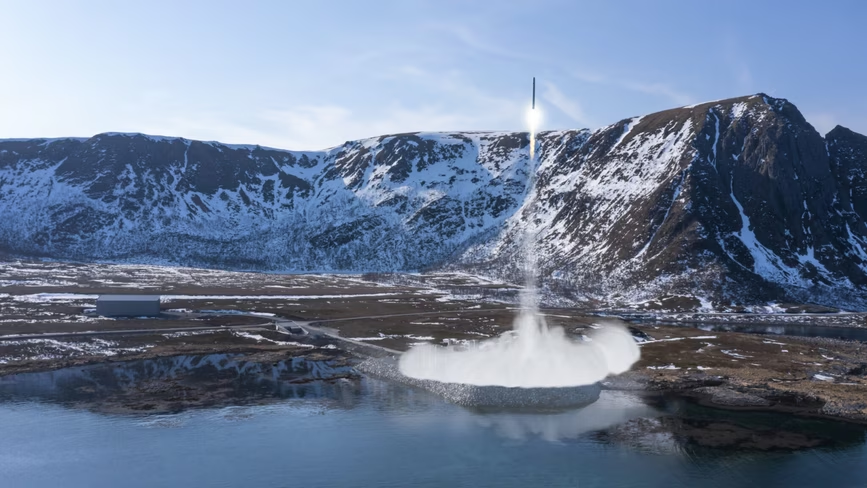
Second is infrastructure: alongside its launchpad at Andøya in northern Norway, Isar has signed up Spaceport Nova Scotia in Canada as a second site, partly through a tie-up with German naval shipbuilder TKMS aimed at a sovereign Canadian launch capability.
Third is the order book, which Isar says already stretches to 2028, with missions for the European Space Agency, Astroscale, and commercial customers.
All of it rests on one stubborn fact: Spectrum has not yet reached orbit. Its first flight, in March 2025, made history as the first orbital launch attempt from continental Europe, then lasted under 30 seconds before tumbling into the sea. Isar called it a successful test of its safety systems.
The qualification flight meant to actually deliver a working launch service has since been scrubbed three times, for a faulty valve, a stray boat, and a suspected leak. A fourth window opens on 15 June.
“Space is no longer a frontier; it is the infrastructure of national power,” said co-founder and chief executive Daniel Metzler. The line captures both the pitch and the pressure: Isar is being funded as though it has already made it, while still needing to prove it can.
It is not alone in trying. Spain's PLD Space and Germany's Rocket Factory Augsburg are chasing the same small-satellite market, and none of Europe's would-be launch providers has reached orbit yet.
Backers from the NATO Innovation Fund to KfW Capital are betting Isar gets there first, and the €270mn buys it the factory, the launchpads, and the manifest to scale quickly if it does. The harder part, as every rocket company learns, is the launch itself. On that, the next answer comes in days.