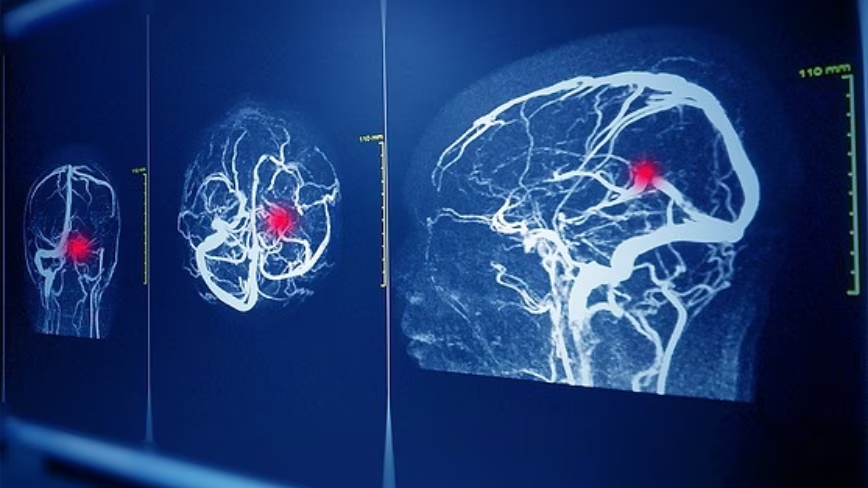
Neurovascular care remains one of the more complex and uncertain areas of modern medicine. Millions of people live with conditions such as intracranial aneurysms without symptoms, yet when an event occurs, the consequences are often catastrophic, carrying high mortality rates and a substantial risk of long-term neurological disability.
For neurospecialists, one of the most critical challenges is determining which cases can be safely monitored and which require intervention before a life-threatening event occurs.
That clinical uncertainty is the problem CARA Systems Inc. is attempting to address. The Brooklyn-based NYU spinout, led by Co-Founder and CEO Prithvinath Garigapuram, has developed a non-invasive clinical decision-support platform that integrates AI-driven medical imaging and patient-specific analytics into a unified workflow for neurovascular assessment. The company's broader objective is to improve how complex neurovascular cases are evaluated by consolidating fragmented clinical and imaging information into a more consistent, interpretable, and patient-specific decision-making framework.
The Anatomy of a Difficult Call
Neurovascular decision-making and risk assessment relies on imaging interpretation, and patient-specific physiology. Current risk stratification methods still rely heavily on clinical frameworks centered around factors such as size, anatomical location, and basic patient demographics, but offer limited insight into the individualized anatomical and hemodynamic characteristics that may influence disease progression in a specific patient.

The 💜 of EU tech
The latest rumblings from the EU tech scene, a story from our wise ol' founder Boris, and some questionable AI art. It's free, every week, in your inbox. Sign up now!
The result is interpretive variability. Two clinicians reviewing the same case can arrive at meaningfully different conclusions regarding severity, rupture risk, urgency, or the need for intervention. A 2024 study published in Scientific Reports, for example, found substantial inter- and intra-rater variability in aneurysm sizing measurements, with deviations exceeding thresholds commonly associated with rupture-risk categorization.
When uncertainty persists, clinical workflows often escalate toward invasive diagnostic procedures such as digital subtraction angiography, introducing added costs, and operational burden for both patients and healthcare systems. In many cases, the escalation reflects not simply the complexity of the disease itself, but the difficulty of consolidating fragmented clinical information into a clear and consistent assessment pathway.
Garigapuram mentions that this challenge extends beyond neurovascular medicine alone. Across specialties including oncology, cardiology, and acute care, clinicians are routinely required to synthesize imaging, laboratory findings, physiological measurements, and patient history under significant time pressure and within highly fragmented information environments. Much of the data needed to inform a decision already exists within the care workflow, but rarely in a form that is integrated, contextualized, and readily actionable at the point of care.
For Garigapuram, that structural fragmentation represents a broader opportunity for healthcare technology. “It's well known how difficult healthcare systems can be from an implementation and adoption standpoint,” he says. “But that's also what I see as a key opportunity: identifying where meaningful gaps exist within clinical workflows and building systems that can help clinicians navigate them more effectively.”
A New Place for the Synthesis to Happen
What Garigapuram describes is a shift in the clinical synthesis. For much of modern medicine, the integration of imaging, patient history, physiology, and risk factors largely depends on the clinicians interpreting fragmented information in real time, often under the constraints of busy clinical workflows and time-sensitive decision-making.
A newer generation of healthcare technology is beginning to move part of that synthesis upstream by organizing and contextualizing patient-specific signals before they reach the point of care. Rather than leaving critical information distributed across imaging studies, reports, and clinical records, these systems aim to surface relevant clinical insights in a form physicians can interpret and act upon more efficiently.
The shift is not about replacing clinical judgment, but about improving the quality and specificity of the information clinicians reason over. Instead of relying primarily on generic triage framework, physicians can evaluate a case through the additional lens of patient-specific anatomical, biomechanical, and clinical characterization derived directly from the individual patient.
One example of this approach in neurovascular care is AneuView™, a clinical decision-support platform developed by Brooklyn-based CARA Systems Inc., an NYU spinout. The platform combines AI-driven medical imaging analysis and patient-specific analytics within a unified workflow operating on routine non-invasive imaging already acquired during standard clinical care.
The output is a structured patient-specific risk characterization intended to support physicians decision-making during neurovascular triage and treatment planning.

Prithvinath Reddy Garigapuram , Co-founder CARA Systems Inc
Garigapuram, the company's Co-Founder and CEO, puts it this way: “There is already a significant amount of information within the clinical workflow. The opportunity is in consolidating that information into a system that can better support clinicians during the decision-making process.”
What Changes at the Point of Decision
The practical implications of this type of patient-specific approach begin at the earliest stages of triage. By providing individualized risk characterization at the point of initial imaging, clinicians are able to evaluate neurovascular cases with greater contextual information before committing patients to more invasive diagnostic or treatment pathways.
In some cases, patients who might otherwise progress toward invasive diagnostic procedures because of diagnostic uncertainty may instead be more confidently evaluated through non-invasive assessment and surveillance. In others, patient-specific anatomical and hemodynamic analysis may identify elevated-risk characteristics not fully captured by conventional population-based scoring systems, allowing higher-risk cases to be recognized earlier, when intervention strategies may be broader and clinical outcomes potentially more favorable.
The broader effect is a foundational shift in how clinical certainty is established. More of the triage process occurs upstream, before patients are committed to additional invasive procedures, unnecessary escalation, prolonged diagnostic uncertainty and delayed procedural risks.
The impact also extends into long-term surveillance. Many neurovascular findings require monitoring over time rather than immediate intervention, yet determining appropriate follow-up intervals often remains highly variable between clinicians and institutions. Patient-specific risk modeling introduces the possibility of tailoring surveillance strategies to the evolving characteristics of the individual case rather than relying solely on generalized follow-up protocols. This can help clinicians identify meaningful disease progression earlier while reducing unnecessary repeat imaging for lower-risk patients.
For healthcare systems, the implications are operational as well as clinical. Reductions in avoidable follow-up imaging, invasive diagnostics, and downstream escalation have the potential to improve resource utilization and lower per-patient costs across the neurovascular care pathway. While the long-term impact of these platforms will continue to be evaluated through broader clinical deployment and validation, the underlying premise is increasingly clear: earlier and more patient-specific triage decisions can meaningfully reshape both clinical workflows and healthcare economics.
The Broader Lesson for Clinical AI
For Garigapuram, the transition underway in neurovascular care is one early case of a broader shift occurring across medicine. In his view, the future of clinical AI is more about integrated systems capable of transforming routinely acquired clinical data into actionable insights that physicians can use within the pace and constraints of everyday care delivery. He believes the same underlying framework can extend beyond neurovascular medicine into other specialties involving high-stakes, multimodal, and time-sensitive decision-making, including cardiology, oncology imaging, and acute stroke care.
“Especially in the age of AI, I feel this is the best time and opportunity to be building in healthcare,” Garigapuram says, expressing his belief in a future of medicine with more personalized, precision-driven care. He also mentions that the primary challenge is no longer purely technical. The harder constraint is designing systems around the realities of clinical workflows from the outset, ensuring that new technologies integrate naturally into how physicians already practice rather than introducing additional operational complexity.
For Garigapuram, successful translational healthcare technology ultimately comes down to a simple principle: systems that interpret clinical data physicians already use, generate outputs clinicians can trust, and fit within the practical demands of day-to-day patient care. Platforms like AneuView™, developed by Prithvinath Garigapuram and CARA Systems Inc., represent one example of what that template may look like in practice, transforming patient-specific clinical signals into decision-support insights that can assist physicians at the point of care.