The battery industry has a translation problem. Researchers can identify promising new materials in the lab; the challenge is moving those discoveries through chemistry, engineering, and manufacturing without losing years and hundreds of millions of dollars in the process. The gap between discovery and production has long been one of the defining bottlenecks of the clean energy transition.
Holyvolt, a Swedish battery technology company founded in 2022, thinks it has a way to close it. On Thursday, the Volvo-backed startup announced the acquisition of Wildcat Discovery Technologies, a San Diego-based battery materials specialist, in a $73 million deal structured as a mix of cash, equity, and deferred milestone payments.
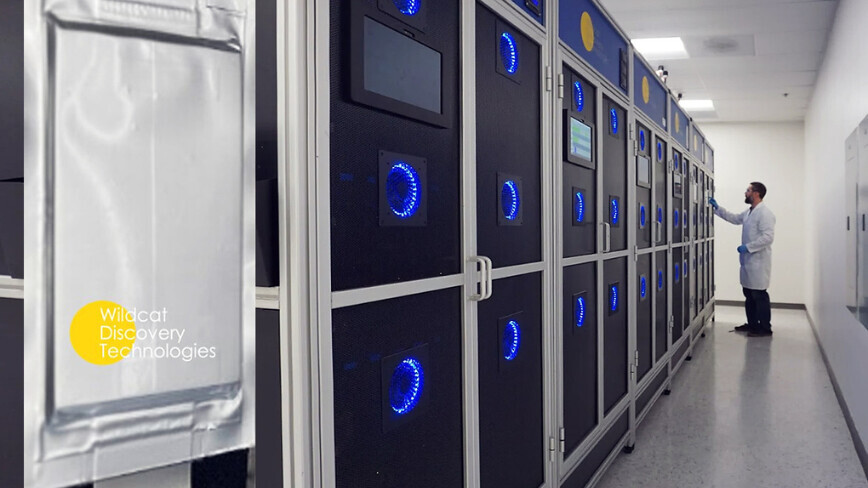
The transaction brings together two technologies that have been developed on parallel tracks for years: Holyvolt's screen-printing and water-based manufacturing process, and Wildcat's High Throughput Platform (HTP), which can synthesise and screen thousands of material combinations simultaneously.
Holyvolt CEO Mathias Ingvarsson told Impact Loop that the company had previously been a customer of Wildcat before pursuing the acquisition. “Wildcat is today the world leader, hands down the best in the world, in battery chemistry,” he said. “They have focused for 18 years on battery chemistry and become world leaders in anodes, cathodes, electrolytes, and essentially everything around a battery.”
Wildcat's HTP is, at its core, a materials discovery engine. It runs combinatorial experiments in parallel, a methodology originally developed for pharmaceutical drug discovery, and can identify optimal battery chemistries up to ten times faster than conventional research methods. Crucially, the platform generates terabyte-scale, structured materials datasets as it works: the kind of high-quality, labelled data that machine learning models need to be genuinely useful rather than merely decorative.
Holyvolt's contribution is on the manufacturing side. Its process replaces the organic solvents used in conventional battery electrode coating with water-based processing, and uses screen-printing techniques developed over more than 20 years of research. The approach is designed to be flexible, modular, and scalable, attributes that matter enormously when trying to move from pilot-scale production to commercial volume without rebuilding the factory.
Together, the companies describe a pipeline that runs from molecular discovery all the way to pilot-scale production. The combined entity will operate from offices in Stockholm, Munich, and San Diego, and will serve customers across the battery supply chain through both technology development partnerships and licensing arrangements.
The acquisition follows Holyvolt's €20 million funding round, which was in turn designed specifically to finance this deal. According to Ingvarsson, the company raised approximately €12 million at a €182 million valuation in February, building on an earlier round of around €5.5 million. Investors include Volvo, climate tech VC Course Corrected, and FAM, the investment arm of Sweden's Wallenberg family.
The intellectual heritage of Wildcat's platform goes back to Prof. Peter Schultz, the company's founder and a Professor of Chemistry at Scripps Research in San Diego. Schultz is one of the world's foremost pioneers of combinatorial chemistry, the technique of running vast numbers of parallel experiments to identify promising compounds, which transformed drug discovery in the 1990s and 2000s. He founded Symyx Technologies to apply the same approach to materials science, and later Wildcat to do the same for batteries.
“With Holyvolt, we can do for batteries what high throughput and AI have done for drug discovery,” Schultz said.
Schultz's credentials are substantial: he holds the Wolf Prize in Chemistry, is a member of the National Academy of Sciences, and has received numerous other prestigious scientific honours.
What is not in doubt is the significance of the combinatorial chemistry methodology Schultz pioneered. Whether applying it to battery materials at the scale and speed Holyvolt envisions is technically achievable, and whether the combined entity can turn a compelling technology stack into commercial contracts , is the question the next few years will settle.