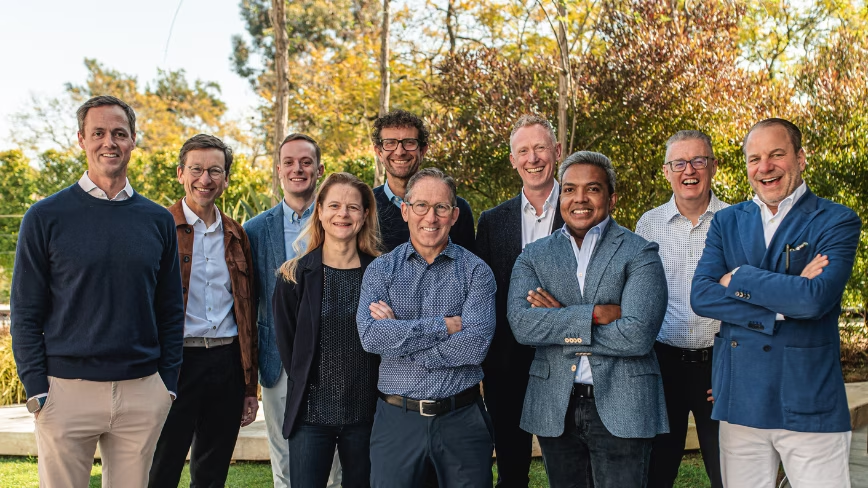
Highland Europe has closed a €1.1 billion fund, its sixth, giving the growth-stage investor fresh capital to keep backing European technology companies as they scale.
The firm announced Fund VI on 30 July, alongside the promotion of two investors to partner, and after a year in which it says it returned more than €1 billion to its own backers.
The timing leans on momentum. Highland's 2026 has been unusually rich in exits, the events that turn paper valuations into cash and let a firm raise its next fund with a straight face, and a €1.1 billion close is the reward for a portfolio that has started paying out.
The marquee exit was Nexthink. The Swiss software company was sold to Vista Equity Partners at around $3 billion, a return on a company Highland had backed since its Series B a decade ago.
It was not the only one. Highland points to the agreed sale of the nutrition brand Huel to Danone, a $7.5 billion merger of the fitness firms EGYM and Playlist, and the Nasdaq listing of the Italian app maker Bending Spoons at a market value above $18 billion.
The through-line is scale, which is the firm's whole remit. Highland does not chase seed-stage bets; it invests in companies that already work and need capital to grow, a stage where Europe has long struggled to keep up with the United States.
Since 2012, the numbers add up to a track record. Highland has raised €3.75 billion across six funds, backed more than 80 companies, and seen 30 through to an exit, the kind of history that reassures the pension funds and endowments that supply the money.
The current portfolio spans the consumer-and-enterprise divide. Fund V holds the smartphone maker Nothing, the credit-intelligence firm 9fin, the healthcare AI assistant Nabla, and n8n, an AI orchestration platform that has ridden the automation boom.
More recent cheques show where the firm is leaning. Highland led a $70 million round for the legal-AI platform Wordsmith, a $50 million round for the enterprise-AI firm Unframe, and a $105 million round for Ecorobotix, which builds precision-agriculture robots.
AI is the backdrop to all of it. Highland's partner Sam Brooks framed Fund VI as arriving at “a uniquely transformational moment, as AI reshapes every industry,” the now-standard investor line that also happens to describe where much of the money is going.
The firm used the announcement to promote from within. Helena Richardson, who joined in 2016 and has backed brands including Ffern, ME+EM, Modulr, and Huel, and Jacob Bernstein, who joined in 2017 and invests in enterprise companies such as Unframe and Zero Networks, were both made partner.
Highland made a point of the structure. Brooks described the firm, founded in 2012, as “an enduring, equal partnership,” and cast the two promotions as recognition of people who had spent a decade helping build it, a nod to continuity in an industry prone to churn.
The raise says something about the wider market too. European growth capital has been scarcer than founders would like, even as the continent has produced some of its largest rounds yet this year, and a €1.1 billion fund from an established name is a vote of confidence that Europe can still build companies worth backing at scale.
It also puts Highland among the larger European growth funds. It sits alongside peers such as Balderton and Creandum, which have raised big funds of their own, in a cohort betting that Europe's best scale-ups no longer have to cross the Atlantic for money.
What the fund does not change is the hard part. Deploying €1.1 billion into companies that actually become category leaders is far harder than raising it, and the exits that will justify Fund VI are years away from being known.
For now, Highland has the capital and the record to keep playing. A firm of 36 people across London and Geneva now has more than a billion euros to spend on the next set of European companies it believes can go global.