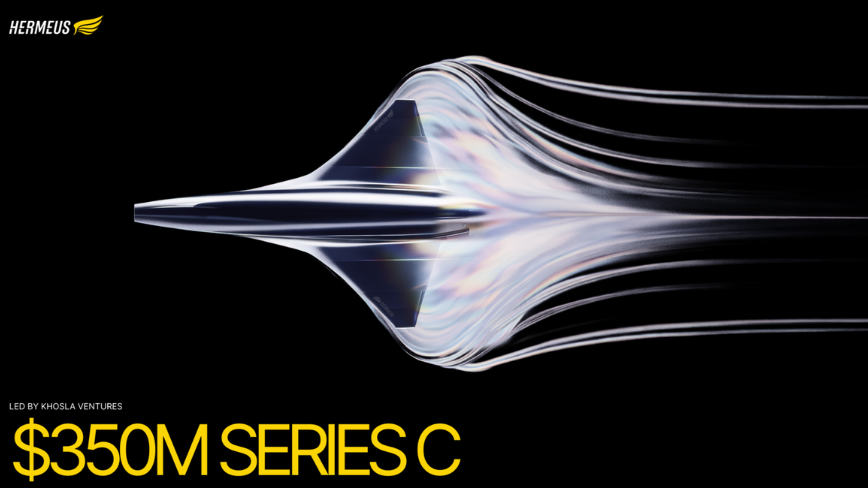
Hermeus, a Los Angeles-based defence aviation startup developing autonomous hypersonic aircraft, has raised $350 million in a round that values the company at $1 billion.
The raise comprises $200 million in equity, led by Khosla Ventures, with participation from existing investors Canaan Partners, Founders Fund, In-Q-Tel, and RTX Ventures.
New money is coming from the venture fund of media conglomerate Cox Enterprises and the publicly-traded closed-end investment company Destiny Tech100, among others. The remaining $150 million is debt, structured to limit dilution as the company scales its hardware manufacturing.
Hermeus was founded in 2018 and has been building what it describes as the fastest unmanned aircraft in development. Its approach is deliberately iterative: the company builds one aircraft per year, each designed to unlock a specific technical challenge on the path to Mach 5 hypersonic flight.
Last month it flew the second and largest demonstrator to date, a version approximately the size of an F-16 fighter, in what was the company's second first flight in under a year. A third aircraft is now in development.
CEO AJ Piplica told TechCrunch that hardware failure is not a risk to avoid but a milestone to plan around: ‘Yeah, we could crash an airplane, and I expect it'll happen at some point in our development program. We're set up to do that very safely.'
A pivotal decision a few years ago helped set up the current fundraising environment. Hermeus had been developing its own engine from scratch, partly out of necessity.
After RTX Ventures, the corporate venture arm of RTX Corporation, formerly Raytheon, invested, a different path became available: working with RTX subsidiary Pratt & Whitney to modify its F100 engine, the same propulsion system used by the F-15 and F-16, to power Hermeus's hypersonic aircraft.
The move gave the company a proven, functional engine baseline to test and iterate against, shortened the timeline, and opened government contracting opportunities that purely technology-risk bets do not.
President Zach Shore said the arrangement creates overlapping incentive structures that simultaneously advance the technology, satisfy near-term Department of Defense demand, and improve the economics of the business.
The round lands at a moment when defence tech is attracting capital at a pace not seen in years. PitchBook data cited by TechCrunch shows global venture investment in defence tech crossed $9 billion across 265 rounds last year, with corporate investors alone contributing $2 billion across 28 rounds.
The new capital will be used to continue expanding its manufacturing capabilities and headcount. Piplica points to SpaceX as the closest model for a company willing to build, test, fail, and repeat rapidly enough to actually change what is possible, and says the hardest constraint Hermeus faces is not capital or technology but talent, because there are virtually no people alive who have done this kind of work before.