TL;DR
Alphabet's Verily is seeking EPA approval to release 64 million Wolbachia-carrying male mosquitoes in Florida and California over two years to suppress Aedes aegypti populations. Earlier Debug trials achieved up to 95% reductions in biting mosquitoes in Fresno and 70%+ dengue reduction in Singapore.
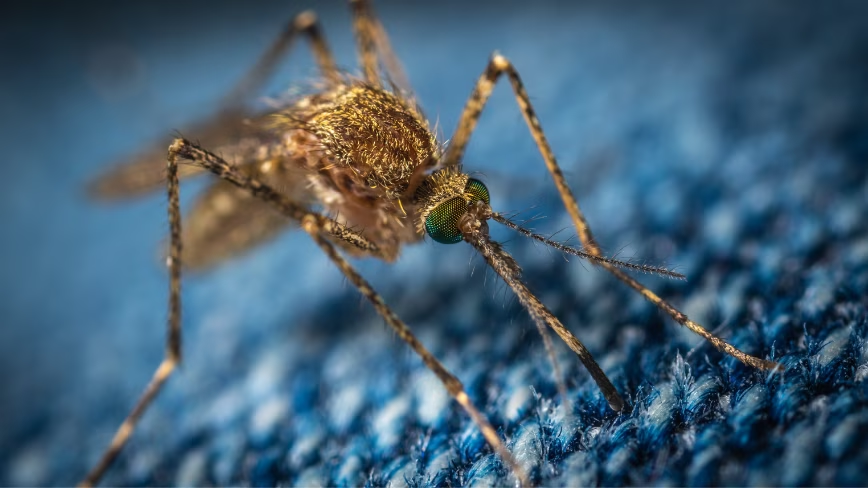
Verily, the health and life sciences subsidiary of Google parent Alphabet, has asked the US Environmental Protection Agency for permission to release up to 64 million lab-bred mosquitoes (up to 32 million per year) across Florida and California over two years. The proposal, submitted under the company's Debug initiative, would deploy male Aedes aegypti mosquitoes carrying Wolbachia bacteria into areas where the species transmits dengue fever, Zika virus, yellow fever, and chikungunya. The EPA is reviewing the application under an experimental use permit, with a public comment period running through early June.
The approach is elegant in its biology. Wolbachia is a naturally occurring bacterium found in roughly 60% of insect species, but not in Aedes aegypti. When lab-reared males carrying Wolbachia mate with wild females that lack it, the resulting eggs do not develop. The males do not bite, do not transmit disease, and cannot reproduce with each other, making the release self-limiting. Each generation of released males reduces the wild population without introducing permanent genetic changes or synthetic chemicals into the environment.
The results so far
Debug has been running field trials since 2017. In Fresno, California, the programme achieved reductions in biting female Aedes aegypti populations of 68% in its first year, over 95% in 2018, and 84% in 2019. The results put it among the most effective biotech-driven population control methods tested at scale in the United States.
In Singapore, where the government has deployed Wolbachia-based mosquito control as part of its national dengue strategy, releases of sterile males achieved 80% to 90% suppression of Aedes aegypti populations and a more than 70% reduction in dengue cases within six to 12 months. The World Mosquito Program, which operates independently of Verily, has deployed Wolbachia across 14 countries using a different approach that infects both male and female mosquitoes to establish self-sustaining Wolbachia populations in the wild.
How Verily scales it
The challenge with mosquito releases is not the biology but the logistics. Releasing millions of male mosquitoes requires breeding them at scale, sorting them from females with near-perfect accuracy (releasing females would increase biting), and distributing them across target areas at the right density and timing. Verily is applying its parent company's AI capabilities to each of these steps.
The Debug programme uses AI-powered mosquito sorting systems that can separate males from females using computer vision, automated breeding technology that maintains colony health at industrial scale, and specialised release platforms, including drones and ground-based dispensers, that distribute mosquitoes across target zones. The total programme scope is 64 million mosquitoes, broken down to 16 million per state per year over the two-year permit period. Some outlets have reported the figure as 32 million, which appears to refer to the annual release across both states rather than the full two-year total.
The debate
Not everyone is comfortable with the idea of a tech company releasing tens of millions of insects into the wild. The intersection of AI, biotech, and public health raises questions about corporate involvement in ecological interventions, long-term environmental effects, and community consent. Critics have raised concerns about whether reducing one mosquito species could affect the food chain, whether Wolbachia could transfer to non-target species, and whether corporate-led biological interventions should require stricter oversight than the current EPA permit process provides.
Proponents counter that Aedes aegypti is an invasive species in the Americas, not part of the native ecosystem, and that its removal would have minimal ecological impact. The species is responsible for hundreds of millions of dengue infections annually worldwide, with cases rising sharply as climate change expands the mosquito's range into previously temperate regions. AI-driven approaches to biological and medical challenges are producing results that traditional methods have struggled to match.
Why it matters for tech
Debug is one of the few surviving projects from Verily's original mission to apply technology to life sciences at scale. Alphabet has restructured its health ambitions multiple times, shutting down or spinning off various initiatives. While most of Big Tech's resources flow toward AI infrastructure, Verily's mosquito programme represents a different kind of applied technology: using automation, computer vision, and logistics software to solve a public health problem that kills hundreds of thousands of people each year.
If the EPA approves the permit, Florida and California would become the largest US deployment of Wolbachia-based mosquito control to date. The decision is expected after the public comment period closes, with releases potentially beginning in late 2026 or early 2027.