Venezuela has no national earthquake warning system. Yet moments before two huge quakes hit on Wednesday, millions of phones lit up. Google earthquake alerts reached 11.4 million people, the company says, buying some of them up to two minutes to act.
The warnings came from Google's Earthquake Alerts system, which turns ordinary Android phones into a vast seismic sensor network. The New York Times traced how the system worked during the disaster.
Jose Flores was driving his family to the cinema in Caracas when his wife's phone blared. Six seconds later, the ground began to shake. “It seems like it almost predicted the earthquake,” he said.
Phones as seismometers
The trick is the accelerometer inside almost every smartphone. The same chip that rotates your screen can feel the faint tremor of a seismic wave. Google taps more than two billion of them worldwide.
A quake sends out two kinds of wave. Fast primary waves arrive first and do little harm. Slower secondary waves follow, and they cause most of the shaking. The gap between them is the warning window.
Primary waves travel at about four miles a second. The secondary waves move at roughly half that speed. A digital alert can win the race, because it travels at almost the speed of light. That is how a phone can warn you before the worst shaking reaches you.
A still phone near the quake senses the early waves. It sends an anonymous signal and a rough location to Google's servers. The servers pool data from many phones, confirm a quake is real, then push alerts out faster than the destructive waves can travel.
How the Venezuela alerts unfolded
Within three seconds, phones picked up the first quake's primary waves, Google principal engineer Marc Stogaitis said. Six seconds later, the system sent its first warnings. The alert zone then grew as the quake grew.
The timing was brutal. A magnitude 7.2 quake struck first, then a 7.5 quake hit about 39 seconds later. The second was the strongest to hit Venezuela since 1900, and the two events killed hundreds. Google said its system read the overlapping waves as one large event.
Distance decides who benefits. People far from the epicentre gain the most warning. Those closest often feel the shaking before any notification arrives.
Three levels of warning
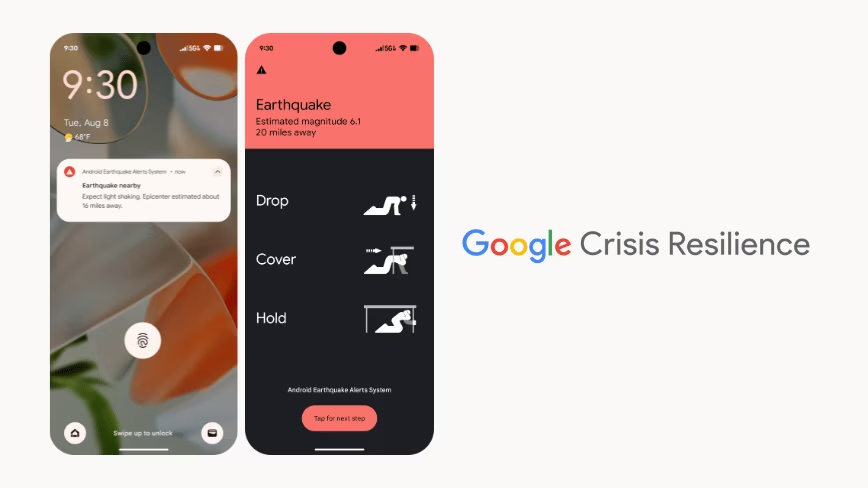
Google sends alerts for quakes of magnitude 4.5 and up. The mildest tells users to be aware. A louder one tells them to get ready. The most severe, called “Take Action,” blares a sound and urges people to drop and cover. Nearly 1.4 million of those top alerts went out in Venezuela.
A safety net for the global south
This is where the system matters most. Japan, Mexico, Canada and the United States run their own networks of buried sensors. Those alerts reach both iPhone and Android by default. Many poorer countries cannot afford such grids, and that is the gap Google fills with phones people already own.
The reach is huge. About 70% of the world's smartphones run Android, so the net stretches almost everywhere. Google began the alerts in 2021 in New Zealand, Greece and Turkey, and by 2023 it covered 98 countries. A 2025 paper in the journal Science laid out the method.
The system has limits. Phones must sit still to sense a quake, and the closest users may get no useful lead time. It cannot predict quakes, only catch them as they begin.
Why it matters
Early warning itself is not new. Doing it without dedicated hardware is. Google has built a planet-scale sensor grid out of consumer gadgets, at no cost to the people carrying them. It is a rare case of Google scale serving public safety rather than ads.
It is too soon to know whether the alerts saved lives in Venezuela. Even a few seconds, though, can be enough to act. Most agencies tell people to drop, cover and hold on before the shaking starts. For Flores, the lesson stuck. Next time, he said, he will know what the sound means.