TL;DR
AT&T's finance organization is building agentic AI workflows using LangGraph to automate manual journal entry preparation under SOX controls. The architecture separates repeatable preparation from human judgment through finance-owned playbooks, node-level audit evidence, and explicit approval boundaries.
Generative AI has already changed how companies draft, summarize and search for information. The next challenge is more complex: whether AI can coordinate work across business systems while preserving controls, auditability and human accountability.
That is the central test for agentic AI. Unlike a chatbot that returns an answer, an agentic system can interpret a goal, retrieve data, call tools, apply rules, validate results and prepare work for human review. In regulated functions such as finance, that capability creates both opportunity and risk. A useful system must do more than automate a task. It must show what data was used, what decision logic was applied, where exceptions occurred and who approved the final action.
Manual journal entries offer a practical example. In large finance organizations, these entries often require analysts to gather information from multiple systems, reconcile inputs, apply accounting logic, calculate values, prepare support documentation and route the package for approval. The process is repetitive, time-sensitive and control-heavy, especially because journal entries affect financial reporting and operate within SOX-controlled environments.
At AT&T, Monika Malik, a Lead Data and AI Engineer in the finance organization, has worked on an agentic approach to this problem through the company's Manual Journal Entry initiative. The design is not intended to let an AI model independently post entries. Instead, it separates repeatable preparation work from professional judgment and final approval.
The scale of the finance environment is significant: the tax and accounting workflows connected to this broader modernization effort are tied to hundreds of millions of dollars in accrued obligations and recurring business value.
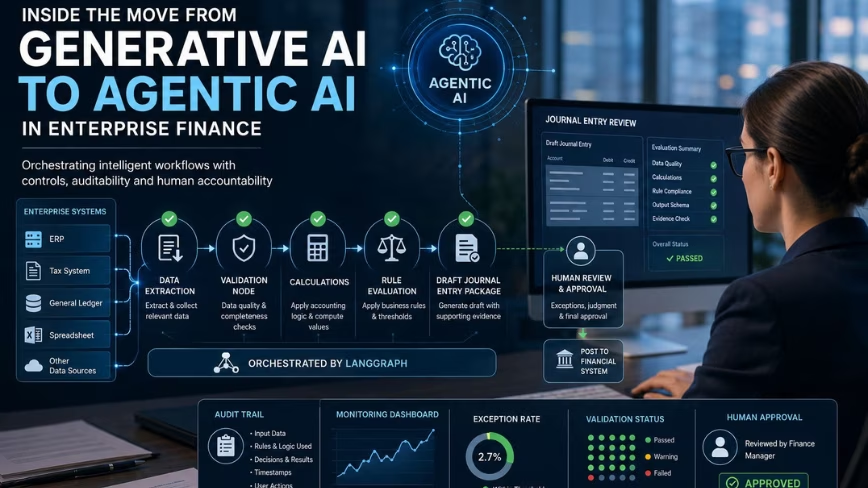
The workflow uses LangGraph as the orchestration framework. That choice matters because a graph-based architecture allows a finance process to be represented as a series of explicit nodes, branches and checkpoints rather than as a single opaque automation. In a SOX-controlled process, that structure is useful because each step can be audited individually. Conditional branches can also map to real finance approval paths: a clean entry can move forward, while entries with threshold breaks, missing evidence or rule exceptions can be routed for review.
In this model, a workflow node might handle data extraction, another might transform source data, another might calculate journal values, and another might generate a draft template. Each node produces a structured, timestamped output that records the input data used, the decision or rule applied and the validation result. This creates an evidence trail that can be reviewed later, rather than relying on a final output with little visibility into how it was produced.
Another important design choice is the use of finance-owned playbooks. Instead of hardcoding every rule into engineering logic, the business process is defined and maintained by finance subject-matter experts. These playbooks specify the steps to run, the tools to call, the thresholds to apply, the evidence required and what “good” looks like for a particular journal-entry type. Engineering owns the orchestration and execution layer; finance owns the business logic. That split keeps process accountability with the business while still allowing the workflow to scale across multiple entry types.
The system also uses node-level evaluations as control points. In practice, that means each stage of the workflow can be checked before the next one runs. Data-quality checks can confirm whether required fields are present. Calculation checks can recompute totals and validate sign conventions or balancing rules. Output-schema checks can verify that the journal-entry template is structurally complete. Rule-based checks can compare values against thresholds or prior-period expectations. LLM-based evaluation can be used to flag unsupported explanations, such as narratives that reference data not present in the workflow state.
Monitoring is another part of the architecture. A model-monitoring layer tracks whether the system continues to behave within defined boundaries over time. In a SOX context, that includes output drift, exception rates, repeated validation failures and changes in pass/fail patterns. The purpose is not only to catch model-quality issues, but to determine whether the workflow remains reliable enough for a controlled finance process.
The human-in-the-loop boundary is explicit. The system prepares a validated package, including the draft output, evaluation results, exception notes, retry history and supporting evidence. Human reviewers remain responsible for exceptions, professional judgment and final approval. The workflow can make preparation more consistent and schedulable, but it does not remove accountability from the finance function.
Malik's prior experience in regulated banking environments also informs this approach, particularly the emphasis on data quality, traceability and operational reliability.
The Manual Journal Entry example points to a more specific enterprise pattern: agentic AI becomes useful in finance only when orchestration, business-owned rules, node-level evidence, monitoring and approval boundaries are designed together. LangGraph provides the workflow structure, finance-owned playbooks preserve business control, node-level evaluations create audit evidence, monitoring tracks whether behavior remains within thresholds, and human reviewers retain responsibility for exceptions and final approval. In regulated finance, the value of agentic AI may depend less on autonomy itself than on how precisely that autonomy is constrained.