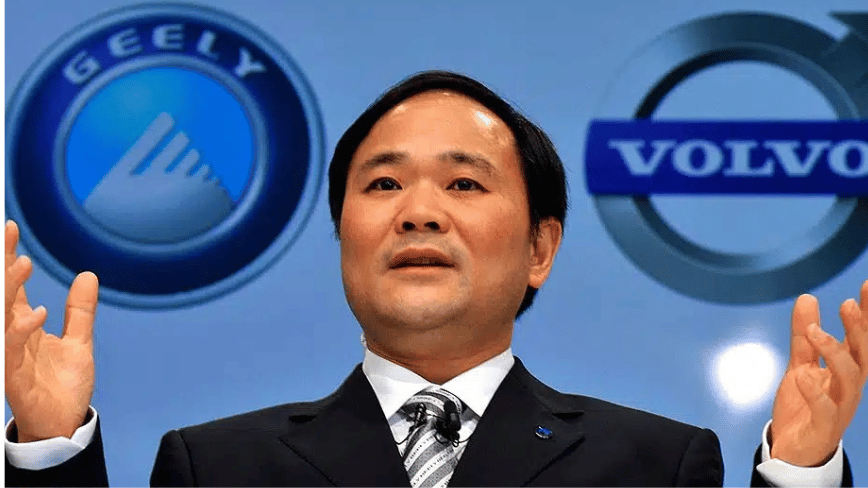
Li Shufu, the billionaire chairman of Geely Holding Group and the man who bought Volvo Cars from Ford for $1.8 billion in 2010, has arrived at a conclusion that many of his peers in the global automotive industry have been slower to reach: the world has too many car factories, and building more of them is a waste of money. In a statement reported by Bloomberg and the South China Morning Post, Li said Geely would no longer construct new production facilities anywhere in the world, and would instead lean on existing plants, particularly those belonging to Volvo Cars, to manufacture its vehicles in overseas markets.
The declaration amounts to a formal strategy shift for China's second-largest carmaker. Rather than purchasing land, erecting buildings, installing equipment, and hiring workforces in new markets, Li said the company would pursue partnerships, integration, and the revitalisation of existing capacity. The approach is pragmatic: global automotive production surplus is estimated at between 5 and 20 million vehicles per year, depending on whose numbers you trust, and China's domestic demand accounts for roughly half its output. The era of building your way to global scale, Li appears to be arguing, is over.
The most immediate consequence is that Volvo's factory network, plants in Sweden, Belgium, China, Malaysia, India, and the United States — becomes the primary vehicle for Geely's international ambitions. Li told Bloomberg that Volvo should begin producing its Chinese sister brands' models at its existing facilities, a move that would fill underutilised capacity while giving Geely access to manufacturing bases in Europe and America without the capital expenditure of greenfield construction. The Volvo plant in Ridgeville, South Carolina, already produces the electric EX90 and will add the XC60 later this year. The Belgian factory in Ghent began building the EX30 in April 2025 after the model was moved from China specifically to avoid EU tariffs on Chinese-made electric vehicles.
The tariff landscape has made this kind of flexibility not merely advantageous but essential. The Trump administration's tariffs on imported vehicles and auto parts have cost the global automotive industry more than $35 billion since their implementation in 2025, according to Automotive News. European automakers absorbed roughly $6 billion of that in 2025 alone. Volvo took a particularly severe hit: in April 2025, the company revealed an SEK 18 billion cost and cash action plan, approximately $1.9 billion — that included cutting 3,000 positions globally, roughly 15 per cent of its office-based workforce. The restructuring was completed by autumn 2025, with financial benefits beginning to materialise from the fourth quarter into 2026.
Volvo's response to the tariff pressure has been to regionalise production with unusual speed. The company restructured its global operations to give its three key business regions, the US, China, and Europe, greater decision-making power. Polestar, the electric performance brand also owned by Geely, consolidated global manufacturing of the Polestar 3 at Volvo's South Carolina factory, abandoning plans to build the vehicle at a plant in Chengdu, China. A new Volvo factory in Slovakia will produce the Polestar 7 for the European market. The strategy is straightforward: build where you sell, using whatever plants already exist in the right geography.
Li's no-new-factories pledge extends the logic further. Rather than limiting the strategy to Volvo, he is applying it across Geely's entire portfolio of brands, which includes Lynk & Co, Proton, and the commercial-vehicle division, and extending it to partnerships with companies outside the group. Geely is already in preliminary discussions with Ford about using the American manufacturer's excess production capacity in Europe to build Geely vehicles, according to Reuters. Talks between delegations from both companies took place in Michigan and China in early February 2026. Separately, Geely has partnered with Renault in South Korea and Brazil to produce and sell vehicles built on Geely platforms through the French company's factories and sales networks.
The approach inverts the playbook that Chinese automakers were expected to follow. For years, analysts predicted that companies like BYD, Geely, and SAIC would replicate the model pioneered by Japanese and Korean manufacturers in the 1980s and 1990s: export first, then build local factories to secure market access and political goodwill. Some are still pursuing that path, BYD is constructing plants in Hungary, Turkey, Thailand, and Brazil. But Li is betting that the economics have changed. With global overcapacity severe and tariff regimes shifting unpredictably, tying up capital in fixed assets that take years to build and decades to amortise looks riskier than it once did.
Geely's ambitions remain expansive. The group is targeting 6.5 million vehicle sales and 1 trillion yuan in revenue by 2030. Li Shufu personally invested $200 million in Polestar in June 2025, and Geely is preparing to announce its entry into the US market within two to three years, using, presumably, factories it already owns through Volvo rather than anything it plans to build. The company is also set to complete production of its first in-house solid-state battery this year, a technology that could give its vehicles a significant edge in range and charging speed if it can be manufactured at scale.
The question is whether Volvo's existing partners and shareholders will welcome having their factories repurposed for Chinese-branded vehicles. Volvo Cars is publicly listed in Stockholm, and while Geely holds a controlling stake, minority investors may have views about the margin profile of contract-manufacturing Lynk & Co SUVs alongside premium Volvo models. There is also the political dimension: European and American regulators have spent the past two years trying to keep Chinese-made vehicles out of their markets. Letting Chinese-designed vehicles in through the side door of a Swedish-owned factory may prove more diplomatically complex than the industrial logic suggests.
Li Shufu, for his part, appears unbothered. The man who began his career making refrigerator parts in Zhejiang province before building China's first privately owned car company has never been one to follow the expected playbook. His latest move — borrowing the world's factories instead of building his own — is either the most capital-efficient strategy in the modern automotive industry or an admission that the age of Chinese manufacturing expansion has reached its natural limit. It may, of course, be both.