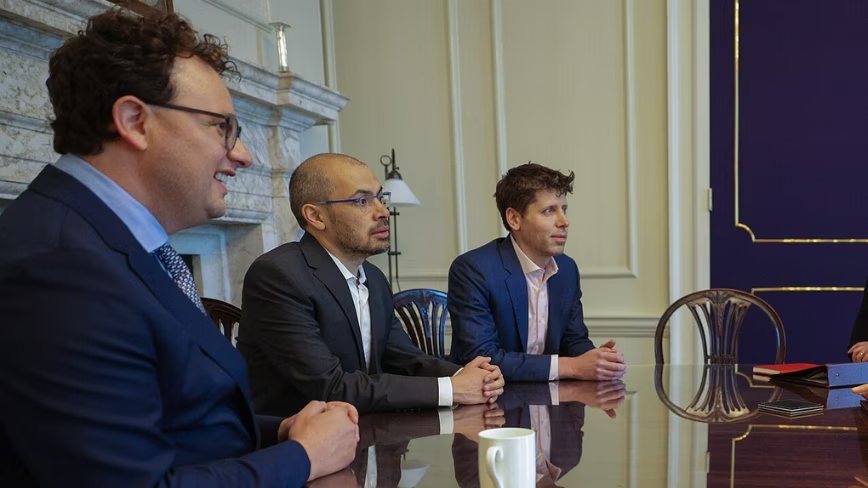
The chief executives of the three most powerful artificial intelligence companies on Earth are about to sit in the same room as the leaders of the world's seven largest advanced economies. OpenAI's Sam Altman, Anthropic's Dario Amodei, and Google DeepMind's Demis Hassabis are all slated to attend the G7 summit in Évian-les-Bains, France, which runs from 15 to 17 June, according to Bloomberg.
Their names appeared on a guest list released by the French presidential office. All three companies confirmed attendance, though none offered specifics on what they plan to discuss.
What the summit is about
An OpenAI spokesperson said the company expects to discuss the opportunities and threats posed by advanced AI, but declined to go further. Anthropic and Google similarly confirmed their executives would attend without elaborating on their agendas.
France, which holds the rotating G7 presidency this year, has placed AI prominently on the summit's agenda. CNBC reported that President Emmanuel Macron personally invited Altman, with OpenAI's chief global affairs officer Chris Lehane saying the CEO would be “engaging in the leaders-level conversation.”
The invitation builds on the G7's growing interest in AI governance. The bloc launched the Hiroshima AI Process in 2023 under Japan's presidency, producing international guiding principles and a code of conduct for organisations developing advanced AI systems.

The 💜 of EU tech
The latest rumblings from the EU tech scene, a story from our wise ol' founder Boris, and some questionable AI art. It's free, every week, in your inbox. Sign up now!
Canada's 2025 presidency deepened those commitments with pledges on AI adoption in public services and youth safety. France's presidency now inherits the mandate to push further.
Rivals in the same room
The gathering marks a rare moment when the leaders of fiercely competing AI labs appear side by side before world leaders. The three men normally occupy opposite corners of a market where every benchmark, every enterprise contract, and every model release is a zero-sum contest.
The last time they shared a stage did not go smoothly. At India's AI Impact Summit in February, Prime Minister Narendra Modi lifted Altman's and Sundar Pichai's hands before an applauding crowd, but Altman and Amodei, standing side by side, raised their fists instead of holding hands.
The moment went viral. Altman later said he was “confused” and “just wasn't sure what we were supposed to be doing,” while Anthropic declined to comment.
The IPO backdrop
The summit arrives at a pivotal financial moment for two of the three attendees. Both Anthropic and OpenAI have confidentially filed S-1 registration statements with the SEC in recent weeks, setting up what could be two of the largest technology IPOs in history.
Anthropic submitted its paperwork on 1 June, a week after closing a $65 billion funding round that reportedly valued the company at $965 billion. OpenAI followed on 8 June, with Goldman Sachs and Morgan Stanley as lead underwriters and a valuation that could reportedly exceed $1 trillion at listing.
The timing means both companies will face G7 leaders while simultaneously courting public-market investors. Appearing at a summit focused on responsible AI governance offers obvious reputational value for two labs that have spent the past fortnight publishing safety research and warning about risks while filing to go public.
Broader pressure
Beyond the IPO race, all three executives are navigating public anxiety over the pace of AI development. Job displacement, autonomous weapons, and deepfakes have become mainstream policy concerns, and the G7 offers a stage to show that the industry is engaging with governments rather than outrunning them.
The flags
None of the three companies disclosed what their executives plan to discuss, and the summit may produce voluntary pledges rather than binding commitments. The reported valuations for Anthropic ($965 billion) and OpenAI (above $1 trillion) come from press reports, not audited filings.
The G7's Hiroshima AI Process has so far produced principles and codes of conduct but no enforceable regulation. Whether Évian-les-Bains changes that will depend on what happens behind closed doors next week.