TL;DR
The Freedom Ship, a mile-long nuclear-powered vessel for 80,000 people, has been revived under new leadership with fresh renderings and a £12 billion price tag. The concept has been “about to break ground” since the 1990s, with no confirmed funding.
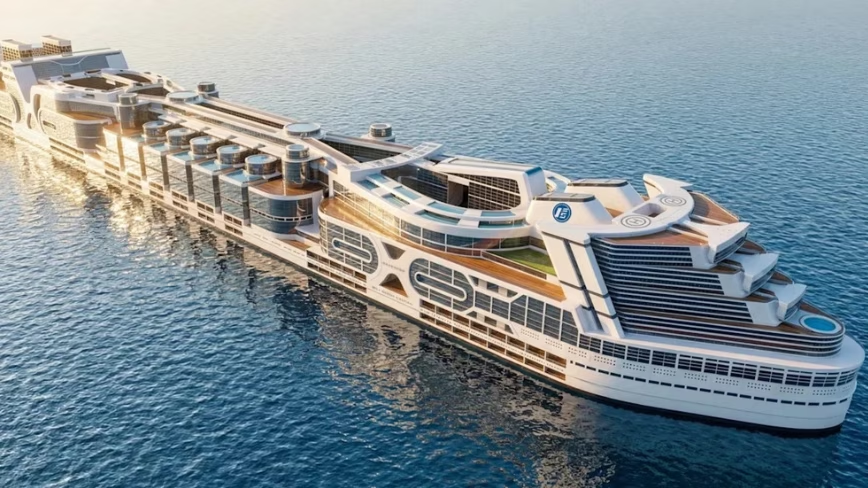
The renderings are gorgeous. A mile-long vessel, 800 feet wide, 30 decks high, gliding across the open ocean with parks, schools, a 15,000-seat sports stadium, and enough residential space for 50,000 permanent inhabitants. Nuclear-powered, perpetually circumnavigating the globe, never docking in port. A floating city, in the most literal sense.
The Freedom Ship has been proposed, revised, shelved, revived, and re-rendered so many times since the 1990s that Newsweek recently noted the headline announcing its imminent construction has now run, in nearly identical form, across three different decades. It is back again, this time under Freedom Cruise Line CEO Roger Gooch, who has assembled a 12-person leadership team and commissioned new designs from arcologist Kevin Schopfer.
“We feel very confident that we can put this together, but the capitalisation is key,” Gooch told the Telegraph.
What the ship would be
The 2.3 million gross-ton vessel would carry homes for 50,000 residents, space for 10,000 tourists and day visitors, and a crew of 20,000. Among the proposed amenities are high-rise hotels, a convention centre, a water park, two museums, a symphony hall, a casino, a dive-able aquarium, and nightclubs. Children would be educated from primary through secondary levels, with references to postsecondary options as well.
Too large to dock in any existing port, the Freedom Ship would remain in international waters, transferring passengers by ferry or helicopter from eight helipads. Residents would move between districts via a tram system connecting 15 miles of walkways and three acres of parkland. The plan calls for a circumnavigation every two to two-and-a-half years at a stately seven knots.
Construction would take place in Indonesia, beginning with the hull built in sections and assembled offshore. Gooch has suggested residents could start moving aboard midway through a three-to-four-year build, with all future maintenance carried out at sea.
The money question
The estimated cost is £12 billion ($16.16 billion). No confirmed funding is in place. The original concept was proposed in the 1990s by American engineer Norman Nixon, who died in 2012 without breaking ground. The blueprints resurfaced publicly in 2013, only to be shelved again.
Gooch insists demand is strong, claiming “we could almost justify building three ships.” Revenue would come from residential sales, commercial leasing, and tourism. “We want entrepreneurs to lease or buy space from us, just like they would in a land-based community,” he says. The holding company would retain ownership of the casino and a “state-of-the-art” research hospital, which Gooch says has attracted interest from medical research facilities because the ship would operate outside the reach of national regulatory bodies.
That last detail, a floating hospital explicitly positioned beyond regulatory oversight, is worth pausing on.
Why floating cities never get built
The Freedom Ship belongs to a category of megaprojects that are simultaneously too ambitious to dismiss and too ambitious to fund. Saudi Arabia's NEOM Line, a 170km mirrored city in the desert, shares the same DNA: extraordinary renderings, staggering price tags, and a gap between vision and execution that no amount of enthusiasm has yet closed.
The engineering challenges alone are formidable. A vessel this size has never been constructed. Nuclear propulsion for civilian maritime use remains largely theoretical outside military applications, and the regulatory framework for a nuclear-powered residential ship carrying tens of thousands of civilians does not exist. Governance, taxation, law enforcement, and liability in international waters raise questions no rendering can answer.
The only residential ships currently afloat are far more modest: The World, a millionaires' vessel with fewer than 200 residences, and the Villa Vie Odyssey, a budget alternative that has had its own well-documented struggles to stay operational.
The perennial dream
Sridev Mookerjea, the project's Singapore-based project manager, brings 30 years of experience in passenger and casino ship management. “Perseverance and determination help people to achieve something in this world,” he told the Telegraph over green tea at London's St Katharine Docks. “I believe that with Roger's efforts, patience and desire to make this a success, the sky's the limit.”
Perhaps. But the Freedom Ship has been roughly a year from breaking ground for longer than some of today's billion-dollar companies have existed. At some point, somebody has to write a very large cheque. Three decades in, nobody has.