Fleek, a London startup building the software plumbing behind the global secondhand clothing trade, has raised $25m in Series B funding to scale the AI it uses to sort, grade and price used garments. The round takes the company's total funding to $45m.
It was led by Burda Principal Investments, an early backer of Vinted and a lead investor in that company's Series C. eBay, FJ Labs and H14 also took part, alongside existing investors including Andreessen Horowitz, HV Capital and Y Combinator.
The problem Fleek is chasing is bigger than most shoppers realise. Every year, up to 24 billion secondhand items travel from donation bins in cities such as London, Paris and New York to sorting and grading centres scattered across the world.
Yet the infrastructure moving all of it remains stubbornly analogue. Despite sitting inside a $200bn-plus industry, garments are still assessed by hand, graded against inconsistent standards and traded through disconnected networks with little pricing transparency.

The 💜 of EU tech
The latest rumblings from the EU tech scene, a story from our wise ol' founder Boris, and some questionable AI art. It's free, every week, in your inbox. Sign up now!
That matters because demand is running ahead of the plumbing. Secondhand fashion is growing about three times faster than traditional apparel, and Fleek's argument is that the sector cannot scale to meet that appetite while so much of it stays offline.
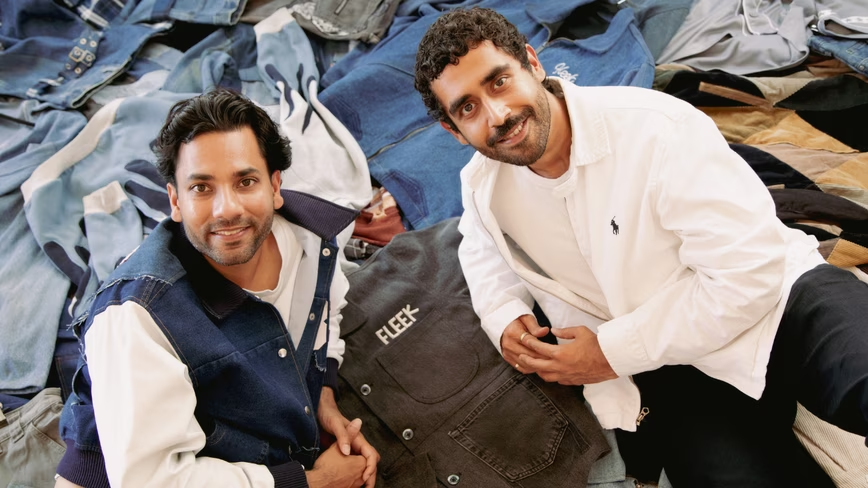
Founded in 2021 by Abhi Arora and Sanket Agarwal, Fleek runs a B2B marketplace and builds the AI systems that feed it. The two sit together, with the software digitising supply as the marketplace moves it.
At the centre is Fleek Sort, a custom vision-language model the company says was trained on millions of secondhand transactions gathered over the past four years. It is already used by graders in sorting hubs in Pakistan, India and Dubai, with pilots launching in the UK, Europe and the US.
The model's job is to turn a manual task into a digital one. Using photos or video, Fleek Sort identifies, categorises, grades and merchandises garments, then learns from what actually sells to sharpen its accuracy over time.
Once processed, inventory is listed automatically on Fleek's marketplace, where AI pricing, search and matching connect stock with buyers around the world. Every transaction generates more data, which the company describes as a proprietary intelligence layer for an industry that has captured very little of its own.
The network behind that claim is already sizeable. Fleek connects more than 2,000 verified wholesale suppliers and graders with over 50,000 retailers, resellers and boutiques across more than 100 countries.
The company also frames the platform in circularity terms. It says it has helped keep more than 12 million items in circulation, saving an estimated 13 billion litres of water and avoiding some 23,000 tonnes of CO₂ emissions.
The fresh capital is meant to push all of that further, funding a more AI-native marketplace, bigger engineering teams and a wider supplier and buyer network. It arrives as resale momentum builds across the sector, from Vinted's US expansion to a wave of live-commerce plays chasing the same shoppers.
“Most people have no idea what happens to a piece of clothing after they part with it,” said Arora, Fleek's co-founder and chief executive. “We started Fleek because that system is broken, the market it serves is exploding, and nobody is building the technology and infrastructure to fix it.”
His co-founder framed the opportunity as one of captured data. “There's more data locked inside the global secondhand supply chain than almost any other market,” said Sanket Agarwal, Fleek's chief technology officer, describing Fleek Sort as the first AI trained specifically to read what used inventory is, what it is worth and who wants it.
For Burda, the bet is a familiar one. “We backed Vinted when secondhand fashion was still considered niche,” said Julian von Eckartsberg, the firm's managing director for Europe, casting Fleek as the infrastructure the next generation of fashion will run on.