TL;DR
Ferrari is replacing its marketing chief one month after the Luce EV reveal sent its stock down 8 percent and drew public criticism from its former chairman.
Ferrari replaces its marketing chief one month after the Luce EV reveal wiped billions off its stock
Ferrari is replacing its marketing chief one month after the Luce EV reveal sent its stock down 8 percent and drew public criticism from its former chairman.
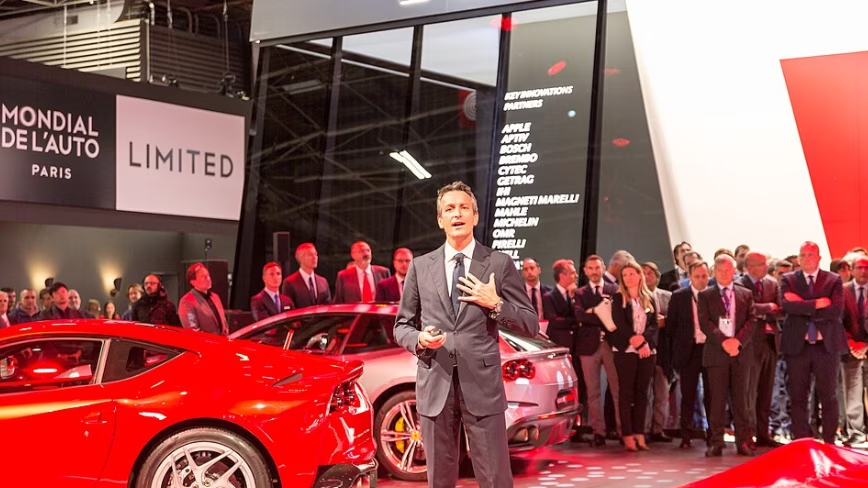
Ferrari is replacing its Chief Marketing and Commercial Officer Enrico Galliera, who has held the role for more than 16 years, with former BMW Italy CEO Massimiliano Di Silvestre. The change takes effect July 1 and comes exactly one month after the controversial reveal of the Luce, Ferrari's first fully electric vehicle, which sent the company's Milan-listed shares down more than 8 percent.
Ferrari said the departure was planned and that Galliera had shared his decision to leave “some time ago,” agreeing to stay through the Luce launch before pursuing what the company described as a new professional chapter. CEO Benedetto Vigna praised Galliera's contributions and his role in building Ferrari's commercial strategy over nearly two decades.
The timing, however, is difficult to separate from the Luce fallout. The four-door, five-seat electric car was unveiled in Rome on May 25, with a starting price of 550,000 euros, roughly $640,000. Within 48 hours, Ferrari's market capitalisation had dropped by roughly four billion dollars.
The backlash centred on the exterior design, which was created in collaboration with LoveFrom, the design firm founded by former Apple chief design officer Jony Ive. The Luce's smooth, edgeless surfaces broke sharply from Ferrari's angular design language, and critics compared it to everything from a rejected Apple Car concept to a mass-market Chinese EV.

The 💜 of EU tech
The latest rumblings from the EU tech scene, a story from our wise ol' founder Boris, and some questionable AI art. It's free, every week, in your inbox. Sign up now!
Former Ferrari chairman Luca di Montezemolo, who led the company for two decades until 2014, publicly described the car as a disgrace to its history. He said the prancing horse badge should be removed from the vehicle and warned that Ferrari risked destroying a legend. Italy's Deputy Prime Minister Matteo Salvini piled on, calling the car outrageously expensive and questioning what Enzo Ferrari would say.
Vigna spent the week after the reveal defending the Luce, telling media the car had received strong interest from new buyers who had not previously owned a Ferrari. He insisted the Luce had “nothing to do with Chinese EVs” and argued that new technology demanded new design. The stock recovered most of its losses within days.
Di Silvestre brings more than 20 years of experience in the premium automotive sector. He most recently served as President and CEO of BMW Group Italy, one of the German automaker's key global markets. He will join Ferrari's leadership team and report directly to Vigna.
The appointment is notable because Ferrari is reaching outside its own ranks for a commercial leader at a moment when the brand's identity is being tested. Galliera was an insider who had shaped Ferrari's marketing during an era of record profitability and exclusivity. Di Silvestre is a volume-brand executive stepping into a company that builds fewer than 15,000 cars per year and charges an average of more than $400,000 for each one.
The Luce remains on track for first deliveries in the fourth quarter of this year, according to Ferrari. The car produces more than 1,000 horsepower from four electric motors, carries a 122 kilowatt-hour battery with roughly 530 kilometres of range, and accelerates to 100 kilometres per hour in two and a half seconds.
Ferrari has not disclosed how many orders it has received. The company's second-quarter results, due on July 30, may provide the first indication of whether the controversy has translated into commercial resistance or whether the Luce is following the path of the Purosangue SUV, which was met with similar scepticism and sold out immediately.
The broader luxury EV market has not been kind to early entrants. Lamborghini cancelled its planned electric vehicle due to lack of demand, and Bentley has delayed its first EV repeatedly. Porsche's Taycan and Lucid's Air have both struggled with sales volumes.
Whether there is a viable market for a $640,000 electric car remains an open question, and Ive's design firm LoveFrom has not had an easy reception with its first complete car.
Di Silvestre's first job will be answering that question with a marketing strategy for a car that half the internet has already decided to hate. His second will be convincing Ferrari's existing clientele that the brand they pay a premium to belong to has not just lost the executive who defined its commercial identity for the better part of two decades.