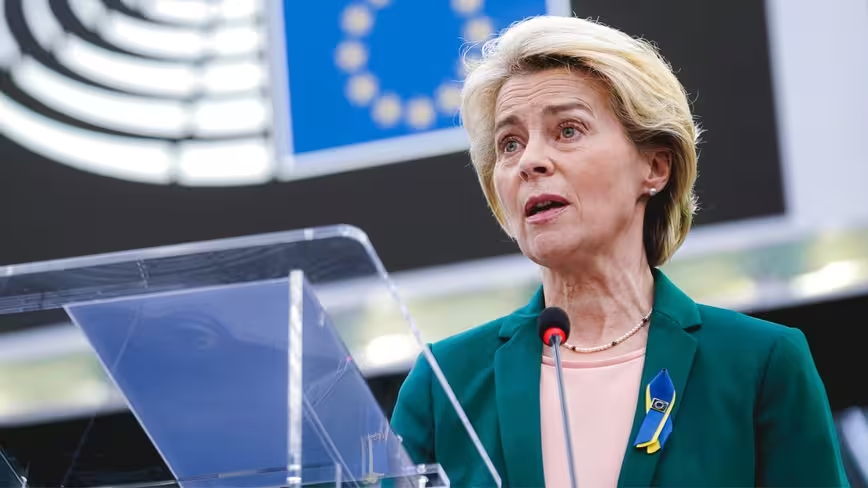
The European Union will propose limits on children's access to social media, Commission president Ursula von der Leyen said on Monday, hours after an expert panel she convened delivered its recommendations on how the bloc should shield minors from harmful content.
She has been building towards this since May, when she first told MEPs a legal proposal would arrive over the summer.
The panel, made up of doctors, academics, youth representatives, and parents, met three times this year, most recently in June. Its members stayed conspicuously quiet in the weeks before Monday's handover, and two European officials said they expect Brussels to unveil a proposal on an age limit, while cautioning that nothing has been settled.
What the Commission would not say is whether von der Leyen intends to go as far as a blanket ban. “We are exploring possibilities to make minors safer online,” a spokesperson said. “More can and must be done.”
The pressure has been building for a year. Greece, France, and Spain led the push in 2025 for restrictions on minors' access, and Australia's ban on under-16s, in force since December, gave the campaign a working precedent to point at.
The bloc, though, has 27 answers to a question that needs one. Spain wants under-16s off social networks. France would prohibit anyone aged 15 or under. Estonia, along with Belgium, has declined to sign up to the restriction consensus at all, arguing that age-based bans are unenforceable and that the correct target is the platforms, not the children.
Harmonising that into a single European rule is the hard part, and it is where a ban may quietly turn into something else. The likelier landing point is a risk-based regime that goes after the design of the products rather than the age of the user, limiting access to platforms with what the Commission has taken to calling “harmful designs”.
The German expert panel, whose co-chair also sits on the EU group, offered two options last month: a statutory minimum age of 13, which most platforms already claim to enforce, or restrictions on individual services and features. It did not recommend a blanket ban, which is a reasonable indication of where the European panel landed too.
Digital rights groups have spent months arguing for exactly that shift. “If features such as infinite scroll or surveillance advertising aren't safe, they shouldn't be on social media in the first place,” said Michiel van Hulten, EU director at the public policy organisation Reset Tech.
Brussels has not waited for the report to start acting on that theory. On Friday it told Meta to dismantle the addictive features built into Facebook and Instagram, five months after issuing a similar warning to TikTok, and accused the company of failing to contain the risks its products pose to children and vulnerable adults.
Michael McGrath, the EU's consumer protection commissioner, said new rules expected later this year would give children stronger protection against addictive design.
“Digital markets are designed to capture attention and influence behaviour,” he said in a statement to AFP. “The new rules will help ensure consumers can make informed choices free from manipulation.”
The enforcement question remains the one nobody has fully answered. Any age limit needs a way to check ages, and the Commission's own age-verification app, built to confirm a user is above a threshold without revealing who they are, has had a bumpy debut. The bloc's wider child-safety agenda has been stuck in the machinery for months.
Platforms have argued that hard thresholds will simply push minors towards unmoderated or non-EU services. That argument will now be made to a Commission that appears to have already decided the status quo is untenable.
A formal proposal is expected in the coming weeks, after which it goes to the European Parliament and member states, where the number itself, 13, 15, or 16, becomes the fight.